
12
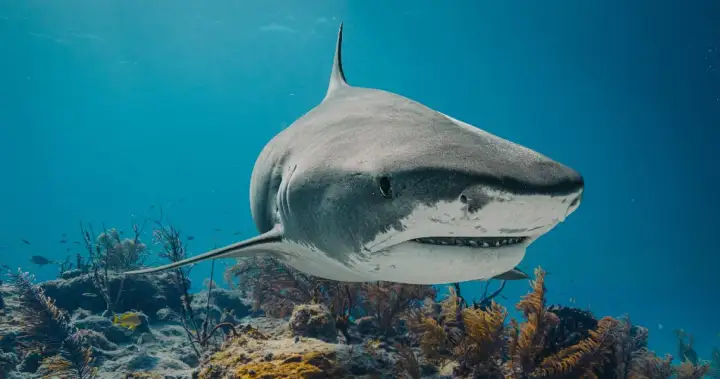
A 12-year-old American boy was attacked by a shark this week while in the Bahamas, according to the Royal Bahamas Police Force.
In a news release, Bahamian police said the encounter took place on Tuesday in Staniel Cay, Exuma, and “left a juvenile male injured.”
“According to the preliminary report, shortly before 3:30 p.m., police received information that a 12-year-old American boy was transported to New Providence by boat after being attacked by a shark,” police said.
The boy’s mother reported to police that while on a tour in the Exuma Cays area, the boy was swimming with his brother when a shark attacked him.
“He received medical treatment for his injuries and was last listed in stable condition,” police added.
The Royal Bahamas Police Force did not release the boy’s identity or the type of shark involved in the encounter.
The University of Florida’s International Shark Attack File (ISAF) reports that the odds of being bitten by a shark are incredibly low. ISAF recommends ocean swimmers stay close to shore, avoid swimming at dawn or dusk and avoid excessive splashing.
The ISAF investigated 105 alleged shark-human interactions worldwide in 2025, with five total cases coming from the Bahamas.
ISAF confirmed 65 unprovoked shark bites on humans and 29 provoked bites, which occur when a human initiates interaction with a shark in some way.
The 2025 worldwide total of 65 confirmed unprovoked cases is in line with the most recent five-year (2020 to 2024) average of 61 incidents annually, according to the ISAF.
Earlier this year, a study reported that sharks in the Bahamas tested positive for consuming cocaine, caffeine and other substances.
According to the findings, published in the journal Environmental Pollution, pharmaceuticals such as acetaminophen and sertraline, as well as caffeine, cocaine and other chemicals, were present in the systems of three shark species.
Known as CEC, or contaminants of emerging concern, these substances were found to be particularly prevalent in tourist areas.
Of the 85 sharks analyzed in the study, Caribbean reef sharks, Atlantic nurse sharks and lemon sharks were found to have varying levels of the painkillers diclofenac and acetaminophen in their bodies, as well as cocaine and caffeine.
Research also found that sharks that had consumed CECs “showed altered triglycerides, urea, and lactate levels,” which may cause “physiological responses” in species that test positive for contaminants.
—With files from Global News’ Rachel Goodman
Related Stories
 World
World
Dutch soccer pulls support for FIFA president Gianni Infantino
46 minutes ago
 World
World
Mountain Bike World Championships: Tom Pidcock dedicates second title to Fin Tarling
1 hour ago
 World
World
Home rule for Bell as FIM Flat Track World Championship braves torrential rain in Great Britain
2 hours ago
 World
World
People fleeing Sudan civil war face ‘dire and deteriorating’ conditions in refuge city
4 hours ago
 World
World
7 dead, 172 rescued after ferry carrying 270 capsizes off North Cyprus, ‘completely’ sinks | World News
4 hours ago
 World
World
Video. Latest news bulletin | August 30th, 2026
4 hours ago
 World
World
Iceland rejects EU accession talks after divisive referendum campaign
5 hours ago
 World
World
How has life changed for Iranians six months into the war?
5 hours ago