
A key CUSMA 'checkpoint' is coming. Businesses and unions are balancing anxiety and hope
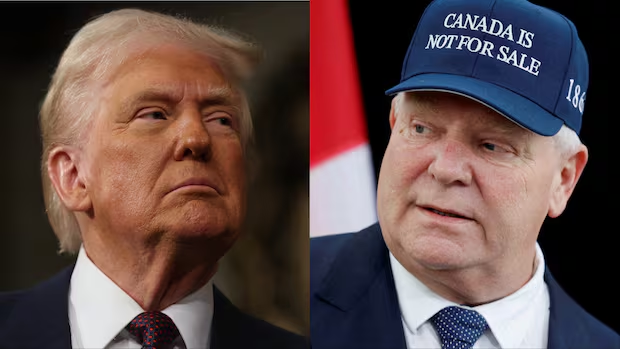
A key CUSMA 'checkpoint' is coming. Businesses and unions are balancing anxiety and hope
Ontario Premier Doug Ford heads to U.S. again as agreement set for review
Premier Ford heading to the U.S. for the 3rd time this month ahead of July 1 CUSMA deadline
Businesses and labour groups are watching with a mix of anxiety and hope as a key trade moment arrives on Wednesday, as Premier Doug Ford sets off on his third trip in less than a month to meet with U.S. lawmakers.
The Canada-U.S.-Mexico Agreement on trade officially comes up for review on July 1 after an 18-month trade war sparked by U.S. President Donald Trump’s tariffs.
Groups representing both large and small Canadian businesses and one of the country’s most prominent labour unions say they’ll be watching the official opening of the review on Wednesday.
“We knew that we would be at this stage, that it would be potentially used by the United States to try to create pressure on us,” said Unifor national president Lana Payne. “My advice has been, stay calm, hold the line, don't lose your nerve.”
One month until the CUSMA 'deadline'
July 1 is checkpoint, not deadline: negotiators
Canadian negotiators have been clear that the July 1 date is not a hard deadline. The trade agreement is up for mandatory review this year. The text of that deal says July 1 is the date the three countries need to approve a renewal of the existing agreement or signal their intention to exit the agreement, but that process can take up to 10 years.
Canada and Mexico have indicated they’d like to continue the deal for another 16 years. But the U.S. position has appeared to lean towards annual review of the agreement, with Trump occasionally musing that the agreement he negotiated during his first term is no longer needed by the U.S.
But Payne said even that tone appears to be shifting because of the negative effect Trump’s tariffs have had on the U.S. economy.
“I think the cake is baking a bit in the United States right now,” she said of the impact of rising energy prices and falling consumer confidence in the American economy.
“If you listen to what the U.S. Ambassador to Canada has said in the last number of weeks, it's ‘Yeah, there are things that the U.S. needs from Canada: critical minerals, potash, energy,’ all of the things that we knew before.”
Stakes high for auto sector: union president
But Payne said the talks will be high stakes, and the future of the auto sector has to be defended. Right now, workers are paying the price for all of the economic uncertainty, she said.
“The auto industry cannot be surrendered in these talks with the United States,” Payne said. “We have to fight for it, we have to defend it.”
Ontario Chamber of Commerce CEO Daniel Tisch said that group has been reassuring its members that Wednesday is not a hard deadline. But there is still urgency to get a deal, he said.
'The trust is gone': Ontario business and labour look for new partners as U.S. trade war continues
A more conciliatory Ford says 'I love the U.S.' as trade talks loom
“We look at next week with some anxiety, but also hope, because the deal will continue. This is a checkpoint, not a cliff,” he said.
Tisch said the impact of the trade war — specifically the tariffs applied to auto, steel, aluminium and forestry sectors — has been pronounced and hurt both the Canadian and American economies. Businesses want those tariffs removed and they at least want a deal that creates stability, he said.
“There are three things that are critical: it should be stable, it should be trilateral, it should be rules-based,” he said. “It's about a renewal, not a re-do of CUSMA.”
The CEO of the Canadian Manufacturers and Exporters, Dennis Darby, said Trump’s tariffs have caused a predictable drop in exports to the U.S. over the past 18 months. They’ve also seen many businesses halt capital investment in their operations, he added.
“It's the effect of uncertainty,” he said, adding that the U.S. has seen a similar effect on its manufacturing sector. “What they've caused companies to do is sit on their hands in both countries.”
Darby said manufacturers would like to see the U.S. tariffs dropped before Canada enters into serious discussions about CUSMA. Overall, they want trade certainty after a year and a half of unpredictability, he said.
“I think at this stage there is a ton of anxiety,” he said. “But there's somewhat of a hopefulness that this will eventually get resolved. We just don't know when.”
Independent and small business owners across the country have not gone unscathed by the tariffs either, said Corine Pohlmann, executive vice-president for Advocacy with the Canadian Federation of Independent Business.
“It's like a permanent uncertainty that you've sort of gotten used to a little bit, and people are figuring out how to work around it,” she said, adding that many businesses have worked hard to find new markets for their products since the trade war started.
“It doesn't mean it doesn't hurt, it doesn't mean that you haven't had to make some really tough decisions as a result.”
Canada tells U.S., Mexico it wants CUSMA renewed
Is Doug Ford's tough talk on Trump working? Experts say it might be gaining traction
Pohlmann said the CFIB has been busy talking with members ahead of Wednesday, assuring them that even though the review window formally opens, CUSMA isn’t going away. It's members want negotiators to pursue tariff removal, but also fight for more help tailored to their needs in the trade deal.
CFIB members are willing to be patient if it means Canada gets a better deal, Pohlmann said.
The CUSMA review window opens as Ford prepares to speak to American lawmakers, businesses and lobby groups about trade. He’ll attend the Western Governor’s Association conference in Utah on Monday and Tuesday.
Last week at a governor’s meeting in South Carolina, Ford stressed the need for a trade deal.
“I can tell you what people want, what businesses want, they want certainty,” he said. “They want stability, because when you have certainty and stability, what happens? It creates jobs, it creates economic growth, it creates production.”
Shawn Jeffords is a Provincial Affairs Reporter covering Queen's Park for CBC Toronto. He has previously covered Toronto City Hall for CBC and the Ontario Legislature for The Canadian Press. You can reach him by emailing shawn.jeffords@cbc.ca.
Related Stories
 AI News
A strong aftershock rattles Venezuela as rescue workers race to find survivors
13 minutes ago
 AI News
One person killed and one injured in shooting at California World Cup ‘fan zone’
13 minutes ago
 AI News
Weather tracker: North
13 minutes ago
 AI News
Brazil Dealt Unfortunate News Amid Japan World Cup Game
13 minutes ago
 AI News
Rescue teams race against clock to find Venezuela earthquake survivors
13 minutes ago
 AI News
Alberta separatists rally in Taber
14 minutes ago
 AI News
Gilgeous
14 minutes ago
 AI News
Heavy rainfall across Saskatchewan leaves some streets of Regina underwater
15 minutes ago