
Accommodations filling up as wildfires spur more evacuations in northwestern Ontario
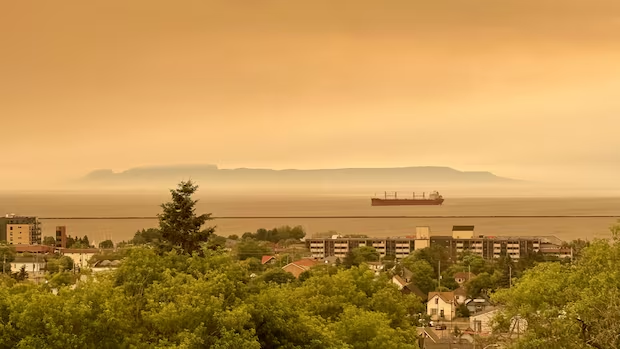
Accommodations filling up as wildfires spur more evacuations in northwestern Ontario
Collins First Nation awaits confirmation that community is 'completely devastated'
Additional communities are facing evacuations as dozens of wildfires continue to rage on across northwestern Ontario.
The Ontario Provincial Police (OPP) North West Region has confirmed the following communities are under mandatory evacuations:
Evacuees from Armstrong, Whitesand First Nation and Collins First Nation have been sent to Thunder Bay. CBC News is seeking confirmation of where evacuees from other communities are going.
Heat and air quality warnings remain in place in much of the region, as wildland fire hazards range from moderate to extreme.
Members of Collins First Nation had to self-evacuate by personal boats and vehicles Monday night as a wildfire quickly approached the community, where between 30 and 40 people live.
“At this time, we do not know the scale of the damage to our community but we know that trees directly next to our houses were on fire as community members fled by boats,” Chief Helen Paavola wrote in a statement Tuesday.
“We are waiting for the Ministry of Natural Resources to complete their aerial assessment and report back to our community. We are preparing to receive official confirmation that our community was completely devastated by this forest fire.”
Kiiwetinoong NDP MPP Sol Mamakwa issued a statement Tuesday, saying “what we are witnessing right now is devastating … an entire First Nation community has been erased because of this disaster.”
Meanwhile, Gull Bay First Nation says there are no more accommodations available in Thunder Bay for its members.
Evacuees from Armstrong, Whitesand and Collins First Nations in Thunder Bay following wildfire evacuations
Wildfires cause multiple evacuations in northwestern Ontario during extreme heat
Community members are being transported to Thunder Bay on Wednesday before being flown south to Toronto, the community said in an update Tuesday evening.
“There is no way to ‘create accommodations’ this evening — a sad and unfortunate point that many communities are facing,” the First Nation said.
The following communities are on standby for potential evacuations, according to the OPP:
A spokesperson for Ontario’s Minister of Emergency Preparedness and Response, Jill Dunlop, provided an emailed statement Tuesday.
“The Provincial Emergency Operations Centre is working closely with the Ministry of Natural Resources, Indigenous Services Canada and municipalities to co-ordinate this evacuation. Impacted residents should follow the direction of local authorities and follow any evacuation orders,” wrote Nastassia Varela.
Road closures, burn bans, outages
The following highways have closures in place:
As of Wednesday, the Ontario government is implementing a restricted fire zone across the northwest region and a small portion of the northeast, which means “no open-air burning, including campfires, is permitted and all burning permits are suspended.”
“Current conditions in this region indicate that fire hazards are expected to remain elevated, with problematic fires continuing to pose risks. As a result, increased forest fire activity is expected to persist into the foreseeable future,” the Ministry of Natural Resources (MNR) said in a statement Tuesday.
“Members of the public are urged to stay away from active fire areas and wildland fire response operations to allow firefighters and aircraft to work safely and effectively.”
Heat can have adverse effect on people taking certain medications, street drugs
Heat wave brings temperatures of nearly 40 C to Thunder Bay on Monday
Severe weather and ongoing wildfire activity has caused multiple telecommunications outages across the region, according to Kuhkenah Network (K-Net):
Nishnawbe Aski Nation (NAN) is a political territorial organization that represents 49 First Nations across Treaties 9 and 5.
It says it’s especially concerned “about the disruption to critical services in affected communities, including road closures that are impacting daily medical transport for community members requiring dialysis and other essential health services.”
“The wildfires also pose a serious threat to powerlines servicing remote First Nations communities, which could further impact the health and safety of community members,” NAN said in a statement Tuesday.
People can check the province’s interactive forest fire map for updates on fires near them.
Sarah Law is a CBC News reporter based in Thunder Bay, Ont., and has also worked for newspapers and online publications elsewhere in the province. Have a story tip? You can reach her at sarah.law@cbc.ca.
Related Stories
 Canada
Vancouver Police investigating brazen Spanish Banks shooting
43 minutes ago
 Canada
Public meetings to be held on disputed housing plans
43 minutes ago
 Canada
Alberta soldier fighting in Ukraine heartbroken over separation debate
1 hour ago
 Canada
Avanti West Coast main line to be nationalised
2 hours ago
 Canada
Nenagwas village opens on Vancouver Island
2 hours ago
 Canada
Conservatives propose eliminating tax on diesel sales until Canada Day
2 hours ago
 Canada
Ceremonies held across Canada to honour fallen first responders
2 hours ago
 Canada
Against overwhelming odds, Toronto’s beloved rep theatres are thriving: ‘People are starved for this kind of experience’
2 hours ago