
AI Is Coming for Your Job Title
AI Is Coming for Your Job Title
Artificial intelligence may or may not take your job, but it has already broken into the human resources department and vandalized the org chart.
The evidence is all over LinkedIn, where perfectly serviceable occupations now arrive wearing titles such as “forward-deployed and agentic AI architect.” That person may be building sophisticated software. They may also be helping a chatbot remember what happened three prompts ago. Either way, somebody approved the business cards.
The expanding AI lexicon offers a useful counterpoint to the darker debate about technology and employment. Most discussion centers on how many jobs AI will eliminate. Hiring data presents a more complicated picture that includes a weak overall labor market containing a small but rapidly growing neighborhood of AI-related work.
Indeed Hiring Lab found that the number of postings on Indeed mentioning AI surged 134% from its February 2020 level by the end of 2025, even as total postings stood only 6% above that benchmark. AI appeared in a record 4.2% of Indeed postings in December.
AI, in other words, is not merely changing work. It is adding syllables to it.
The Titles Employers Actually Want
The undisputed champion is AI engineer, which ranked No. 1 on LinkedIn’s 2026 Jobs on the Rise list. The ranking, based on growth during the previous three years, also highlighted AI consultants and strategists, AI and machine-learning researchers and data annotators.
The title is popular partly because it is wonderfully accommodating. An AI engineer might build applications around large language models, connect corporate data to an AI system, improve model performance or spend Thursday afternoon persuading a customer service bot not to offer refunds for products the company doesn’t sell.
Indeed’s data showed the terminology spreading beyond Silicon Valley. Nearly 45% of data and analytics postings contained an AI-related term at the end of 2025, along with roughly 15% of marketing postings and 9% of human resources listings. A more recent Indeed analysis reported by Business Insider found that the number of frequently advertised job titles explicitly referencing AI rose from 264 in 2022 to 822 in the first quarter of 2026. Nearly two-thirds were outside traditional technology fields.
That produces titles such as AI marketing manager, AI learning specialist, responsible AI counsel and AI transformation lead. These are not always new occupations. Frequently, they are familiar jobs that have discovered a highly effective résumé keyword.
LinkedIn data cited by the World Economic Forum estimated that AI investment has supported 1.3 million positions, including AI engineers, data annotators and forward-deployed engineers, plus more than 600,000 AI-enabled data center jobs. The server racks, unlike the chatbots, still need electricians.
The Jobs With the Science-Fiction Salaries
At the upper end, AI has created a compensation market that resembles professional sports, except the competitors wear hoodies and discuss inference latency.
A Syracuse University review put chief AI officer compensation between $200,000 and more than $500,000, while specialized roles can exceed $400,000 after bonuses and equity. Frontier research engineers, AI infrastructure specialists and engineers who can train or deploy advanced models command some of the largest packages.
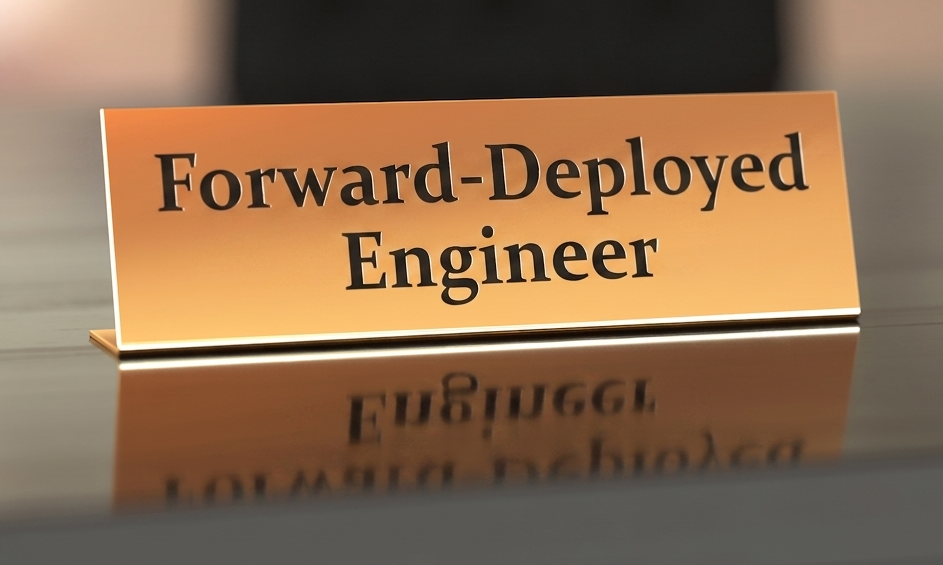
Then there is the forward-deployed engineer, an old Palantir title that the AI boom has placed on a rocket sled. These engineers embed with customers, translating an executive’s desire to “do something with AI” into software that works. The Next Web reported that Indeed postings for the role were about 19 times higher in January than a year earlier.
A CTO guide from the blog Signal Through the Noise placed forward-deployed engineer compensation between $238,000 and $700,000, research-engineering packages as high as $1.4 million and chief AI officer compensation above $1 million in some cases. It also made a less flattering observation: Many lavishly differentiated titles describe the same three basic functions. People build AI products, train models or keep the infrastructure from catching fire.
The Department of Unnecessary Titles
AI has created some genuinely new work. Evals engineers design tests to determine whether models perform reliably. AI red teamers try to make systems fail before customers do. Model behavior engineers study why an AI system responds as it does. AI governance leaders manage risks involving data, bias, security and regulation.
Other titles seem to have escaped from a brainstorming retreat.
There is the Claude Evangelist, whose mission apparently combines product education with the traditional duties of an apostle. There are vibe coders, who build software by describing what they want and accepting AI-generated code with varying degrees of supervision. “Vibe engineer” is the more respectable version, roughly equivalent to putting on a blazer before asking the machine to fix the login page.
“Context engineer” is a real discipline involving the data, instructions, memory and tools supplied to AI models. “Prompt engineer,” once advertised as a possible six-figure profession for gifted chatbot whisperers, is increasingly treated as one skill inside a broader AI role.
The CTO guide also identified “builder,” “AI-native developer,” “RAG engineer,” “agentic AI engineer” and “principal agentic GenAI forward-deployed context architect,” the last of which appears to require both technical proficiency and exceptional lung capacity.
Has AI created entirely new jobs? Absolutely. Some occupations, including AI safety, evaluation and model governance, exist because modern generative systems introduced new technical and business problems. However, many job titles are old jobs with fresh vocabulary, higher salary bands and a sudden aversion to the words “software developer.”
That may be the safest prediction about AI and employment. The machines will automate some tasks, generate others and force companies to rethink the division of labor. Before any of that is settled, however, corporate America will form a steering committee, appoint a chief agentic transformation evangelist and schedule a meeting to determine what that person does.
For all PYMNTS AI coverage, subscribe to the daily AI Newsletter.
Related Stories
 AI News
Bill Gross bets AI can help mass
2 days ago
 AI News
Nigeria records 93% rise in AI micro
2 days ago
 AI News
The Italian gelato maker using AI to invent new flavours
2 days ago
 AI News
Closing the Gap Between Agentic CX Pilots and Production
2 days ago
 AI News
New Brunswick data centre debate highlights cross
2 days ago
 AI News
How to Structure an AI Agent Referral Fee Agreement Between Startups
2 days ago
 AI News
No, AI didn’t delete a Swedish reality TV series
2 days ago
 AI News
There is no AI in Armageddon. Artificial intelligence is a tool, not an apocalypse
2 days ago