
Alberta anti
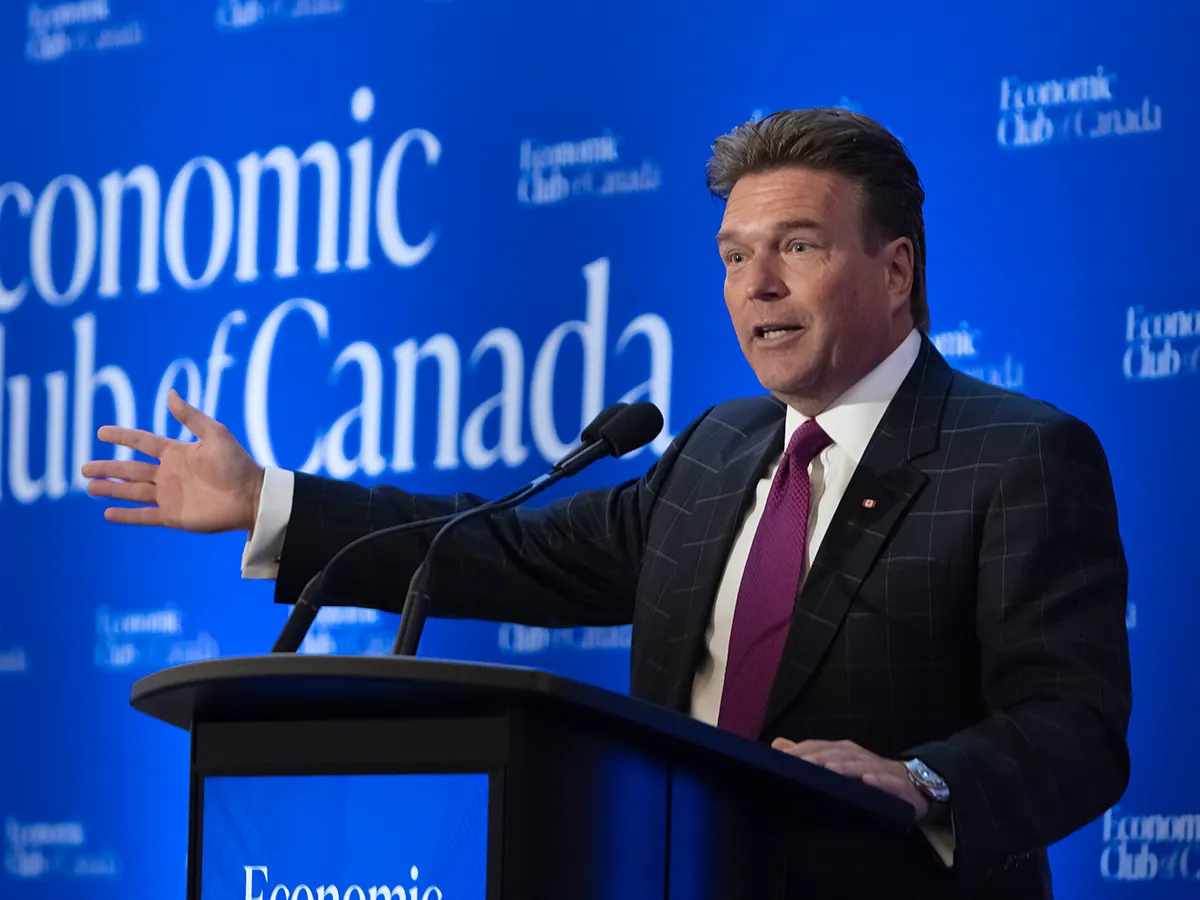
The most striking moment in former Alberta deputy premier Thomas Lukaszuk’s speech to a Toronto business audience about the perils of Alberta separatism came when he mentioned Thursday’s breaking news that Prime Minister Mark Carney will fast-track a new Pacific Link pipeline from Alberta to the West Coast as a project of national interest.
It was striking because there was no applause, not even a murmur of assent or a rustle of emotional reaction for this pipeline that is being styled as a marquee nation-building project for a divided and imperilled nation, strategically announced 18 days before Alberta votes on whether to hold a sovereignty referendum.
If anyone was looking for a case against Alberta going it alone, this was it.
So the downtown Toronto audience’s silence was an illustration of a recurring theme, that some of Alberta’s beef with the rest of Canada, especially Central Canada, is the attitude.
This came up first in the speech to the Economic Club of Canada by Lukaszuk, a staunch anti-separatist and a former cabinet minister in the Progressive Conservative governments of Ed Stelmach and Alison Redford. And it came up again in the following roundtable discussion led by former Ontario premier Dalton McGuinty.
“It’s time to admit that some of those grievances are real,” Lukaszuk said. Alberta contributes substantially to Canada as a whole and has legitimate concerns that equalization payments to the provinces give Albertans short shrift. “A certain amount of gratitude is not too much to ask.”
He said the separatist movement is boosted by unequal representation in the Senate, and by the tendency for national elections to be decided before polls even close in the West. Lukaszuk said he has had the deflating experience of hearing CBC declare a majority while he was still waiting in line to vote in Alberta.
“To us, it feels like our votes don’t matter,” he said. It is fodder for separatism, but it also encourages Albertans who are merely frustrated with their place in Canada to vote with the separatists just to send a message.
“It’s a message the rest of Canada needs to listen to,” he said. “Please don’t pat us on the head with the promise of a pipeline, thinking that’s enough.”
Albertan separatism is based on “unsubstantiated claims and magical thinking” and it is hampered by squabbling factions, Lukaszuk said. Polling in the last few days has shown separatist sentiment to be low and falling, and pegged the remain vote as high as 70 per cent.
But Lukaszuk is concerned this is a recipe for low voter turnout, with the remainers lacking the conviction and motivation of the leavers.
“Fervent separatists will crawl across broken glass to make their vote count,” he said. “This is a genie in a bottle that magically will not be put back in. It will take strong leadership to convince Albertans that Alberta belongs in Canada.”
In Alberta, he said this current high water point for the long-running separatist movement is dividing families, dragging away investment and causing Albertan businesses to consider relocating.
“It should be enough to make people throw up their hands in despair,” he said. “And yet something else has happened.”
He credited the trade war brought by U.S. President Donald Trump with “the rekindling of Canadian pride and healthy patriotism,” and he spoke of a “uniquely Canadian combination of pride, persistence and hope.”
Last year, Lukaszuk launched a petition called Alberta Forever Canada that got more than 400,000 signatures in 90 days in favour of Alberta remaining in Canada. This year he has campaigned across the province against separatism in a recreational vehicle styled as the Unity Bus.
After his keynote address, he took questions from McGuinty alongside Martha Hall Findlay, a former Liberal MP now with the University of Calgary’s School of Public Policy, and Andrew Leach, professor of economics and law at the University of Alberta.
Hall Findlay recently published a report for the government of Alberta on the potential costs of separation, which concluded it could cost as much as $170 billion over five years.
“Those were only the five year out numbers,” she said. Her analysis ran several models, including one that assumed separation went completely smoothly, which suggested over 20 years there was “potentially a little upside,” thanks to a more efficient civil service and other factors.
But with the assumption of a turbulent separation, for example with pushback from Ottawa, the downside is “really big,” she said, with a potential provincial debt of close to $400 billion.
She compared Albertan separatism to the British Brexit movement, in the sense that then Prime Minister David Cameron thought a failed vote would take the wind out of the Brexiteers’ sails, but the momentum got away from him, and it cost him his leadership.
She spoke of an ignorance among Central Canadians for how things work in Alberta, and how much it contributes to the country, such as the Trans Mountain Pipeline expansion project that added fully half a point to national GDP when it opened in 2024. She described an “incredibly arrogant” framing of pipeline approvals as basically gifts from Ottawa, an attitude that would never be taken with infrastructure projects in Quebec, where separatism is also a perennial threat to national unity.
“Remember, we’re only 15 years removed from the federal government putting out loans to restart an asbestos mine in Quebec,” said Leach. “That mentality was very different when it came to Alberta’s business,” he said. It looked more like Ottawa thinking its job is to save Albertans from themselves, he said.
He urged the audience to consider what he has experienced in Edmonton, when an oil boom goes bust as in 2014, and how it must feel for an oil patch worker to hear the federal government say, “Oh but there might be solar panels manufactured in Medicine Hat, you’ll be fine.”
Lukaszuk said the separatist sentiment falls with Alberta’s economic successes and rises with its failures. He thinks it is driven predominantly by younger men in the oil and gas industry, overleveraged by debt, with limited transferable skills, who are noticing the economy is pivoting on them.
“Now they fear for their future, and the fear is real,” Lukaszuk said. He described this dynamic as “infectious” and catching on in Saskatchewan and British Columbia.
“If we don’t inoculate this now in Alberta, we will be dealing with it on a wider scope, maybe with different industries,” he said.
Our website is the place for the latest breaking news, exclusive scoops, longreads and provocative commentary. Please bookmark nationalpost.com and sign up for our newsletters here.
Related Stories
 Canada
'There’s pride in building trains at home': Quebec plant sees a comeback | CBC News
24 minutes ago
 Canada
‘Very cautious’: Canadians skeptical of major airports privatization, Nanos survey shows
1 hour ago
 Canada
Michael J. Fox to be promoted within Order of Canada at Rideau Hall today
2 hours ago
 Canada
The battle between Mississauga's current and ex mayor
2 hours ago
 Canada
What 'Cornell 7' and 'Hockey Canada 5' assault cases reveal about consent and trauma
2 hours ago
 Canada
Hans Zimmer is 'rooting for Canada' as trade war crescendoes before North American tour
2 hours ago
 Canada
Hans Zimmer 'rooting for Canada' amid U.S. trade war
2 hours ago
 Canada
Canada
3 hours ago