
Alberta proposes new pipeline, but hurdles to construction, profitability remain
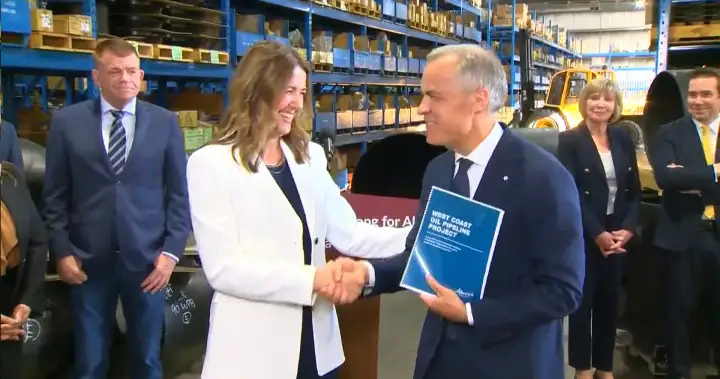
Is it a project that will create “transformational wealth,” as Alberta Premier Danielle Smith claims, or one whose costs and commitments are so “onerous,” as some industry insiders fear, that it will likely never be built?
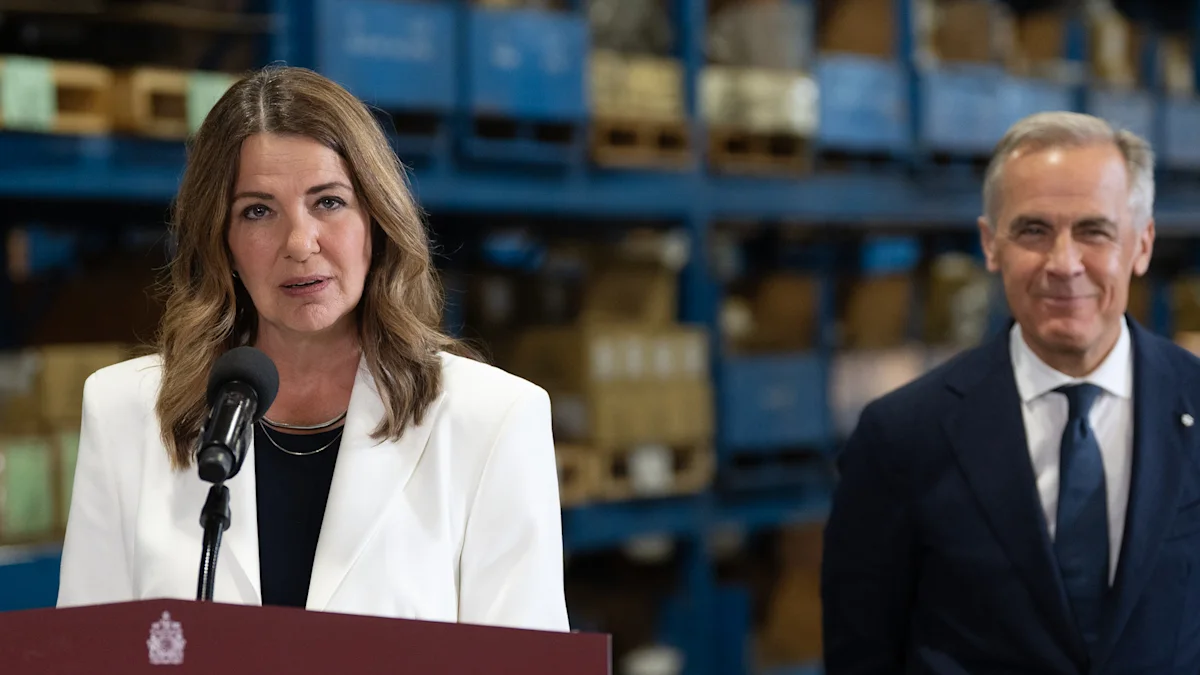
Those are two opposing views up for public debate on the heels of Thursday’s announcement by Prime Minister Mark Carney and Alberta Premier Danielle Smith that a proposal to build a new oil pipeline from Alberta to a deep water port on the south coast of B.C., has been submitted to the federal government’s Major Projects Office as a “project in the national interest.”
The pipeline, proposed to be built alongside the existing Trans Mountain pipeline, would pump over a million barrels of oil a day, to be exported by tanker to markets in Asia, according to Smith.
It would “unlock Alberta’s energy for the world,” said Carney, unlocking many billions of dollars worth of investment in Canada and create tens of thousands of jobs.
But despite the politicians’ effulgent optimism about the project being built — with the province hoping to have construction begin as early as 2027 and oil to begin flowing as soon as 2033 — many hurdles remain.
“So they’ve agreed on the route, but the outstanding issues that are still there and haven’t yet been resolved are: ‘Are they going to have actual customers? Are the major oil sands producer is going to commit to it — to ultimately produce the incremental oil, as much as a million barrels a day, to fill up this pipeline? Do they have the competitive conditions that are available to them to make those investments so they can take on the long-term commitment to use this pipeline?'” asks Dennis McConaghy, who is a retired Canadian energy executive and author of several books on the energy industry and climate policy.
The existing Trans Mountain expansion project cost taxpayers more than $34 billion by the time the pipeline began pumping oil in May 2024.
With the new pipeline expected to cost even more, Richard Masson, the former CEO of Alberta Petroleum Marketing Commission, questions whether producers will be willing to pay the tolls.
“My rough calculation says the toll might be 50 to 60 per cent higher than the existing Trans Mountain system,” said Masson, who points out that there are already three other pipeline expansions in the works.
“We have Trans Mountain expanding the existing pipeline (by) 300,000 barrels a day, Enbridge 400,000, barrels a day on its system, South Bow 500-plus-thousand barrels a day resurrecting the Keystone XL — so that’s over a million barrels a day right now. That is lower risk and probably quicker and cheaper than this big new proposal,” said Masson.
“There’s a lot of hurdles that remain. You’ve got to have an economic pipeline. Shippers need to sign up for it. That’s a voluntary process through commercial negotiation and they don’t do 20-year commitments of 100,000 or 200,000 barrels a day unless they know they’ve got the supply to fill it and they know it’s competitive with their alternatives,” Masson added.
“And we won’t know about until the final route is selected, more engineering is done, all these things are put in place to allow the Trans Mountain Company to say, ‘Here’s the toll on this new system and it is competitive.'”
Another big hurdle that remains is the Pathways Project –finalization of an agreement between the governments of Canada, Alberta and the Oil Sands Alliance — which is made up of five major oil sands producers (Canadian Natural Resources Ltd., Cenovus Energy Inc., Imperial Oil Ltd., Suncor Energy Inc. and ConocoPhillips Canada) for construction of the world’s largest carbon capture and storage project that Smith claims “will make Alberta bitumen along among the lowest emission heavy oil globally.”
It would work like this: Pathways members would be responsible for installing carbon capture equipment at their own oilsands sites.
The carbon emissions would then be compressed into a liquid and pumped from more than a dozen oil sands sites, into a larger transportation artery and distribution line from Fort McMurray to a storage hub in the Cold Lake, Alta. region, where it would be injected and stored deep underground.
The cost of the project, with 400-plus kilometres of pipe, is estimated at $16.5 billion.
“It’s a very onerous expense,” said McConaghy,
“The interesting thing is, the producers that have to commit to the pipeline and to commit the investment to create the extra million barrels a day are the same ones who are the principals of Pathways. So are we in a scenario that Pathways could have come before the pipeline or is the pipeline just going to have to come first before Pathways is figured out,” questioned McConaghy.
The president of the Oil Sands Alliance was among those on hand for Thursday’s pipeline announcement. When asked about the status of an agreement on the Pathways Project, Kendall Dilling said the governments and Alliance have agreed on the “broad terms of the agreement. Now it’s really just a question of getting that papered and signed in the coming days — and then a lot of those details will be available.”
Related Stories
 AI News
Socceroos heartbreak at the FIFA World Cup | Morning News Bulletin 4 July 2026
26 minutes ago
 AI News
How extra time, penalty rules work for Argentina
26 minutes ago
 AI News
Gaza has become frozen in 'humanitarian purgatory'
26 minutes ago
 AI News
B.C. Conservatives leave Penticton retreat united under new leader
27 minutes ago
 AI News
Taxes may rise as Canada pledges to increase defence spending; feds resist calls to detail spending
27 minutes ago
 AI News
Alberta moves toward pipeline dreams becoming reality
27 minutes ago
 AI News
'Heartbreaking to see': Grandview, Roblin among flooded Parkland areas
27 minutes ago
 AI News
Alberta
27 minutes ago