
Anthropic’s Claude Science app is coming for Kendall Square
This is the year artificial intelligence has emerged in the public square as a full-fledged bogeyman.
College grads boo commencement speakers who invoke AI as the modern equivalent of “plastics,” the career advice given to Dustin Hoffman’s character in the 1967 film “The Graduate.” Workers recoil when companies wield it as a cost-cutting, job-slashing sword. Even a wary Pope Leo XIV warns against the fusion of AI into nuclear war-fighting systems.
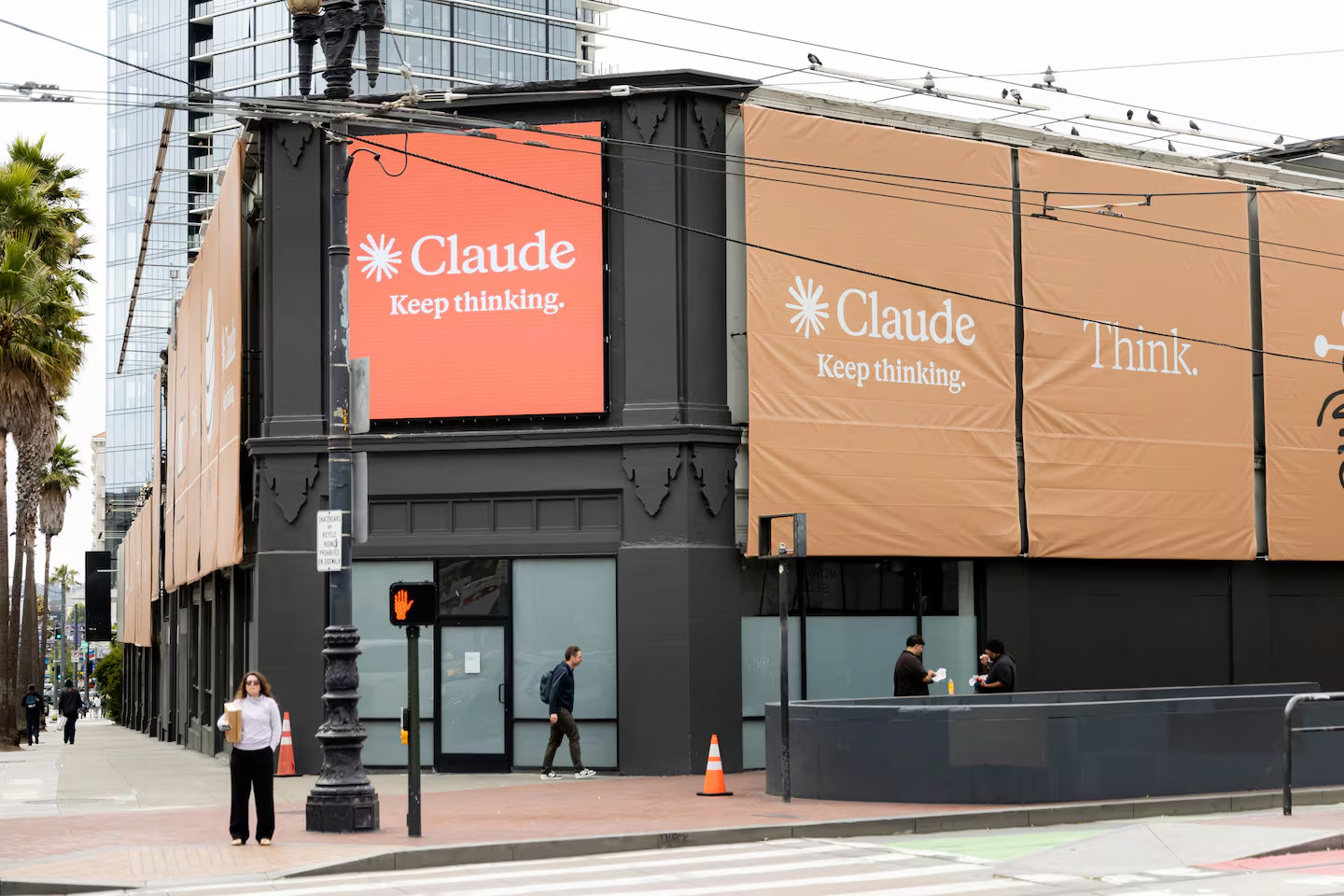
So this month’s low-key unveiling of Claude Science, an app that adapts Anthropic’s large language model for biopharma research labs, was a timely reminder that AI still has the potential to do more than reduce corporate headcounts and endanger civilization.
The promise: Speeding up the painfully long process of drug discovery — typically a decade-or-longer marathon — has been a promise of AI for many years.
Anthropic is seen by some as a white knight in the cutthroat arena of AI development, for its flagging of ethical concerns and calling for guardrails. It has specifically tailored Claude Science for researchers who hunt for lifesaving drug candidates. Using such customized tools, scientists may achieve a 10-fold acceleration in new medicines targeting cancers, dementia, and a raft of rare genetic diseases over the coming decade, Anthropic cofounder Dario Amodei suggested.
“I absolutely believe that we can make 10 years of progress every year,” Amodei, who holds a PhD in biophysics, said at a San Francisco launch event.
And no sooner had it rolled out Claude Science than Anthropic announced, as a kind of exclamation point, that it plans to begin developing drugs of its own. (Take that, Pfizer, Biogen, Vertex, and Eli Lilly!)
Why it matters here: Few places on the planet have more at stake in AI’s transformation and disruption of life sciences than the Massachusetts biomedical ecosystem centered in Kendall Square and Boston’s sprawling hospital research sites.
The Bay State accounts for nearly a sixth of the total US drug development pipeline and drew more than 20 percent of the nation’s venture funding for biotech startups last year, according to a report from the industry group MassBio. Its roughly 50 million square feet of lab space is the largest of any US market, according to commercial real estate firm JLL.
But the state has seen a sharp drop in private investments and the National Institutes of Health grants that bankroll academic research labs as the Trump administration cut research funding over the last two years. And the vacancy rate for the state’s biomedical labs is roughly 30 percent, higher than rival clusters in San Francisco and San Diego.
Against that backdrop, AI has the potential to exponentially boost the process of matching drug compounds with cell mutations. That could lead to more drugs targeting hard-to-treat illnesses, along with higher sales and profits for drug makers. But there are fears it could also hasten a trend, already underway, of paring down jobs in research labs.
Faster workflows: The reality is that biotechs are already using AI — not only Claude, but Google’s Gemini for Science, an Nvidia toolset, and other homegrown apps — to help identify compounds, run experiments, and even prepare regulatory filings.
“Biotechs are all over AI,” says Boston venture capitalist Jeff Bussgang. “They’re incorporating it into their work flows, into every aspect of their business.”
Two startups backed by Bussgang’s venture firm, Flybridge Capital, help to tell the story. Both are pioneering technology that enables biotechs to capitalize on AI to save valuable time.
Scitara, based in Marlborough, uses machine learning to let companies collect, analyze, and connect fragmented data from the equipment in their labs.
“Biology is a game of running experiments,” Bussgang says. “The more experiments you can run in parallel and the better you can analyze the data, the faster you’re going to compress the drug discovery process.”
Alchemi, a New York startup launched by a pair of Harvard Business School grads, builds AI agents that rapidly gather data from disparate sources to speed up documentation and compliance processes needed for biopharma regulatory filings.
But, but: For those taking the pulse of the Massachusetts economy, the big unanswered questions are around what AI will mean for jobs and real estate. Employment in research and development fell 1.7 percent in 2024, the first drop since MassBio began tracking jobs data, and large volumes of lab space remain unleased in Cambridge and beyond.
“The hope is that AI will help us absorb some of that space, and absorb it with novel uses and novel companies going forward,” says Travis McCready, head of industries for JLL’s leasing advisory practice. “But we’re in the middle of a story that’s being written.”
McCready says new types of life sciences companies could emerge as AI progresses, some running on lean workforces. They include “spec labs” designed for smaller AI-enabled startups, life sciences-focused AI data centers, and highly automated “self-driving labs” staffed by robots 24/7.
Yet he admits there is no evidence yet that AI’s promise of more treatments for diseases is being fulfilled.
“Are we improving the R&D cycle?” McCready asks. “Yes, we are. Are we improving drug discovery and making it more efficient? Yes, we are. But we haven’t yet seen that translate into a greater number of AI-designed and approved FDA products.”
What about jobs? Large life sciences companies, including Takeda, Replimune, and Thermo Fisher, have shed hundreds of jobs in Massachusetts over the past year. But those companies were navigating major changes in tariff and drug pricing policies. It’s not clear how much, if at all, AI factored into their layoffs.
Some see AI reshaping, rather than hollowing out, biotech employment, fueling demand for new skills and rewarding employees who analyze as well as generate data on drug compounds and test results. Whether the new mix will also mean employment at today’s levels remains to be seen.
AI is also creating a cohort of new “tech-bio” companies that combine AI apps and data analytics with traditional drug discovery methods. MassBio runs an accelerator program called DRIVE that pairs tech-bio entrepreneurs with seasoned biotech executives to share resources and “upskill” workers in AI.
“We want these tech-bio companies to know they have a home here in Massachusetts,” said Jason Cordeiro, MassBio’s chief operating and innovation officer.
Related Stories
 AI News
From data to decisions to action: How agentic AI is powering the always
32 minutes ago
 AI News
Xinhua Headlines: China promotes coordinated development of data industry, artificial intelligence
34 minutes ago
 AI News
Big business has shown small firms what to do – and what not to do
34 minutes ago
 AI News
How, when, and why the Cobb County Courier uses artificial intelligence
2 hours ago
 AI News
A Scientist Was Presenting His Vibe
3 hours ago
 AI News
Why investors should be concerned about the growing backlash to AI data centers
3 hours ago
 AI News
Why the AI economy is like a bad dating app — drowning in decks, pilot purgatory
3 hours ago
 AI News
Canada's music scene sees pushback against AI
4 hours ago