
Artificial intelligence 'creating, not cutting' jobs in Newport
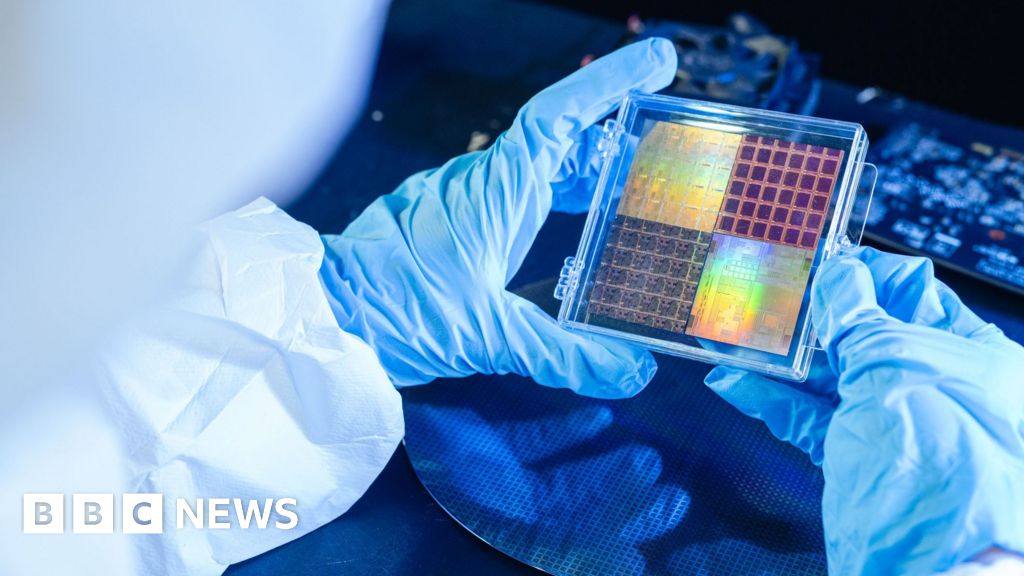
We're growing jobs based on AI, not destroying them, says tech boss
"I think there's a huge fear of AI taking away jobs. It's quite the opposite here," said Jutta Meier, who leads one of Wales' most successful semiconductor companies.
In a vast metal building on the edge of the M4, scientists and engineers at IQE wear futuristic overalls as they create the chips that fuel the revolution in artificial intelligence (AI).
"We are growing great jobs based on AI and supporting AI, quite the opposite from destroying jobs by AI," Meier said.
The UK's AI minister Kanishka Narayan said Wales had to "reindustrialise itself" for an AI future, while also "supporting everyone who is affected" by changing technology.
Newport has established a cluster of semiconductor companies, with IQE in production since 1988 and the wider cluster is growing.
An independent report for CSconnected, produced by Cardiff University's Welsh Economy Research Unit, found the south Wales compound semiconductor sector supported 3,140 jobs across Wales in 2025, up from 2,748 a year earlier, a 14% increase.
Of those, 1,914 were direct jobs in the industry, concentrated around Newport and the wider M4 corridor.
The report said average salaries in the sector were about £66,000.
Office for National Statistics data estimated the median monthly pay in the UK in August was £2,657 - or £31,884 a year.
Nearby Bassaleg School in Newport now offers a semiconductor qualification to students who are keen to join the industry.
IQE has benefited from the recent boom in AI because its chips are part of the physical architecture of data centres.
They are not connected to the algorithms that allow humans to interact with chatbots, but are found in the computer hardware that underpins the operation.
"The last 18 months were quite bumpy," Meier admits, as IQE struggled for relevance with investors.
Earlier this year its role in data centre computing power was acknowledged and its share price grew quickly, allowing the firm to clear debts and begin hiring more staff.
The impact of AI on jobs has been evident recently with tech giant Oracle slashing 21,000 roles globally as it reshaped its business around the technology.
Amazon and Facebook-owner Meta have also cut thousands of jobs in recent months as they invest heavily in AI.
But Meier said: "We're really lucky to have a very dedicated workforce that stuck with us throughout this bumpy road.
"Talent, for IQE, is one of the biggest assets that we have."
Two miles from IQE, students at Bassaleg School are among the first in the UK to be offered a semiconductor qualification.
Head teacher Victoria Lamb said it allowed students to learn about an industry that was "right on their doorstep".
She said it was "important that we work with our community to offer pupils these kinds of opportunities".
"It is really good fun," said 15-year-old Grace.
"We are doing practical work, and before the course I used to think semiconductors were all on a computer."
Grace said it was "pretty cool" to have the semiconductor industry in the city.
Her classmate Evan, who counts soldering as a hobby, welcomed the chance to put the skills into practice in school.
"I think semiconductors will play a big role in what I want to do," he said.
"I want to go into the electro-mechanical side, making robots. And semiconductors play a massive role in making that possible."
Evan said there were "so many different companies, especially around Newport" offering careers after leaving school.
Kanishka Narayan, the UK government's AI minister, said Wales' "amazing heritage in manufacturing" needed to be applied to the growth in AI.
"The biggest economic opportunity for us is how we create more manufacturing jobs here in Wales, re-industrialise ourselves, hark back to our heritage but for a more durable future and AI is going to be a big part of it," he told BBC Wales.
The semiconductor cluster was "paying 40 to 50% higher wages" than many other sectors in the area, Narayan said.
But he warned that the boom in AI-related jobs would come at a cost.
"I think in all industrial change of the past, there have been some jobs created, some jobs lost.
"The task for us as a society is to make sure that we're supporting everyone who is affected and creating opportunities for our kids, for their kids as well."
While the chips are powering the AI revolution, there are already examples in Wales where the technology is creating new roles and changing existing jobs.
At TiqToq, a Welsh software engineering firm that helps companies to search for security flaws in its systems, the company said AI was initially viewed as a cost-saving opportunity.
"But that's not been the story at all," said director Mike Beck.
AI meant the work of its human engineers was now "much more efficient" and their use of AI to help stress-test their clients' software had led to "over 53% time saving" for employees.
The pace allowed the company to hire more people, while AI became a key tool in completing tasks for clients.
"What we've found is that the projects that our customers were looking to release next year, they'll now bring them forward to this year," Beck said, adding that engineers were now "focusing on the areas that require that extra human insight".
In other cases, AI is reducing the burden of paperwork facing frontline health and support staff.
Social workers in Vale of Glamorgan are testing Beam Notes transcription software that records and summarises their interactions with clients, cutting the time it takes to produce the paperwork associated with their roles.
"You know it's going to capture all the information you need, without worrying about writing everything down," said social worker Sian Palmer.
The technology was "absolutely not" replacing people, Palmer said, and it was enhancing interactions with clients.
"It's obviously a time saver, and for me I've got dyslexia, so for me it's always been a bit of an added stress, I suppose, in making sure my assessments are up to the level they need to be."
Using the AI transcription tool was "just a way of sort of gathering the information in great detail, in a fast way," she said.
Related Stories
 AI News
Amazon invests another $1.9 billion in the Delivery Service Partner program
56 minutes ago
 AI News
Rare look at the remote engine rooms powering China's AI ambitions
56 minutes ago
 AI News
Trump pitches ‘super intelligence’ as new name for AI
56 minutes ago
 AI News
Minister says he's working with G7 to set up AI safety organization
56 minutes ago
 AI News
EASA Carries On With Cautious Approach To Artificial Intelligence
56 minutes ago
 AI News
Trump wants to rebrand artificial intelligence. It was almost called these 3 names
1 hour ago
 AI News
Trump tells world leaders AI should be called something else & he won't rein it in
1 hour ago
 AI News
Anthropic and OpenAI roll out cheaper models in first release since call for slowdown
2 hours ago