
Artificial intelligence deciphers the rules of a lost Roman board game, found on a 20
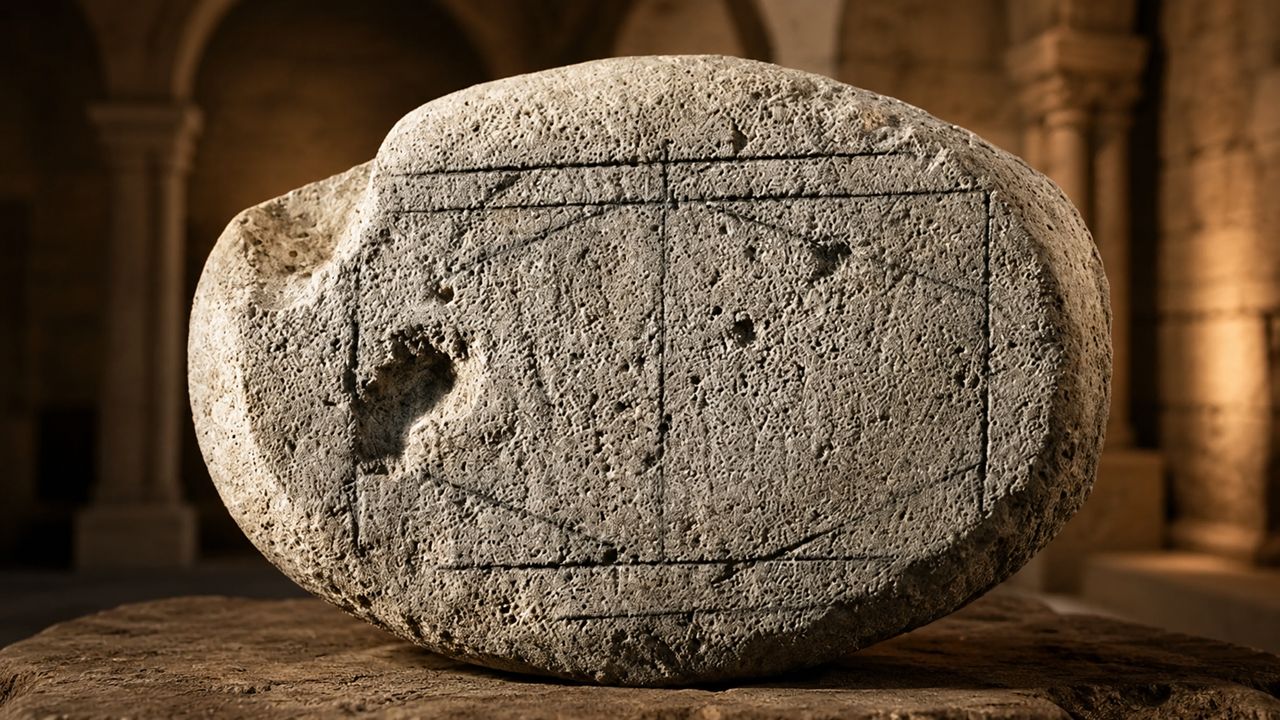
Stored in the Roman Museum of Heerlen, the limestone artifact displayed unusual lines and wear marks left by the repeated movement of pieces. Digital simulations indicated that Ludus Coriovalli was an asymmetric blocking game and anticipated by several centuries the presence of this type of pastime in Europe.
A lost Roman board game, identified on a stone kept for decades in a Dutch museum, had its rules reconstructed with the help of artificial intelligence. The object reveals a form of entertainment previously unknown in the Roman Empire.
The discovery began in 2020, when archaeologist Walter Crist visited the Roman Museum of Heerlen, in the Netherlands, during a break in pandemic restrictions. In a showcase, he found a small limestone slab with unusual geometric drawings.
The piece, about 20 centimeters in diameter, displayed an elongated octagon within a rectangle. Although it was cataloged as a possible board, the pattern did not match any Roman game known to the researcher.
The artifact, registered as object 04433, was produced in Norroy limestone, a material imported from France by the Romans for columns and monuments. In this case, the stone was likely repurposed from rubble and received deliberately engraved lines.
It was found at the end of the 19th century or the beginning of the 20th century, but without detailed archaeological records. Therefore, its function remained uncertain: it could be a mason’s exercise, a casual drawing, or a true board game.
The answer appeared in the wear marks. Surface analyses identified smooth areas and abrasions concentrated on specific lines, compatible with the repeated movement of glass or stone pieces over the limestone.
These marks indicated not only that the object had been used, but also which paths were most frequently traversed. One of the diagonals showed more intense wear, providing a decisive clue to reconstruct the game’s dynamics.
The researchers turned to the Digital Ludeme Project and the Ludii system. Artificial intelligence agents received a digital version of the board and tested hundreds of rule combinations inspired by traditional European games.
Each set was contested in 1,000 simulated matches. The system compared the paths taken by the digital pieces with the worn areas on the stone, discarding models that did not produce similar patterns.
Formations with different quantities of pieces were evaluated, as well as alignment and blocking games. The most compatible result pointed to an asymmetrical contest, in which one player tries to immobilize the opponent.
Named Ludus Coriovalli, or Game of Coriovallum, the pastime would have four pieces controlled by one player and two by the other. The four would function as “dogs,” while the remaining two would be the “hares.”
The dogs would start at the four points on the far left. The hares would occupy the two internal points on the right side. Each round, participants would move a piece to an adjacent empty space, following the engraved lines.
The objective of the dogs would be to completely block the hares. Meanwhile, the player of the hares would try to remain free for as long as possible. The winner would be the one who managed to resist the longest in this position during the matches.
Games of this type were mainly associated with medieval Scandinavia and pastimes like Fox and Geese. The Heerlen board indicates that similar mechanisms were already known in the Roman period, centuries before medieval records.
The discovery also presents a new use for artificial intelligence in archaeology. Instead of just organizing data, the system simulated human behaviors and helped interpret physical marks left by everyday use.
The Ludus Coriovalli expands knowledge about leisure in Coriovallum, a Roman city that existed where Heerlen is today. The stone shows that simple activities, carried out with movable pieces, were also part of Roman social life. Now, its reconstructed rules allow the public to experience this pastime again.
Ancient games help archaeologists understand social habits, reasoning strategies, and forms of coexistence of past populations.
Since many boards were made of wood, earth, or perishable materials, few have survived, making each preserved example especially important. In this case, microscopic wear functioned as an indirect record of the matches, allowing simulated movements to be compared with real marks.
The combination of archaeology and artificial intelligence also opens up space to analyze other objects without a known function, as long as they present physical patterns capable of recording repeated use. Thus, the method can expand the interpretation of pieces stored in museums.
Related Stories
 AI News
AI can cut reinsurance’s operational drag
1 hour ago
 AI News
New warnings about the risks of AI to humanity revive a long-running debate
1 hour ago
 AI News
Malaysian premier warns of AI 'colonization' risk for Muslims
2 hours ago
 AI News
“Layer 2”: the weapon law firms are using against AI to prove their worth
2 hours ago
 AI News
Cybersecurity Is the Next Big Market for Artificial Intelligence (AI), According to Jensen Huang. This Super Stock
2 hours ago
 AI News
AI CEOs say they need to slow the pace of development. But will they?
2 hours ago
 AI News
Singapore start
3 hours ago
 AI News
Meta May Be an AI Winner After All: Morgan Stanley
3 hours ago