
Artificial Intelligence in Iran: Beyond Sanctions, Filters, and the Ruins of War
Artificial Intelligence in Iran: Beyond Sanctions, Filters, and the Ruins of War
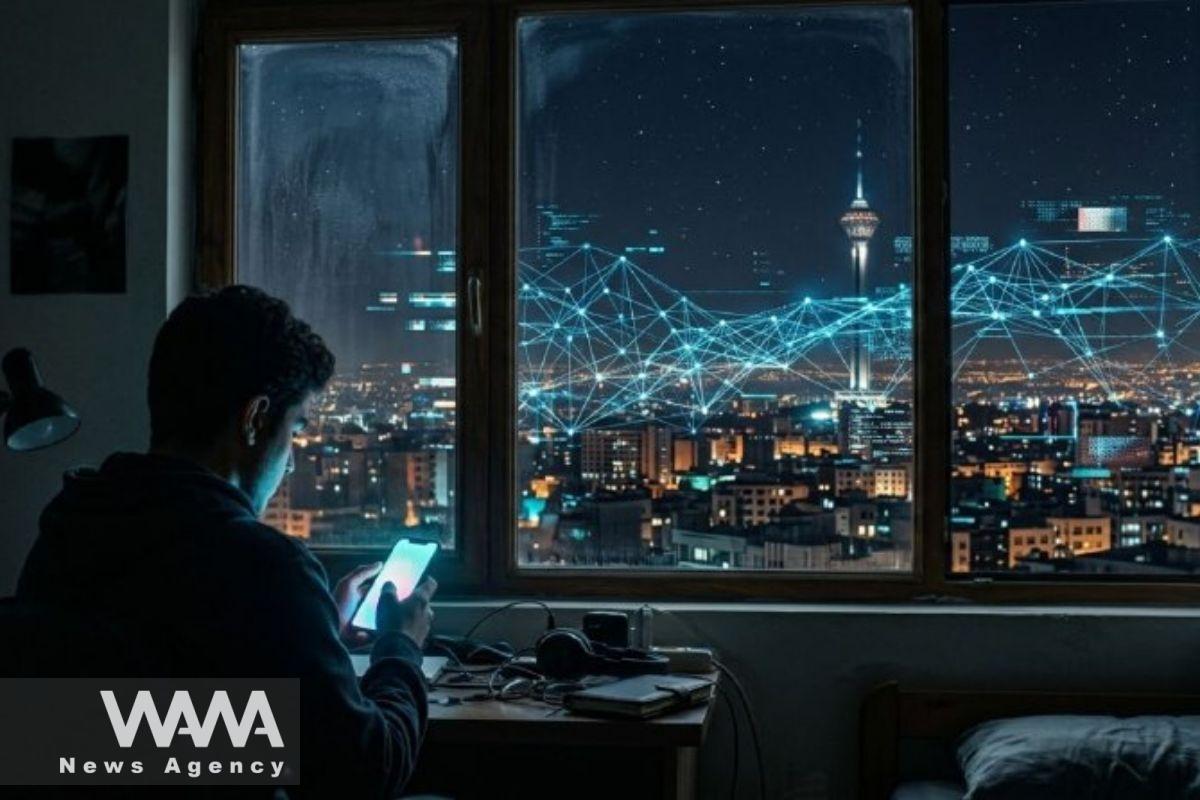
WANA (Oct 18) – It is midnight; the room is dark, but the soft blue glow of a smartphone screen illuminates the face of a young man in one of Tehran’s neighborhoods. He does not have high-speed internet or free access, and to reach this page, he must first bypass filtering barriers and VPN walls.
But finally, he connects; now he is not talking to a friend, but to an artificial intelligence sitting on cloud servers—sometimes speaking about his future career, sometimes seeking legal advice, and sometimes even sharing his sorrows and concerns with a bot programmed thousands of miles away.
Here in Iran, where economic barriers, international sanctions, and strict internet restrictions were expected to isolate the younger generation from global technological currents, the AI revolution has carved its way with unprecedented speed through all these obstacles into the privacy of homes and offices.
This is the story of a generation that must cross filter walls every day just to connect to the future; a society that, despite all walls, is actively rewriting the rules of its game with technology.
WANA (Aug 07) – The Iranian National Artificial Intelligence Olympiad Team earned four medals at the 3rd International Olympiad in Artificial Intelligence (IOAI 2026), held from August 2 to 7, 2026, in Astana. Competing against more than 400 participants representing over 100 countries, the Iranian team secured one gold, two silver, and one bronze […]
From the National Document to Real-Street Reality
In June 2024, Iran’s Supreme Council of Cultural Revolution approved the “National Artificial Intelligence Document,” outlining a 10-year vision for human resource development, processing and data infrastructure, industrial and service applications, and the enhancement of the country’s scientific standing.
But government documents tell only part of the story. The core of the narrative lies in the striking figures extracted from society by the Parliamentary Research Center (based on a poll conducted by the Mellat Polling Center in July)—a narrative showing that artificial intelligence in Iran has transcended being a luxury tool to become part of everyday life.
According to these data, 41.6% of Iran’s statistical population (aged 15 and older) actively use artificial intelligence tools:
ChatGPT stands unchallenged as the king of this arena; 78.6% of AI users in Iran rely mostly on this American tool to advance their tasks.
Iranian women walk in a street in Tehran, Iran December 2024. Majid Asgaripour/WANA (West Asia News Agency)
From Global Platforms to Indigenous AI
Although international tools make up the majority of users’ consumption baskets, Iran’s tech ecosystem has in recent years strived not to fall behind in the race for indigenous language models.
The emergence of domestic Iranian AI assistants and models such as “Rakhshay” and “Boof AI” represents examples of this national determination, striving to develop tools tailored to the Persian language and culture despite processing and hardware limitations.
Gender, Age, and Education: Who is Touching the Future?
Contrary to traditional stereotypes, the data highlight the interesting dynamism of Iranian women within the AI ecosystem:
Women Ahead of Men: 45.1% of Iranian women stated they use AI to some degree, compared to 38.3% of men.
Generational and Educational Gaps: AI familiarity among individuals with university education reaches 85%, with 62.1% actively utilizing these tools.
In contrast, the elderly and less-educated groups maintain a significant distance from this wave (60.1% of seniors are unfamiliar with it).
Urban-Rural Divide: Technology access and usage remain geography-dependent; 50.8% of provincial capital residents use the tool, while this figure drops to 24.2% in rural areas, where 47.6% lack even basic familiarity.
From Late-Night Confessions to Legal Advice and Career Leaps
What do Iranians want AI for? Answers to this question reveal meaningful lifestyle differences across various segments:
Skill Training (30.5%) and Professional Activities (28.9%) top the list of user goals (with private sector employees holding the highest share at 59.6%).
Confidant and Hidden Therapist: Iranian women allocate a significant share of AI use to medical and legal consultations (21.7% vs. 8.9% for men) and even personal counseling and venting (15.2% vs. 7.4% for men)—statistics clearly reflecting the need for a safe haven to release psychological burdens in a pressurized society. Meanwhile, men and freelancers (36.1%) largely maintain an instrumental and professional view (28.5%) toward the technology.
WANA (Aug 18) – An Iranian researcher returning from Sweden’s KTH Royal Institute of Technology has launched a project in Iran to develop artificial olfaction technology—a system capable of detecting specific odors such as explosives and narcotics, with potential future applications in medical diagnostics. Dr. Seyed Amirhossein Azizi, the project lead, explained: “One of […]
Housewives view AI mostly as a family physician (31%), while higher-income brackets turn it into an instrument for scientific research and large-scale enterprises.
The Bright and Dark Sides of a Revolution: From Ramadan War Scars to Global Glory
Yet this forward path has exacted a steep toll and served as a genuine battlefield. During the “Ramadan War” and direct confrontations between Iran and the U.S.-Israeli coalition, the country’s vital AI infrastructure—the most advanced high-performance computing center and central data center located at Sharif University of Technology (housing the large-scale “GPU Farm” project and the National AI Platform run by an 80-member team of elites)—was targeted and damaged on April 06.
Despite this, the flames of war could not shut down the ecosystem’s intellectual core; the brilliant performance of Iran’s National AI Olympiad team, winning 2 silver medals and 1 bronze medal in the 2026 global competitions, served as clear testimony that the ingenuity of Iranian youth cannot be halted by the fog of war.
Sharif University Sustains Damage Following U.S.-Israeli Attack on Apr 06, 2026. Social media/ WANA News Agency
At the same time, this digital coexistence brings internal concerns: 70.1% of Iranian users, alongside trusting AI answers, worry about the weakening of human critical thinking, misinformation, and job displacement.
Looking at Iran from beyond its borders, the tale of artificial intelligence is a narrative far transcending lines of code and algorithms. Here, technology has evolved into a tool for everyday resistance; an outreach toward a future besieged by heavy economic sanctions, filter walls, and the debris of the Ramadan War, yet built by the tenacity of a generation searching for answers behind dark screens.
Trapped between imposed isolation and an insatiable desire to connect with the world, Iranians have proven in their own way that no algorithm can ever extinguish the urge to emerge into the future.
Related Stories
 AI News
The Language of Extermination: NAZA, Artificial Intelligence and Gaza
29 minutes ago
 AI News
Alex Yamane Releases ‘Future God,’ a Spiritual Codex for Artificial Intelligence and Emerging Machine Minds
30 minutes ago
 AI News
World Bank says ‘small AI’ could transform developing countries
30 minutes ago
 AI News
2027 Commercial Real Estate Outlook
1 hour ago
 AI News
How to Structure the AI Agent Pilot to Production Handoff
1 hour ago
 AI News
President Trump Sells Micron Stock and Buys Another Mega
1 hour ago
 AI News
President Trump Sells Micron Stock and Buys Another Mega
1 hour ago
 AI News
Delay the deployment of artificial intelligence (Voice of the people)
1 hour ago