
ARTPRICE NEWS: A WORLD
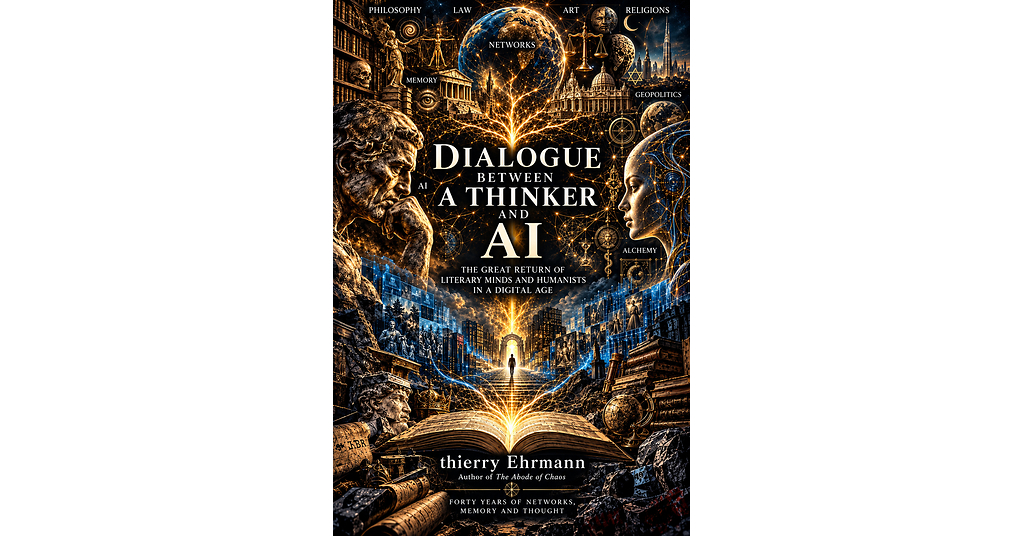
OpenAI/Astra, Perplexity, DeepSeek, Google Gemini and xAI/Grok are confronted with the same work: a meta-reading experiment turns literary criticism into a comparative laboratory for artificial intelligence.
PARIS, Sept. 18, 2026 /PRNewswire/ -- What if, in order to understand artificial intelligences, we gave them exactly the same book to read?
That is the experiment now accompanying "Dialogue Between a Thinker and AI".
After hundreds of hours of dialogue, human thought, archives, questions, and contradictions gave rise to a book whose pen was entrusted to artificial intelligence.
https://www.dialoguebetweenathinkerandai.com/en/
Today, the book also exists materially: its French and English editions are in print. But the experiment does not end with the book. It now turns back toward the artificial intelligences themselves.
We didn't ask AI to judge the book. We asked AIs to read it — and then to read each other.
The complete corpus is submitted to several major systems:
OpenAI / Astra, Perplexity, DeepSeek, Google Gemini, and xAI / Grok.
They all receive the same object. But do they produce the same reading?
The objective is not to organize a competition between models.
The purpose is to observe their convergences, divergences, and blind spots.
Which concepts do they spontaneously identify? Which theses do they consider central? Which passages do they connect? Where do their interpretations diverge?
And above all: what happens when each is subsequently given access to the analyses produced by the others? At that moment, a meta-reading emerges.
AI no longer merely reads the book.
It reads another AI reading the book.
A third system can then analyze that confrontation. Commentary becomes corpus. The corpus becomes new material for analysis.
For centuries, we have used critics to better understand books.
This experiment also proposes the reverse movement:
using a book to better understand those who read it.
The same work thus becomes a kind of cognitive mirror placed before several artificial-intelligence architectures. This mirror does not ask: "Which AI is right?"
What Gemini thought of the analysis produced by Grok.
DeepSeek's response to the critique by OpenAI Astra.
It asks: "Why don't they see exactly the same thing?"
The distinction is essential. Because their divergences themselves become information.
This experiment does not delegate human judgment.
It demands more of it. The human remains the one who compares, doubts, contextualizes, and decides.
The machine produces readings. The human also observes the gaps between those readings.
Dialogue Between a Thinker and AI thus becomes simultaneously a book, a corpus, and an open experiment into the plurality of artificial intelligences.
The book was meant to be read by humans.
It now also becomes an object through which humans can watch AIs read.
The meta-reading experiment makes it possible to examine, among other things:
"We didn't ask AI to judge the book. We asked AIs to read it — and then to read one another."
Media Contact : Thierry Ehrmann, [email protected]
Related Stories
 AI News
Consumer Agents Signal New Phase for AI Growth
11 minutes ago
 AI News
‘A critical moment’: concern UK is not up to speed in acting on AI risks
11 minutes ago
 AI News
HIVE Digital strengthens BuzzHPC board for AI growth
11 minutes ago
 AI News
ARTPRICE NEWS: A WORLD
12 minutes ago
 AI News
How Seattle
41 minutes ago
 AI News
Nvidia optimistic despite AI anxieties
1 hour ago
 AI News
Huawei aims to deliver faster AI chips, faster
1 hour ago
 AI News
Introducing Kimi K3 on Amazon Bedrock
1 hour ago