
As Canada deepens ties with Europe, could it leave U.S. banks and dollars behind?
As Canada deepens ties with Europe, could it leave U.S. banks and dollars behind?
Some see U.S. financial dominance as a threat — and are taking action
Canadians know how it feels to be hit by U.S. tariffs. But Canada hasn't been subjected to Washington's more aggressive tactics such as trade sanctions and asset freezes.
Or rather, most Canadians haven't.
Judge Kimberly Prost, a Canadian jurist who serves on the International Criminal Court, is the exception. She found her credit cards cancelled, her Google accounts closed and was effectively "de-banked" after U.S. Secretary of State Marco Rubio declared the court "an instrument for lawfare against the United States and our close ally Israel."
Prost is a living example of the dangers of digital and financial interdependence with the United States — and a warning of what would happen if such financial controls were turned against this whole country.
Can Canada actually win a trade war with the U.S.? | About That
Until now, Trump's main tool of coercion for most countries has been tariffs, said Fen Osler Hampson, chancellor of Carleton University and co-chair of the Expert Group on Canada-U.S. Relations.
Trump has responded to court defeats by bringing the same tariffs back under new legal justifications. But he is running out of pretexts.
"There's concern that he may shift to using various forms of financial pressure," he said.
"What may happen is that, as the tariff lever becomes harder to pull, the president decides to pressure key trading partners — including Canada — by for example issuing executive orders barring U.S. financial institutions from processing Canadian transactions, or attaching conditions on access to dollar clearing. And those financial tools sit squarely within presidential authority."
Carney says Europe, Canada aren't 'fair-weather allies' while rebuking Trump's tactics
Dollar clearing is the process of ensuring that real funds have been received from one party before releasing to the other.
The most drastic tool a U.S. president could use might amount to a "kill switch" on a large part of Canadian commerce, says Vass Bednar, managing director of the Canadian Shield Institute think-tank.
"If Visa or Mastercard were to be compelled by the Trump administration to turn off our access or geographically restrict service so that the province of Ontario just can't process transactions anymore, it would effectively halt a huge part of our economy," Bednar said.
"It would be unfathomable, but it's not impossible. And that's what happens when you grow too reliant and allow fragility like that to be introduced."
Karl Schamotta is chief market strategist at Corpay, one of the world's largest corporate payments companies. He says the U.S. has always sat at the centre of the world's transactions, but started to realize the power it had when it effectively iced North Korea out of the U.S. financial system.
Schamotta said a small number of banks in New York validate most international U.S. dollar transactions — creating the opportunity for vast "secondary sanctions" against any financial institution connected to those banks.
Ministers say Trump's immigration claims about Canada are bogus
Incoming ambassador says Canada won't pay directly into EU budget
"Not only did they have control of banks within the U.S., but they had secondary control over any bank that touches those banks," he said.
"[The U.S.] realized, wait a second, we have this amazing weapon that we can use … so that escalated fairly rapidly over the years."
Incoming Canadian system has its limits
Canada is expected to launch its new payment system, called Real-Time Rail, later this year. But Bednar says it was conceived at a time when the priority was greater efficiency, not sovereignty, and offers little protection from outside threats.
Visa and Mastercard are central to the U.S. government's ability to shut down other countries' economies, handling about $32 trillion US of transactions annually — 90 per cent of all card transactions outside China.
In Britain, where Visa and Mastercard control about 95 per cent of card transactions, banks are co-operating with the government to create DeliveryCo, a system that can handle payments if the credit card companies ever hit the kill switch.
One country that has succeeded remarkably in freeing itself from Visa and Mastercard is Brazil, with a government system called Pix, originally set up by Brazil's central bank in 2020 to allow people without bank accounts to transfer money and make payments.
"Pix has been phenomenally successful, beyond anyone's expectations," said Schamotta. "There was no expectation that we would see it essentially go viral and displace basically everything else in the Brazilian system."
But the Trump administration accused Brazil of reducing market opportunities for Visa and Mastercard, and cited it as one justification for 25 per cent tariffs.
"They are targeting and bullying another jurisdiction, and saying that your pursuit of a form of digital sovereignty is unacceptable to us," said Bedmar. "This is all the more reason to keep building up sovereign systems like this."
American banks and American dollars
But Pix, like Canada's Interac system, only avoids the U.S. banking system for domestic transactions, said Schamotta.
Still, he said some countries are setting up "swap lines" that go around the U.S.
Cryptocurrencies — including some that are pegged to currencies such as the U.S. dollar — are also gradually replacing dollars in international transfers.
The biggest non-U.S. system is China's Cross-Border Interbank Payment System (CIPS), which works with a digital currency interchange developed by China and other partners called mBridge. When the U.A.E. and Saudi Arabia sell oil to China, the payments clear without touching U.S. banks.
Canada and Europe similarly have the technical ability to design a way for their parallel systems to "talk to each other in a smooth fashion, and clear between one another in a smooth fashion without much difficulty," said Schamotta.
A new lane on an existing highway
Just as Canada seeks to protect its trade with Europe, it should also seek to do the same with other like-minded partners, Bednar said.
"It would be smart for Canada and the middle power alliance to be building up this payment infrastructure … in a way that can maintain that neutrality we expect, instead of a superiority and control that can be weaponized," she said.
The goal, says Hampson, is not to stop dealing with U.S. banks entirely, but rather "adding a lane to a highway."
And if the U.S. were to block or toll international transactions as a form of leverage, he said, the rest of the world will be looking for such a lane.
Coercion is a double-edged sword
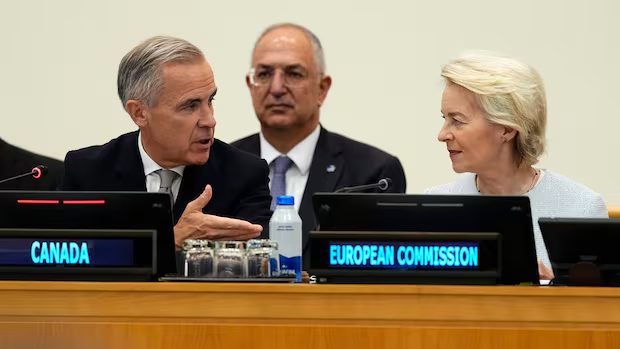
In an interview with Bloomberg days before heading to Europe last week, Carney referred to financial transactions as an example of "those interconnections, that integration [that] can be used as leverage against you."
And speaking to the European Parliament, he listed payments as one of several areas where Canada and the EU can "secure our strategic autonomy through deep co-operation."
Hampson says countries are increasingly seeing their ties to the U.S. as vulnerabilities, rather than advantages.
"Once you start weaponizing the bonds of economic or financial interdependence, it cuts both ways. Just as you know, tariffs impose a real cost on American consumers … the same is true when it comes to government intervention in financial markets, which depend heavily on trust, on stability."
'The old order is not coming back,' Carney says in provocative speech at Davos
Continued U.S. control of the world financial system depends on the U.S. not abusing its position, he said. Such abuse, he said, would "run the risk of losing it."
With most international credit and currency reserves being held in U.S. dollars, Schamotta said breaking free of that dominance is unlikely to happen fast.
But in the meantime, Bednar says Canada can do a lot to reduce its vulnerabilities to reckless behaviour from the U.S.
"We used to smoke cigarettes in the hospital, and that used to be a norm of our society that we didn't question. We moved away from that for very good reasons," Bednar said.
"Right now, when it comes to digital sovereignty and our own payment sovereignty, I would say we're smoking cigars in the hospital, and we can't do that anymore."
Evan Dyer has been a journalist with CBC for 25 years, after an early career as a freelancer in Argentina. He works in the Parliamentary Bureau and can be reached at evan.dyer@cbc.ca.
Related Stories
 Canada
Fatal crash Wednesday night east of Bancroft, police say
3 seconds ago
 Canada
How Carney is positioning Canada to lead middle powers
1 hour ago
 Canada
CBC journalist accosted outside Yom Kippur service and Americans are outraged: ‘Try this in Florida and you go to jail’
1 hour ago
 Canada
Fire at abandoned Coatbridge school was started deliberately
2 hours ago
 Canada
Seven vehicles damaged in suspected arson attack
2 hours ago
 Canada
City tree removals benefit Calgary zoo animals
2 hours ago
 Canada
U.S.
3 hours ago
 Canada
Trump claims Canada is 'destroying itself' with immigration policies
3 hours ago