
Asian stocks are mixed after big tech sell
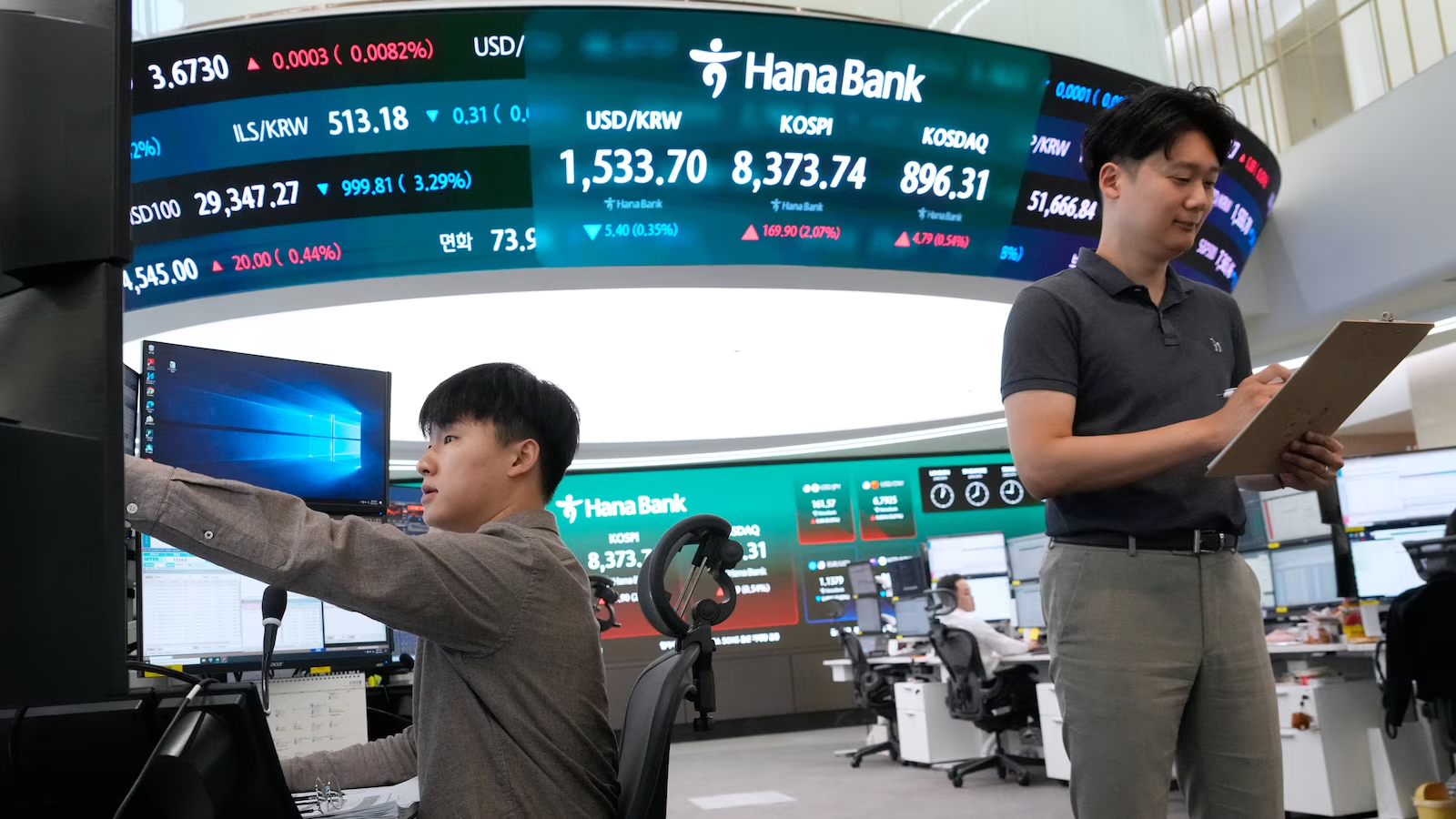
HONG KONG -- Asian stocks were mixed on Wednesday following a sell-off in big technology stocks from Asia to Wall Street.
U.S. stock futures were also trading mixed, as global investors monitor market movements in Japan and South Korea, which have seen big gains in recent months on the global AI boom but both fell sharply on Tuesday.
South Korea’s benchmark Kospi index was up 0.5% to 8,241.23, recovering slightly from its 10% decline on Tuesday. Shares of memory chip maker SK Hynix, one of the country's most valuable stocks, fell 3.6%. Samsung Electronics was up 3.7% after Tuesday’s 12.3% plummet.
Tokyo’s Nikkei 225 lost 1.1% to 68,991.77 after falling 3.6% on Tuesday.
Taiwan’s Taiex, which is also heavily influenced by tech shares, fell 2.5%.
Hong Kong’s Hang Seng edged up 0.1% to 23,364.72. The Shanghai Composite index was down 0.3% to 4,096.14. Australia’s S&P/ASX 200 was trading 0.1% higher at 8,797.00.
The declines in Asian markets, including Japan's, followed Tuesday's 1.4% drop for Wall Street’s benchmark S&P 500 index. The technology-heavy Nasdaq composite fell 2.2%, while the Dow Jones Industrial Average ended 0.1% lower.
Big tech and semiconductor stocks fell in the U.S. On Tuesday, Micron Technology sank 13.2%, while Nvidia lost more than 4.1%.
The big falls in tech shares were an “illustration of rising volatility” in these stocks, said James Reilly, senior markets economist at Capital Economics. “This is particularly true in Korea where domestic retail buyers are taking on an increasing role,” he said.
Oil prices fell early Wednesday, as more ships crossed the Strait of Hormuz while U.S.-Iran talks on a permanent end to the Iran war made progress.
“Price movements suggest the market expects a fairly rapid recovery in Persian Gulf oil supplies,” ING commodities strategists Warren Patterson and Ewa Manthey said in a commentary.
Still, while vessel crossings in the strait increased in recent days, they remained well below pre-war levels, they noted.
Brent crude, the international standard, fell 0.7% to $76.30 a barrel. It has been trading below $80 in recent days but is still elevated compared to the approximately $70 per barrel in late February before the war began.
Benchmark U.S. crude was down 0.7% to $72.70 a barrel.
In the U.S., investors are awaiting a report due Thursday of May’s personal consumption expenditures price index, or PCE, which is the preferred inflation gauge by the Federal Reserve.
Some economists predict the Fed may hold key interest rate this year but is unlikely to raise rates. Bond yields have remained higher, as inflation concerns grew amid global energy shocks.
In other dealings, the U.S. dollar was unchanged at 161.55 Japanese yen. The euro was trading at $1.1364, down from $1.1382.
AP Business Writers Damian J. Troise and Alex Veiga contributed to this report.
Related Stories
 Stocks & Markets
AI giant Anthropic woos potential investors ahead of stock market debut
4 hours ago
 Stocks & Markets
TSX Rises as Banks and Tech Stocks Rebound
5 hours ago
 Stocks & Markets
Aetherion Technologies (NASDAQ:WPRT) Stock Price, News & Quote
6 hours ago
 Stocks & Markets
LIVE : Why are artificial intelligence stocks falling?
7 hours ago
 Stocks & Markets
Nasdaq futures under pressure as tech sell
17 hours ago
 Stocks & Markets
Anthropic flags revenue surge to investors ahead of stock market debut
20 hours ago
 Stocks & Markets
The surge in loans against mutual funds
1 day ago
 Stocks & Markets
What investors really want to know about IP
1 day ago