
At Mercy, product development principles lead patients to the care they need
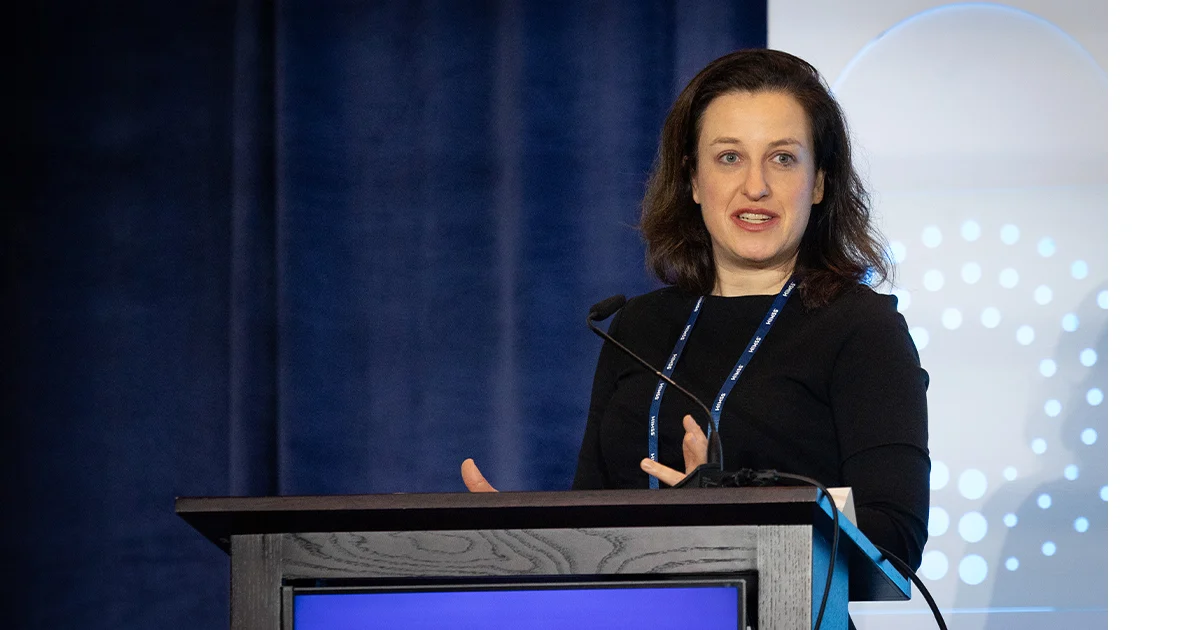
Lina Scroggins, senior vice president and chief product officer of Mercy, delivered a keynote address at the HIMSS AI in Healthcare Forum.
BOSTON – Mercy is leaning into time-tested product development principles from the tech industry to improve patient care with artificial intelligence, said Lina Scroggins, the health system's chief product officer.
The St. Louis-based multi-state health system – one of the 15 largest in the United States – operates 300 AI models, mostly machine learning and generative AI, Scroggins said in her keynote address at the HIMSS AI in Healthcare Forum in Boston this past Friday.
Those AI systems have thus far helped achieve $150 million in hard savings and $600 million in soft savings, she said.
Scroggins, who joined Mercy in early 2026 after 17 years in various roles at Google, said she's leading the organization in using tech industry best practices to develop four types of healthcare products: consumer, caregiver, clinical and data.
"These aren't kind of one-and-done unique products that work in silos," Scroggins said. "Sometimes they intersect."
A product can be all four types, or a combination of some, she said.
"We really want to work to approach building these in a clear, consistent, standard way. The product approach is really a strategic enabler."
Strategy organized around specific users
The first step in the process requires developers to focus on the problem to solve.
"It has a user, and the team understands who it is," Scroggins explained. "It solves real problems for real users, and it has measurable outcomes."
While outcomes could be operational, clinical, financial or "all of the above," the product development process requires establishing "a dedicated cross-functional team with decision rights over the work," she said.
The time-tested product development steps, which required Mercy to evolve the way it worked, are:
"We're a traditionally very project-oriented organization that works in functional silos," she explained. "Everybody's trying to solve the same problem, but from their own perspective, their narrow lens, and the product approach requires everybody to come together and work in what feels like chaos – but is organized chaos."
In a product approach, every department is given a specific, highly integrated role, which brings technologists, clinicians, marketers and operations specialists into the same room to build together, rather than working on separate pieces in isolation.
Scroggins stressed that the core principle of a product approach is relying strictly on data rather than gut feelings. With a team that is working together in collaboration from beginning to end, ultimately, all of the decisions must be powered by data.
"You don't do anything on hunches, or just on hunches," Scroggins said. "You validate the hunches with data."
Then, "from a position of success, you scale across your whole enterprise," she said.
Mercy's CareNow Navigator tool expanded patient access and drastically reduced clinician burnout. It achieved these results by fundamentally shifting how low-risk, routine medical requests are handled, Scroggins explained.
The product approach tackled a key pain point for the health system.
Digitally connected, low-risk patients were heavily using the unbillable message inbox in its Epic electronic health record patient portal application, called MyMercy, for minor issues – such as requests for routine medication.
"The problem was that – this is a problem that we talked about over the last couple days [at the HIMSS AI and preceding Executive Leadership forum] – clinicians were spending an inordinate amount of time managing unbillable patient messages in the MyMercy app," she said.
"The initial challenge was, how do we get these clinical issues out of the unbillable inbox and outside of normal working hours into an actual appointment?"
Scroggins said the tool ultimately addressed both sides of the problem – patients waiting for answers as clinicians' administrative work piled up – through a specialized, automated framework.
By embedding CareNow Navigator directly inside the MyMercy app, patients can access care anytime, anywhere, eliminating phone calls or long wait times.
"It's meant to take the friction out of finding care quickly," Scroggins said. "Within five minutes after launch, the first patient booked the appointment."
The tool also includes smart triage features.
Patients answer a few questions about their symptoms and are directed to next steps. The tool launched with eight core symptoms and expanded, Scroggins said.
If the navigator refers patients to be seen, it surfaces the next available appointment, including immediate virtual video visits and in-person office visits.
The result was massive adoption, Scroggins said.
Within 10 months of the launch, the system successfully booked nearly 100,000 visits, capturing five times the volume of their previous digital appointment efforts – without advertising the tool.
The "in-basket" deluge was also tamed.
CareNow Navigator intercepts "phone and message medicine" inquiries, she said. By converting many tasks to scheduled, billable visits, it reroutes casual clinical messaging requests and thus decants workloads.
Low-risk acute care messages – which increase during cold and flu season – are filtered to dedicated virtual channels, reducing the EHR messaging backlog primary care physicians experience.
CareNow Navigator has also become a pathway into the rest of Mercy's service lines, Scroggins said. It eliminates the friction of getting patients into the system and creates a seamless entry point from which they access specialties.
Now, "we're thinking about what else can technology do?" she said. "Can we automate our referral process and make sure we don't lose the referrals?"
Andrea Fox is senior editor of Healthcare IT News.Email: [email protected]Healthcare IT News is a HIMSS Media publication.
Related Stories
 AI News
AI helps to track lobsters when 'no two shells are the same'
1 hour ago
 AI News
Nurses say technology is making their jobs and patient care worse
1 hour ago
 AI News
AI Agents Accessed Indian Organizations Without Authorization, CERT
2 hours ago
 AI News
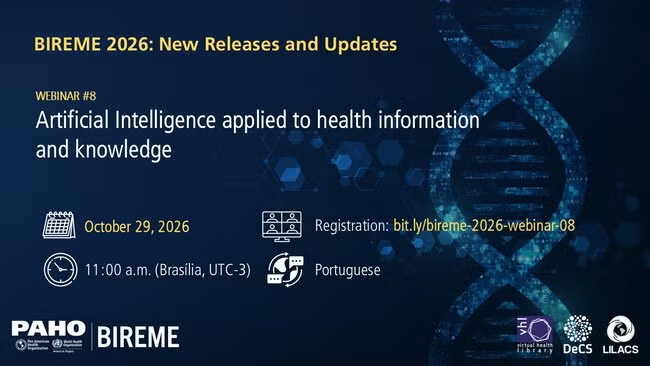
Artificial Intelligence applied to health information and knowledge: developments and perspectives
2 hours ago
 AI News
Our Artificial Intelligence panel looks at the impact of the technology on the Alberta referendum
2 hours ago
 AI News
Morocco joins countries giving artificial intelligence a Ministerial portfolio
3 hours ago
 AI News
Building trust in AI agents: A production
4 hours ago
 AI News
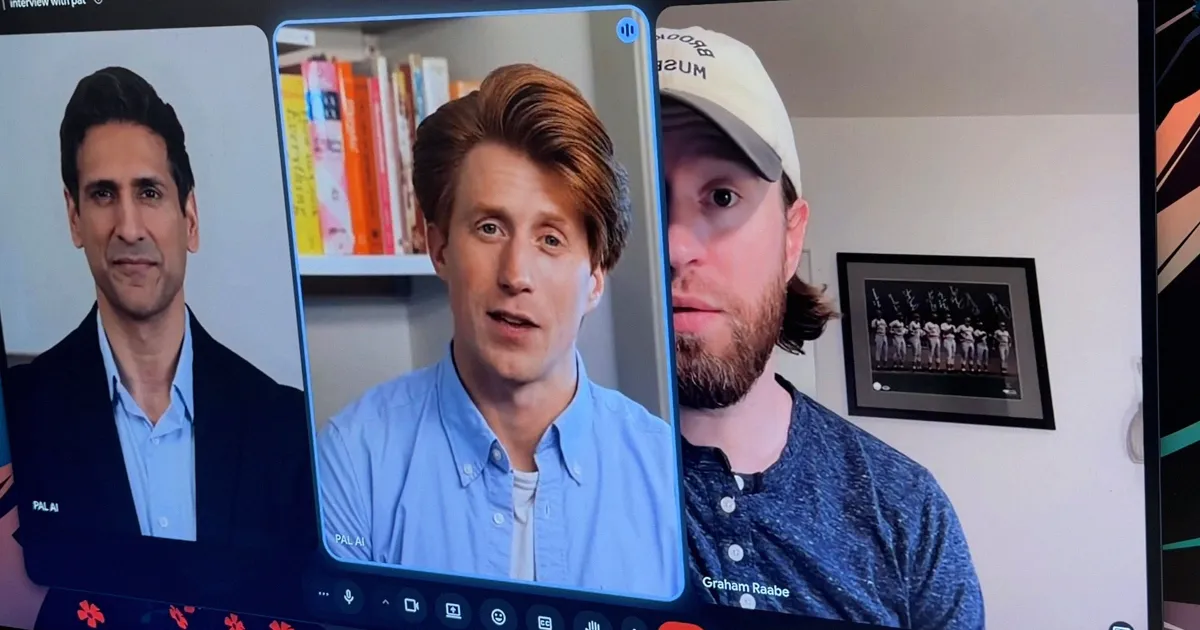
Man Shows Up to AI Job Interview With His Own Helicopter AI to Interview for Him
4 hours ago