
Audio recordings reveal man threatening to kill charity workers
Warning: This article contains language that some readers may find offensive
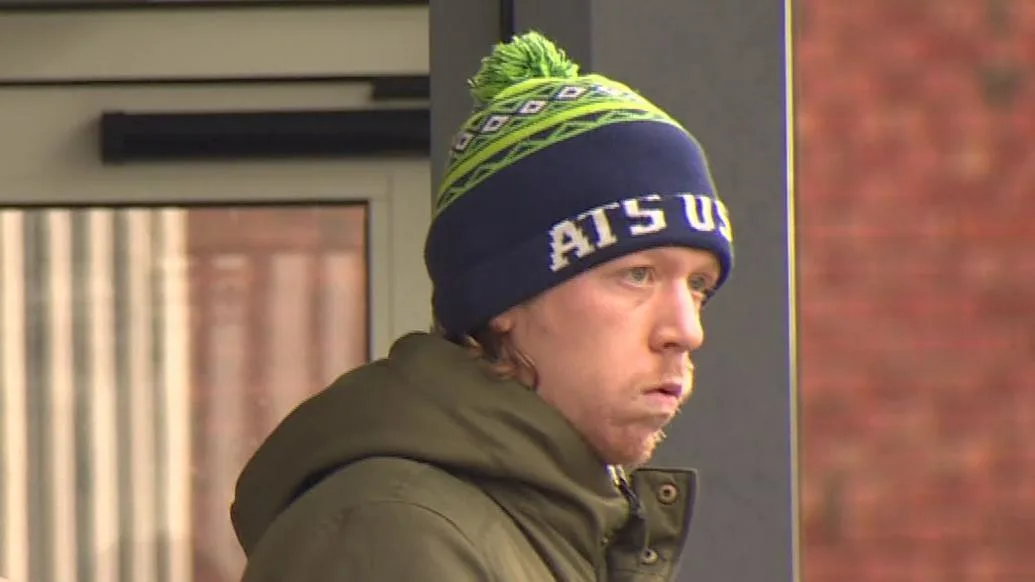
A charity worker who was told he would get a bullet in his head and that everyone in his place of work would be "burnt to a crisp" has called for tougher laws to deal with race hate crimes.
Takura Makoni was also warned he would be beaten with a hammer and his face turned "into a pizza".
The threats were made in March last year in two expletive-filled phone calls, which Makoni recorded.
William Brown, from East Street in Newtownards, was handed a suspended prison sentence in April after he was convicted of making threats to kill Makoni.
The 28-year-old was also convicted of making threats to damage property and improper use of a public communications network.
He was not convicted of a race hate crime because there is no such offence in Northern Ireland.
Makoni, a policy officer at the African and Caribbean Support Organisation Northern Ireland (Acsoni), said he believed this was a failure.
"We need a dedicated law speaking to the issues of racially-motivated crime and if we have that law then we have a deterrent," he said.
"And in terms of reporting of these crimes then we also have the security that if our crimes are reported something will be done, because confidence in the justice system is very low when it comes to issues around racially-motivated crimes."
He said legislative change was crucial, particularly given escalating racial tensions in Northern Ireland that have manifested in violent disorder on the streets over the last three summers.
During the phone recordings shared with BBC News NI, the offender Brown branded Makoni a highly offensive racist term and repeatedly told him to go back to his home country.
In the expletive-filled rants, he could also be heard asking: "What country are you from? Are you a Muslim?
"You're in my country. You adhere to our laws."
He then called Makoni a foreigner and an immigrant, and said: "This is a Christian country for Irish and British and Scottish and Welsh and Anglo-Saxons."
He added that it was not a place for Muslims "like you".
Makoni said he and others from minority ethnic backgrounds were used to hearing racist language every day.
In fact, he said, many experienced worse - like attacks on their properties or physical assaults.
However, he said he had been particularly concerned about Brown's threat to burn down the Acsoni building - because it was also occupied by a south Belfast charity that supports young children and mothers.
"If he had damaged the building, he would have impacted the residents of south Belfast, of which they are Catholics, Protestants, blacks, whites, Muslims, Christians, Jews, Muslims," he said.
"The impact would have been profound, and not only the harm on the building, but what if there had been people in the building when this act that he was threatening to, you know, commit happened? So it was a real concern."
Brown was sentenced to nine months in prison, suspended for three years. The sentence was enhanced due to hostility, which means that a racial motivation had been proven.
But according to Victim Support, which advocates for victims of race hate crimes, that does not happen in the majority of cases.
Michael Avila, a managing consultant for the organisation, told BBC News NI: "Currently you cannot be convicted for a hate crime in Northern Ireland.
"You're convicted for, say, assault. Potentially then the judge may add on at the sentencing stage that there was a hate motivation and maybe stricter sentencing. But that's quite rare."
Avila said that did a "disservice" to victims.
Figures obtained by BBC News NI from the Public Prosecution Service (PPS) showed that in 2024/25, of the 79 defendants who were convicted of a racially-motivated offence, 21 were recorded as having received an enhanced sentence due to the aggravating feature of their offences.
New legislation to address this issue and the wider rise in race hate is progressing through the Northern Ireland Assembly.
Earlier this year, the Department of Justice (DOJ) introduced its Sentencing Bill, which is aimed at changing how racially-motivated hate crimes are prosecuted.
It involves introducing a "statutory aggravator model", which the DOJ said would "provide a system-wide response to the criminalisation of the hate element of crimes".
It said the bill "requires the court to treat the offence more seriously, to state that the offence is so aggravated, to record the conviction in such a way that shows the aggravation, and, in imposing the sentence, to explain how the aggravation affects the sentence imposed".
The new model was recommended in a report six years ago by former judge Desmond Marrinan.
Avila, from Victim Support, said implementing the model would keep any hate motivation consistent from the moment the crime is reported to the moment it is passed to the Public Prosecution Service, through trial and to sentencing.
If you have been affected by any of the topics raised in this article, help and support is available via the BBC Action Line.
The night people in Belfast fled their homes because of racist violence
Residents fear 'what's next?' after racist graffiti
'Hate and racism makes me afraid but I have an amazing neighbourhood'
Related Stories
 Community
Multiple people, including children, injured in elementary school shooting in Oregon
11 hours ago
 Community
Advocates call for solutions as winter approaches
17 hours ago
 Community
News without the paywall: U of T Libraries brings digital access of The Globe and Mail and The New York Times to the U of T community
19 hours ago
 Community
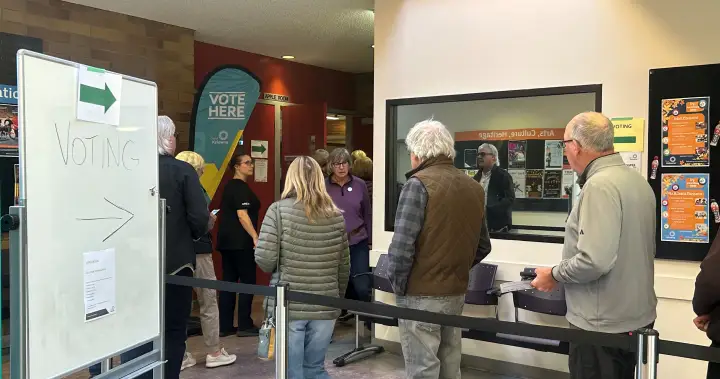
Strong advance voting turnout in Kelowna as municipal election approaches
1 day ago
 Community
Newfoundland thriller 'Below' reels in record audience for a Canadian Netflix title
1 day ago
 Community
'When I win as mayor, I'll get another tattoo': Jeff Leiper on life's twists and turns so far
2 days ago
 Community
Healthcare, affordability lead Canadians’ unmet local news demands: CJF study
2 days ago
 Community
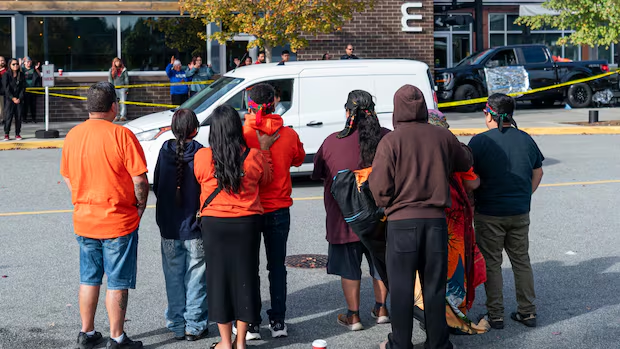
More updates from police needed on TRC day fatal collision investigation, says law professor
2 days ago