
Australian spider declared world’s fastest after record
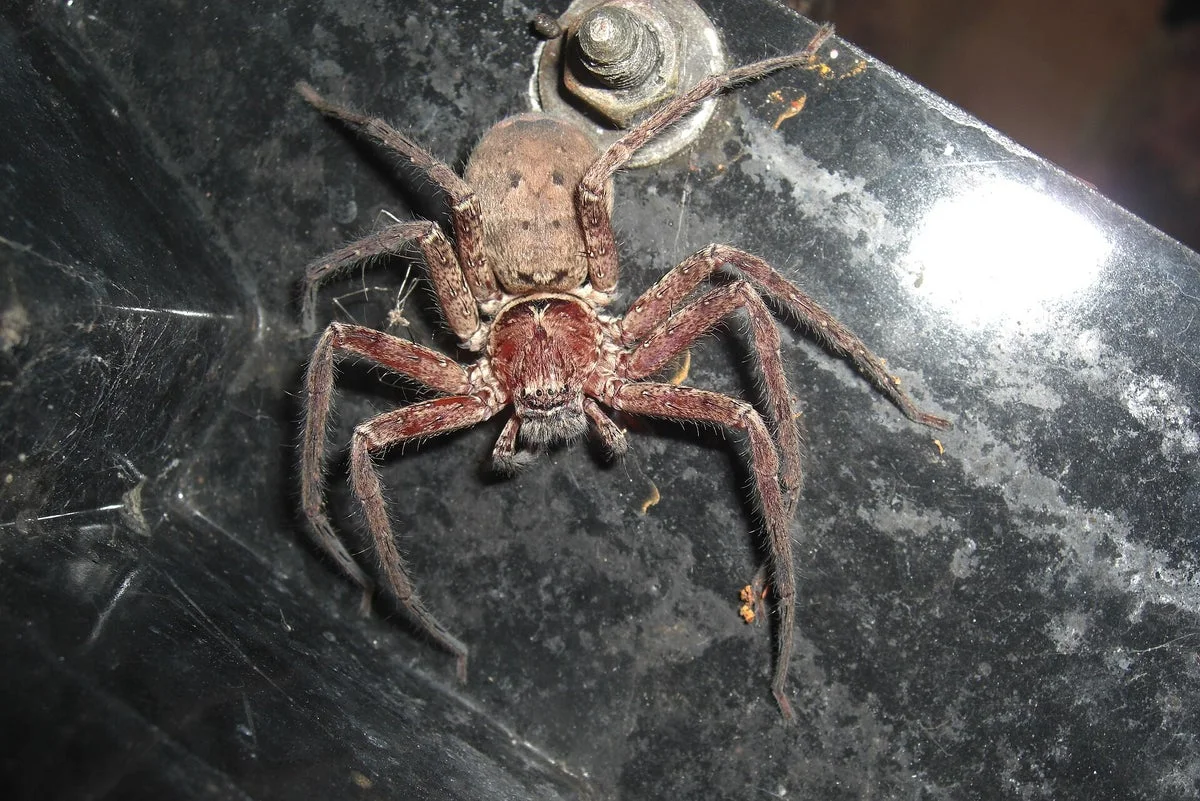
An Australian jungle huntsman spider is the world's fastest arachnid, reaching a top speed of about 3.6 metres per second, according to a new lab study.
For a long time, the Moroccan flic-flac spider was considered to be the world's fastest, with a speed of nearly 1.7m/s, but some experts didn't agree that this is a type of sprinting locomotion.
To settle this debate, researchers from Germany's University of Greifswald and Imperial College London conducted a lab test with more than 160 live spider species from across the UK, Australia, North America, and southern Europe as well as dozens sourced from pet shops.
"We measured maximum sustained running speed for 236 specimens representing 162 species," researchers wrote in a yet-to-be peer-reviewed study posted in bioaRxiv.
"To maximise coverage, we supplemented these measurements with published data for a further 96 species."
Spiders were individually weighed and tested for top speeds on A4 and A3 grid papers, with cameras monitoring the tests to study the biomechanics of their movements.
The papers were mounted on a rigid plastic tray or metal sheet, with liquid paraffin applied to the walls to prevent escape by climbing species.
Scientists compared the performances of the spiders with the sprinting speeds of another 96 species covered in previous studies.
A huntsman spider sourced from Queensland was the fastest of them all, reaching a top speed of 3.59m/s, researchers concluded.
The study also found that a spider's running speed was related to its body weight.
"Running speed increased substantially with body mass, from a minimum of 0.018m/s measured for the money spider Maso sundevalli (body mass 1mg), to a maximum of 3.59 metres per second recorded for the huntsman spider Heteropoda cervina," they noted.
However, there was substantial speed variation among spiders of very similar body mass.
Citing an example of this discrepancy, they said the orange purse-web spider, Calommata signata, and the tube-web spider, Segestria florentina, both weighed 200mg, yet their top running speeds differed by 28-fold.
Large spiders seem to run faster as long as they are not so large that a heavy abdomen burdens them, scientists say.
There are outliers to this, like the tiny orange goblin spider, Oonops pulcher, that weighs only 0.1mg but moves at over 0.2m/s.
It was so fast for its size that researcher Shreyas Kuchibhotla from ICL told New Scientist the spider "practically teleported".
Fast running is also linked to having longer legs, scientists say.
"Strong running performance, after accounting for both body size and shared ancestry, was associated with relatively longer legs...but not with leg slenderness," they wrote.
Whether a spider species hunts on the ground or in foliage and whether it predominantly moves upright or upside down also relates to its running speed, scientists say.
"These differences may well alter both the selective value of running speed, and the way in which it is realised," they wrote.
Related Stories
 World
World
Is there anything like October for sports in LA? Local businesses ride the hype of World Series excitement
10 minutes ago
 World
World
Pictured: Winning entries for Wildlife Photographer of the Year 2026
10 minutes ago
 World
World
Haze: Who's to blame for the toxic smog choking South East Asia?
11 minutes ago
 World
World
COLUMN | Trump Is Going to Lose the Midterms.
11 minutes ago
 World
World
U.S. News and World Report releases 2027 Best Colleges Rankings
1 hour ago
 World
World
Duane "Keffe D" Davis sentenced to 40 years for rapper Tupac Shakur's murder
1 hour ago
 World
World
Hotfixes: October 13, 2026
1 hour ago
 World
World
Seoul launches WYD 2027 app for international pilgrims
2 hours ago