
Back to school: Everything you need to know about Ontario's education policy changes
Back to school: Everything you need to know about Ontario's education policy changes
A cheat sheet on the major changes for the 2026-2027 school year
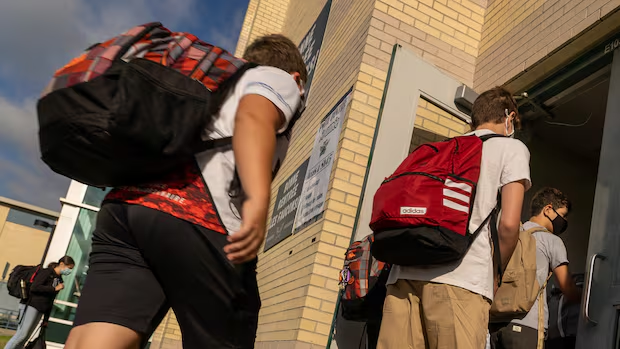
Tuesday marks the official return to school for hundreds of thousands of Ontario students, but the academic landscape inside those halls will look a little different this fall.
If you’ve just come off a busy summer full of beach days and cottage trips, here are some of the major updates you may have missed.
Mandatory final written exams for high school courses
In June, Education Minister Paul Calandra announced a string of changes, including making final written exams mandatory for most high school courses.
The move is “intended to provide a more consistent approach to assessment and evaluation for students in Grades 9 to 12,” according to the province’s website.
Why Ontario is changing high school attendance, exams rules
For Grades 9 and 10, mandatory final written exams are now worth 20 per cent in core subjects like english, math and science. The EQAO Grade 9 mathematics assessment counts as a written final exam.
In Grades 11 and 12, exams account for 25 per cent of the grades in core subjects, while non-core subjects split final evaluations between a written exam and a culminating project.
Workplace preparation, co-op and special education courses remain exempt from written exams, though final non-written evaluations are still required.
Attendance will now factor into final grades
Starting this school year, attendance and participation will account for 15 per cent of a final mark in Grades 9 and 10. In the upper years, it will count for 10 per cent.
A student who has more than two unexcused absences won't be able to get that full 10 or 15 per cent.
Ontario education minister urges parents not to pull kids from school for sports
After the change was announced in June, Calandra told The Canadian Press attendance rates in Ontario high schools have been among the worst in the country.
"My advice to parents is, keep them in school," he said at the time. "Education should be their priority.”
Illnesses and religious holidays are categorized as excused absences and will not affect grades.
New financial literacy graduation requirement
Ontario high school students also now need to pass a financial literacy test in order to graduate.
Grade 10 students will take the new standardized financial literacy evaluation in Career Studies (GLC2O) and must score at least 70 per cent to pass.
According to the province's website, students will have two opportunities during the course to achieve that benchmark. If they don’t succeed, they will be provided more opportunities outside the course.
Parent reacts to Ontario's planned mandatory exams changes
The education minister announced the requirement last spring, saying students need practical, real-world skills, including on how to manage money and budgets.
The evaluation will focus on essential financial life skills, including household budgeting, interest rates, credit cards, saving strategies and consumer awareness, the province says.
Student and family support offices at all school boards
Last week, the province announced student and family support offices will open at all 72 school boards.
The province first announced the program last fall, when it placed five school boards under provincial control for alleged mismanagement, ordering those boards to open support offices by January 2026.
When announcing the program expansion in Hamilton last week, Calandra said the offices are meant to give parents and caregivers a clear next step when concerns cannot be resolved at the school level.
Student and family support offices open across all Ontario school boards, ministry says
“We know there are going to be times when parents have questions and concerns,” he said. “Most of these can and should be resolved with the teacher or principal.”
But parents should not have to spend weeks trying to determine who is responsible for handling more complex issues, Calandra said.
New 'back to basics' kindergarten curriculum
A new kindergarten curriculum will take effect this school year.
The new "back-to-basics" curriculum shifts away from play-based learning towards academic rigour, according to the province.
It includes new learning requirements in math, science and language skills, where the previous curriculum emphasized learning through exploration and play.
Ontario releases ‘back to basics’ kindergarten curriculum to take effect in September
Some teachers have expressed concern over whether the new expectations are age-appropriate for four- and five-year-old children.
The province says the curriculum maintains learning through play while introducing more structured lessons in reading, writing and math.
Tyler Cheese is a reporter with CBC Toronto, telling stories focused on local and provincial issues, public accountability, and life in the GTA.
Related Stories
 Canada
Thieves steal 4 Renoir paintings from French Riviera museum, 2 of them still missing
23 minutes ago
 Canada
Canada strikes back with tariffs on about $20 billion worth of US goods
23 minutes ago
 Canada
Canada retaliates against Trump with counter
24 minutes ago
 Canada
Toronto condo developer launches $10M lawsuit against online critics, alleging a 'malicious campaign'
24 minutes ago
 Canada
Canada’s counter
24 minutes ago
 Canada
Trump sparks fury with post of map with Canada, Iceland as part of U.S.
24 minutes ago
 Canada
Alberta separatist leader Rath faces $109M debt claim from US investors
1 hour ago
 Canada
Posthaste: Small exporters say they need Canada’s trade war to end ASAP
1 hour ago