
Bank of Canada holds key interest rate at 2.25% as economic growth rebounds
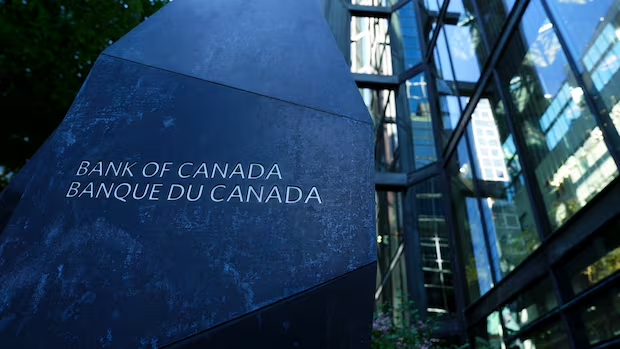
Bank of Canada holds key interest rate at 2.25% as economic growth rebounds
Central bank sees signs of 'improvement,' expects inflation to ease
The Bank of Canada held its key interest rate at 2.25 per cent on Wednesday, predicting the economy would rebound after some rockiness earlier in the year.
A hold was widely expected by economists in the leadup to the decision — all 36 economists surveyed by Reuters ahead of the announcement expected the central bank to hold rates, with a majority forecasting no change until at least July of next year.
This is the sixth consecutive rate hold by the central bank.
"Canada’s economy is showing signs of improvement. Growth is picking up and inflation is projected to ease gradually from its recent spike," the bank's release said.
Risks and uncertainty remain due to the war in the Middle East and ongoing trade talks with the U.S., according to the release. But officials at the central bank are growing more confident that the economy is working its way through those headwinds.
The bank's governing council said the current rate is still at the right level to bring inflation back to the two per cent target, though noted that it remained ready to change rates if needed.
While Canada's economic growth hit snags in the first part of the year, there are "clear signs" that growth has resumed in the second quarter, according to the release.
A contraction in the economy to start the year surprised the central bank, which had expected annualized growth of 1.5 per cent in the first and second quarters. According to the bank's monetary policy report out today, those drags are subsiding as exports contribute to growth and consumer and government spending pick up. The bank predicts the economy will grow by 2.5 per cent in the second quarter.
Inflation rose further in May to 3.2 per cent, though the core measures — which strip out more volatile metrics — remained closer to their target. The Bank of Canada says this suggests that the higher cost of gas isn't spilling over into the cost of other products.
The bank expects inflation will remain high in June before easing in coming months, predicting the inflation rate will fall to 2.5 per cent in the second half of 2026, before reaching the two per cent target in early 2027.
But the bank said that this is highly dependent on what happens with oil and gas prices due to the war in the Middle East.
"We've been looking through the direct effects of higher oil prices on inflation, but the longer they remain elevated, the bigger the risk they spill over to other goods and services," Macklem said.
Oil prices jump as conflict between U.S., Iran escalates
BMO's chief economist Douglas Porter said those up-and-down oil prices will keep the bank on its toes.
"That's the X factor on the near-term inflation outlook," Porter wrote in a note to economists.
While Porter says some positive data led to a more upbeat forecast in the near term, all of that uncertainty is still weighing on any longer-term optimism.
Still, he expects the central bank will remain firmly on hold for the rest of the year.
"It doesn't seem like the bank is in any rush whatsoever to move off the sidelines, even if their rhetoric leans slightly hawkish," Porter said.
Abby Hughes is a writer with CBC News based in Toronto. Originally from Orillia, Ont., she studied journalism at Toronto Metropolitan University. She covers news from the worlds of business, entertainment, health, science and education, and her favourite stories focus on the real people in those areas — the customers, fans, patients, citizens and students. You can reach her with story ideas at abby.hughes@cbc.ca.
With files from Reuters and the Canadian Press
Related Stories
 Canada
Republicans back Trump in his trade war with Canada
1 hour ago
 Canada
The key to winning the Canada
1 hour ago
 Canada
Carney says Trump officials shouldn’t comment on Canadian politics
1 hour ago
 Canada
Toronto begins recovery after ‘100
1 hour ago
 Canada
New U.S. visa integrity fee to affect some travellers including from Canada
1 hour ago
 Canada
How your spouse or partner may be able to join you in Canada sooner than expected
1 hour ago
 Canada
Widespread power outages remain after damaging storms slam southern Ontario
5 hours ago
 Canada
Is Quebec actually the most taxed jurisdiction in North America?
6 hours ago