
B.C. government straining to show World Cup’s economic benefit
B.C. government straining to show World Cup’s economic benefit
Published 4:00 pm Wednesday, June 10, 2026
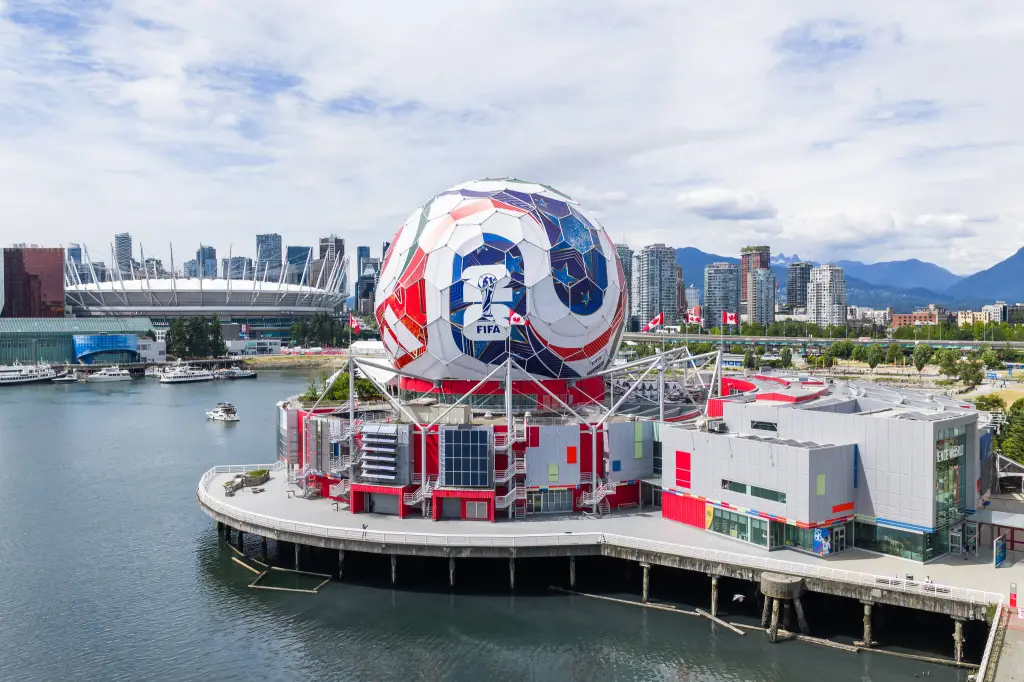
Vancouver’s Science World has been transformed into a giant soccer ball for the World Cup. (Destination Vancouver/Jon Ross Films/Science World)
As players get set to take the pitch this weekend for the first of seven World Cup matches at BC Place in Vancouver, the provincial government is continuing its effort to persuade a skeptical public of the economic benefit of being a host city.
“It’s clear when you host major events like this, there’s an economic impact that comes from that,” said Ravi Kahlon, B.C.’s jobs minister, at a Wednesday news conference.
Shortly after Kahlon’s remarks, the province released its updated economic impact assessment for the games, projecting $1 billion in additional visitor spending in the region over the next five years.
This assumes 196,000 more out-of-province overnight visitors to the region during the games, compared to the baseline, and then 732,000 to 795,000 more overnight visitors over the next five years following the games.
B.C. Conservative Finance critic Peter Milobar doesn’t buy the numbers.
“Hard to believe that they’re projecting post-FIFA to attract as many visitors per year because of FIFA as they’re going to attract for the actual games themselves this year,” he said.
Milobar wants more transparency, particularly on safety and security costs. B.C. projects it will spend $242 million CAD on security to host seven games, while nearby Seattle estimates security will cost $32 million USD to host six games.
The latest estimate of the total taxpayer cost to host the games in Vancouver is between $685 and $729 million. B.C. expects to recoup $250 to $260 million through a special hotel tax and $100 million from the federal government.
While Milobar says he is happy to see Vancouver showcasing itself to the world, he wants more information about the costs and benefits.
“This is really about a government that is continually moving goalposts, trying to justify what has essentially turned into a blank check for FIFA,” he said.
And several recent surveys show both residents and businesses may be souring on the trade-offs being asked of them.
The Canadian Federation of Independent Businesses found that 72 per cent of small businesses surveyed in Vancouver and Toronto expect the tournament to have no impact on revenue.
Angus Reid surveyed Metro Vancouver residents, with 72 per cent of respondents saying that hosting is not worth public costs, especially in light of the disruption, upheaval and the lopsided share of profits going to FIFA, the sports governing body.
Kahlon acknowledges the impact on residents, but said it is worth it to “invite the world” to enjoy your city.
“I think people understand that there are trade-offs,” he said.
Kahlon continues his work to capitalize. On Wednesday, he announced the opening of B.C. Business House, a government-run networking hub for businesses, investors and others to showcase themselves to potential partners.
“This venue creates opportunities for growth and gives B.C. industry as well as a chance to score big during the World Cup,” he said.
Related Stories
 World
World
Who is Karl Bushby and why is he walking around the world?
2 hours ago
 World
World
World Cup 2026: Why late goals are becoming more common than ever
2 hours ago
 World
World
The 10 Best Watches at the World Cup (So Far)
2 hours ago
 World
World
'Light in the darkness': The journey of Noa Argamani
2 hours ago
 World
World
Labubu is bound for the big screen, as Pop Mart aims to capitalize on toy's global success
2 hours ago
 World
World
Biotech news from around the world
3 days ago
 World
World
Europe Today: Inside the G7 Summit in Évian
3 days ago
 World
World
Lionel Messi's hat trick leads Argentina to a 3
3 days ago