
Bones found in Yukon ID'd as ice
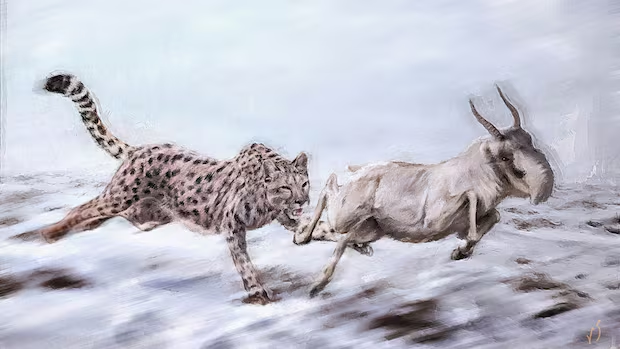
Bones found in Yukon ID'd as ice-age cheetah
‘Any little bone that we find can actually reveal a whole new story’
At first, bones found in the Bluefish Caves and at a mine site in northern Yukon were assumed to belong to an ice-age puma or cougar.
But DNA analysis from the University of California said otherwise.
The test was performed by Molly Cassatt-Johnstone, at the time a lab technician who had just finished her undergrad. The Yukon bones were some of the first samples she ever worked on.
“So when I did the first preliminary analyses, and these didn’t look like pumas at all, I was like, ‘Oh, I’ve done something really, really wrong here,’” she laughed.
Yukon paleontologist Grant Zazula still remembers his amazement at the message he received that evening: “Hey Grant, your cougars aren’t cougars — they’re actually cheetahs.”
“Twenty-five years ago, looking at ancient DNA was almost science fiction, Jurassic Park kind of stuff,” said Zazula. “Now, doing genetic analysis on permafrost-preserved bones from the Yukon is kind of a regular thing we do.”
Cassatt-Johnstone had become the first to identify a Yukon Miracinonyx — the creature also known as the extinct American cheetah. Now, she is the first author of a paper published in Current Biology that sheds new light on the ice-age cat’s diet and range.
'It’s a complete detective story'
Researchers long believed the American cheetah, with the long limbs and slender build of today’s living cheetahs, would have evolved to chase pronghorns across grassy plains. To find them in the middle of Arctic tundra threw paleontologists for a loop.
“They were originally thought to be like really close, specialized predators of American pronghorn antelope in the lower 48,” said Cassatt-Johnstone. “But there were never any pronghorn in Beringia.”
Beringia is the place where Asia and North America were once connected, and includes the land now part of Russia's easternmost region, Alaska and the Yukon.
How did Miracinonyx survive there?
To answer that question, the study authors, which include collaborators from Canada and the U.S., turned to stable isotope analysis.
The technique, also used in forensics, looks for chemical clues to investigate what ancient people or animals were eating, and can even be used to track things like the climate they were living in and where they may have travelled in their lifetime.
Slivers of bone that would have once formed part of the cheetah’s paw and leg were analysed through a process Matthew Wooller says is precise enough to be able to tell if someone has eaten plain carrots or carrot cake.
Wooller, the director of the Alaska Stable Isotope Facility at the University of Alaska Fairbanks, said he was determined to crack the case after reviewing preliminary results.
“I was hooked,” he said. “The data was like nothing I’d seen before, very unusual data from an isotope perspective.”
It turns out Yukon cheetahs had been surviving almost exclusively on fish — a behaviour very unusual in both past and present-day cats, and one researchers believe can be understood in context.
“It’s the whole ecosystem, and figuring that out is like a jigsaw puzzle we don’t always have all the pieces to,” said Wooller. “It’s a complete detective story.”
It was a revelation for paleontologists like Julie Meachen, who specializes in mammalian carnivores from the Late Pleistocene and has done extensive research on this species in Wyoming.
“This animal is doing something so different in the Yukon than it’s doing in midcontinental North America, specifically Wyoming, that it’s acting like it’s a whole different species,” she said.
But in a region where the relatively small cheetahs would have been competing for prey with massive Beringian lions, scimitar cats and the giant short-faced bear, turning to once-plentiful runs of Yukon salmon may have been an effective strategy.
“It must have been the incredible abundance of fish making them a very easy species to catch,” Meachen said. “Basically, do you want to have to work for dinner or get a pre-made meal?”
The study used extensive DNA analysis, and found Miracinonyx was actually genetically closer to North American pumas than African cheetahs. Researchers also looked at the number of variations in the cats’ gene pool, and determined that population numbers always would have been low.
Cassatt-Johnstone said this low genetic diversity and resulting lack of adaptive potential could have been a factor in their extinction.
Zazula believes the existence of arctic fishing felines justifies a renaming of this unique northern population from ‘American Cheetah’ to ‘Yukon Cheetah.’
“There have been paleontologists in the Yukon for decades and decades, tens of thousands of bones… we thought we kind of figured out all the species that were living here in the past," he said.
“But any little bone that we find can actually reveal a whole new story.”
Caitrin Pilkington is a reporter with CBC North in Whitehorse. She previously worked for Cabin Radio in Yellowknife. She can be reached at caitrin.pilkington@cbc.ca.
Related Stories
 Explainers
Why Karnataka politics keeps getting caught on camera
4 days ago
 Explainers
Rare waterspout may have damaged trees near coast
4 days ago
 Explainers
Demolition of M5 bridges is 'going smoothly'
5 days ago
 Explainers
Meteorologists' warning about "El Niño": it develops a second arm from the initial mass and heightens the forecast of its effects
5 days ago
 Explainers
Trump’s new press secretary is leaving the post
6 days ago
 Explainers
What is driving young anglophones out of Quebec?
6 days ago
 Explainers
What is Starshield, SpaceX’s military
1 week ago
 Explainers
Portal Innovations Venture Team Releases New Analysis on Capital Efficiency in Emerging Biotech Ecosystems
1 week ago