
Can Pirelli’s Cyber Tyre Technology Replace Drive Modes?
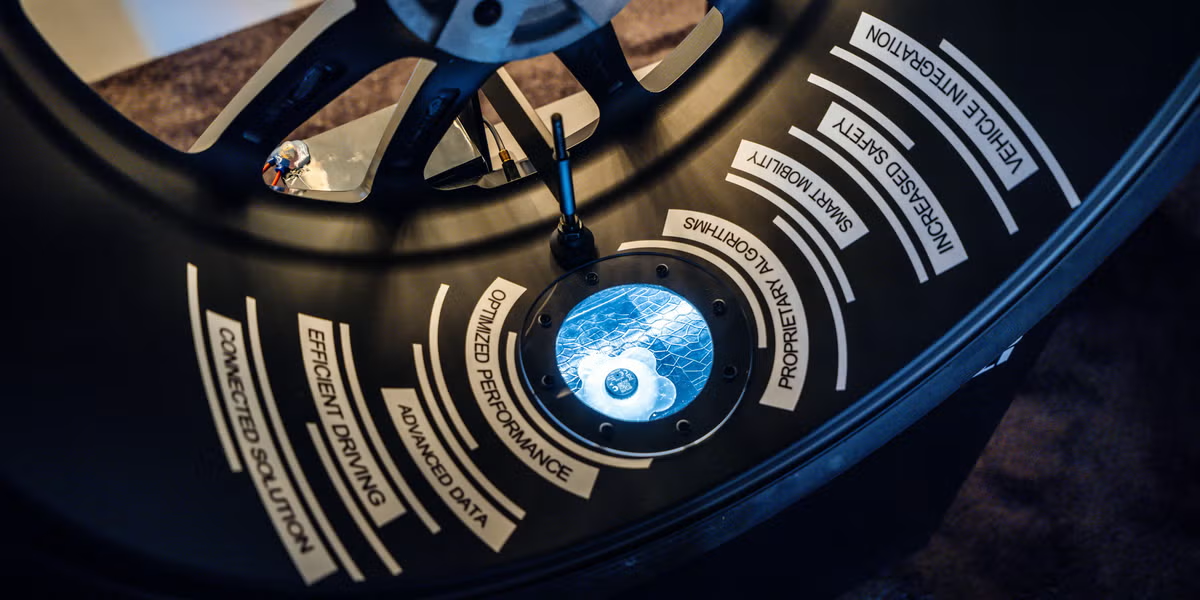
After roughly 25 years of development, Pirelli's Cyber Tyre technology is preparing for a wider rollout. The tires use a sensor that looks a lot like a Dexcom G7 to feed temperature, air pressure, acceleration, and identification data to a vehicle's computers.
That information, combined with software help from Bosch, allows a vehicle to adjust its ABS and traction-control calibrations based on tire data. For example, swap your summer tires for squishier winter rubber, and a compatible car could recognize the change and automatically adjust how its electronic controls intervene, leaving you free to imagine a world where maybe we all just drove better.
See all results for used cars for sale near 8003
"This is one of the worst environments for electronics," explained Pirelli chief technical officer Piero Misani. The sensor, weighing just 13 grams, is bonded to the tire's inner liner beneath the tread using a specially developed adhesive and rubber housing. The process was developed using learnings from Pirelli's Noise Cancelling System, which uses foam inside the tire to absorb sound waves and reduce cabin vibration. The sensor must survive extreme temperatures, constant flexing, and the insane lateral g-forces that tires are susceptible to at over 200 mph. Engineers explained that its battery is designed to outlast the tire and enters a low-power sleep mode during extended storage.
The more inspiring part is what the car does with the information it gathers. As we found in our recent all-weather tire comparison test, summer, winter, and all-season tires perform dramatically differently. Yet a vehicle's electronic controls are generally calibrated around its original equipment, using things like wheel speed sensors that aren’t as close to the road surface as the Cyber Tyre. Instead, it identifies the specific tire installed at each corner, allowing it to use different wheel-slip targets. And with the sensor attached to the inside of the tire, the data informing those systems is closer to the road surface than ever.
We sampled the technology at Las Vegas Motor Speedway in two Mercedes-AMG GT63 S four-doors wearing Cyber Tyre-equipped P Zero MS all-season tires.
The first exercise had us pin the throttle through a corner from 40 mph using three different traction-control calibrations, all on the same P Zero MS all-season tires. The first, intended for ultra-high-performance summer tires, was overly restrictive, cutting power before the tires could deliver much acceleration. The second, calibrated for winter tires, permitted considerably more wheelspin, making the AMG easy to slide. Despite that setting being the most fun (and our favorite), Cyber Tyre delivered a happy medium, allowing more controlled acceleration without either extreme.
This is where Cyber Tyre begins to make the case against selectable drive modes. The same car, wearing the same tires, just behaved three different ways without any mechanical changes. It's not going to replace the button that stiffens your dampers or changes your exhaust note, but it could eventually make some traction-related settings redundant.
The second AMG demonstrated ABS braking from 65 mph. With Cyber Tyre integration active, our stopping distance improved by 0.9 meter, or about three feet, according to Pirelli's instrumentation. That's not dramatically different, but still a measurable improvement.
Of course, these demonstrations weren't proof that Cyber Tyre can outperform a conventional system already calibrated for the correct tires. And the technology isn't smart enough to know it's snowing just because the tires are cold. But the distinction is that Cyber Tyre can give the car information about its tires without the driver doing anything. That could be super useful as tires wear, temperatures change, or owners swap between summer and winter sets. Pirelli is also developing tire-wear estimates using its sensor data, which could prove useful for fleet operators managing hundreds of vehicles.
Pirelli and Bosch announced their development partnership in 2024, and the technology has already appeared in vehicles from McLaren and Pagani. Pirelli executives say a substantially higher-volume application should be announced in the first half of 2027, with production expected in 2028. So it's possible this tech could arrive in models as common as a Ford pickup.
Pirelli is also investing approximately $1.2 billion to expand its Rome, Georgia, manufacturing facility, where Cyber Tyre-equipped products will be produced alongside conventional tires. By 2033, the company expects annual production capacity to reach six million tires and plans to add up to 1000 engineering jobs.
They also recently announced that China's state-owned Sinochem, formerly Pirelli's largest shareholder, reduced its ownership to 13.6 percent in November. The Italian government has restricted Sinochem's influence and specifically prohibited sharing Cyber Tyre data with entities connected to the Chinese government. Following those governance changes, Pirelli received U.S. authorization to market the technology here. Not that anyone was worried about a Pagani Utopia Roadster being a boon of classified information.
Cyber Tyre isn't about to take the Ford Bronco's G.O.A.T. modes out back to shoot them. There are plenty of reasons to let drivers decide how their cars behave. But after experiencing three dramatically different calibrations in the same AMG, it's easy to see why some of those decisions might eventually be better left to the car. Just make sure we’re able to fully disable them.
➡️ Skip the lot. Let Car and Driver help you find your next car.
Austin Irwin has worked for Car and Driver for over 10 years in various roles. He's steadily worked his way from an entry-level data entry position into driving vehicles for photography and video, and is now reviewing and testing cars. What will he do next? Who knows, but he better be fast.
Related Stories
 Technology
Berry growers get access to tech testing ground
46 minutes ago
 Technology
Five Swiss startups selected for European funding
1 hour ago
 Technology
NextGeo Gets $12.7M Offshore Survey Job for Spain
1 hour ago
 Technology
Comfi Named One of Dubai’s 20 Fintech Startups to Watch in 2026
4 hours ago
 Technology
Tech firms back in crosshairs as Huang rally reverses
4 hours ago
 Technology
Boston Consulting Group veteran Caroline Blanch Israel takes on transformation role at Woolworths Group
6 hours ago
 Technology
Second hand sellers stock up on fur coats for vintage shopping feeds this winter, Fleek research
6 hours ago
 Technology
Meet Taipei 2026 Draws Record Attendance, Sets Stage for Taipei Tech Week 2027
7 hours ago