
Can the 'King of the North' fix a fractured Britain?
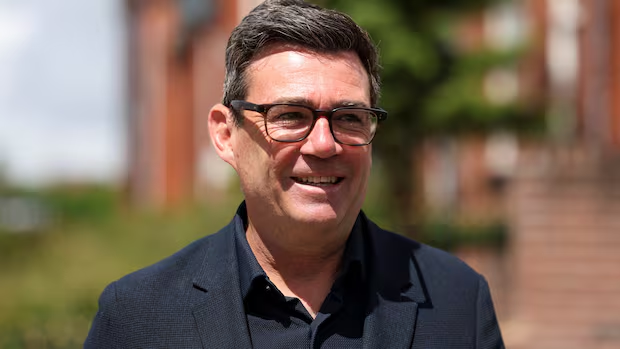
Can the 'King of the North' fix a fractured Britain?
Former Manchester mayor Andy Burnham poised to take over as U.K. prime minister
Not long after distinguished Canadian academic and prominent education leader Duncan Ivison accepted the job as president of the University of Manchester, a conversation with the city’s mayor left a big impression.
Ivison says Andy Burnham wanted to talk about the challenge of creating jobs and opportunities for young people in the city in northwestern England.
“Andy said to me: 'Hey Duncan, it's great that you're here, but you know, two-thirds of young people don't go to university in Manchester. How are you going to help them?'” Ivision said.
“He wasn't saying; 'Hey, you're not doing a good job.' He was saying: 'Look, help me help the part of the city that isn't necessarily coming through your doors,'” said Ivison, who is originally from Montreal.
“He's always connecting — the collaborative infrastructure, if I can put it that way, is very strong in Manchester. And Andy has really leaned into that.”
Fast forward two years and Mayor Andy Burnham is poised to become Prime Minister Andy Burnham on Monday July 20th after he ran unopposed for the leadership of Britain’s Labour Party, following the resignation of Keir Starmer.
Starmer's sudden exit last month has triggered a lightning-fast reordering of British politics. After leading Labour to a historic landslide victory in 2024, he struggled to spark an emotional connection with an increasingly impatient electorate.
According to Ivison, Burnham possesses precisely what his predecessor lacked: an intuitive, magnetic brand of “retail politics.”
“The ability to listen, to connect with people emotionally, to take their experience and connect that to a political program. I think Keir Starmer really struggled to do that,” Ivison told CBC News.
"If Andy Burnham becomes prime minister, you’re going to see someone who can connect with people in that sort of grassroots way.”
During the COVID-19 pandemic, Burnham led a rebellion of sorts against Prime Minister Boris Johnson’s one-size fits all lockdown rules, which Burnham claimed hurt people outside of London disproportionately.
Supporters cheered him on and dubbed him, the “King of the North,” a title borrowed from the fantasy TV series Game of Thrones that played up the theme of a northern leader challenging a dominant southern capital.
But translating local popularity into national success is a daunting task.
Burnham, 56, is Cambridge-educated and has spent almost his entire working life in or around politics at one level or another.
He was first elected as a Labour MP in 2001 and served in junior positions in former prime minister Tony Blair’s cabinet starting in 2005.
He left Westminster in 2017 to run for the newly created position of mayor of Greater Manchester, a job he was subsequently re-elected to twice.
When Starmer stumbled as prime minister and Labour began losing supporters and local elections to the surging populist Reform UK and the Green Party, Burnham announced his decision to return to the national scene.
U.K. PM Starmer announces resignation plan
He secured his path back to Parliament by winning a byelection in the Greater Manchester constituency of Makerfield last month and ran uncontested for Labour Party leader after potential rivals stood aside.
He is now expected to officially “kiss hands” with King Charles and assume the role of prime Minister on July 20.
Burnham takes the reins of a deeply fractious country of 70 million people.
The traditional dominance of the Conservatives and Labour has been broken by the upstart populist party Reform UK, a resurgent Green Party and strong showings by regional parties in Wales and Scotland.
"Can he do it on that scale? Yeah, we will see," said Ivison of Burnham’s ability to parlay his local appeal onto a national stage.
Burnham’s primary pitch to the country is "Manchesterism," a philosophy centred on the "politics of place." In his final speech as mayor in late June, he set the stage for a significant devolution, or a shift of decision-making away from London to other regions. Burnham says its only by empowering politicians, business leaders and administrators at the local level that Britain can break its downward cycle.
Under his local administration, Manchester's regional economy frequently outpaced London, driven by booms in digital media, advanced manufacturing and financial services. A report released by Manchester city council in late June says job growth over the last decade stood at 19.7 per cent — significantly higher than the national average of 13.9.
Supporters say one of his most high-profile achievements was the creation of the "Bee Network,” which brought the region's fragmented bus system back under unified public control and introduced a strict two-pound ($3.80 Cdn) cap on single fares.
For small business owners like Mark Wrigley, co-owner of the iconic Atlas Bar on Deansgate, Burnham's approach was a breath of fresh air.
"I'm sure you've heard him say, lots of people have seen him say, it's not about politics so much, it's about the place," Wrigley told CBC News. "And that's certainly how I feel he's approached his mayoralty here ... it's been more about what do we need to succeed in this place.
“Whenever I've been in conversation with him … he listens and he's very collaborative.”
One of Burnham's most widely discussed proposals for what he will do as prime minister involves decentralizing the machinery of government away from London entirely, including the establishment of a secondary "No. 10 North" office in Manchester to push out regional infrastructure investments across the U.K.
However, national governance brings severe structural hurdles that regional mayors rarely have to balance.
Critics argue that Burnham's local economic miracle was heavily cushioned by demanding financial bailouts from central government taxpayers.
Laura Evans, a prominent Conservative politician who ran against Burnham for mayor twice, cautions that the gleaming skyscrapers of Manchester's city centre mask deep, unresolved societal crises.
"Let’s take a look at his place," Evans told CBC News, gesturing toward Piccadilly Gardens, a gritty inner-city transport hub. By day, the space features plenty of food stalls and people enjoying green spaces, but at night, it can also be one of Manchester's crime hotspots.
"It’s a mess'" said Evans. "We have a lot of crime, we have a lot of issues here, drugs. He hasn't improved the situation around homelessness, rough sleeping, it got worse.”
Evans also warns that Burnham’s public transport expansion leaves a severe fiscal burden behind. Its operator carries almost 750 million pounds ($1.4 billion Cdn) of debt and transit fares fall far short of covering operating costs.
"This has gone totally on the backs of the taxpayer. That burden is now on everybody’s household council tax bill."
Furthermore, small business owners are warning that the current economic landscape leaves no room for error.
Wrigley, the bar owner, notes that recent national insurance tax hikes implemented by the broader Labour government have hit independent operators like him like a sledgehammer.
"Just for our business alone, it doubled our employers' cost in one year — so we went from paying about 27,000 pounds [$51,300 Cdn] to last year 60,000 pounds [$114,000 Cdn]," Wrigley said. "Before any of these staff do any work ... that's just the privilege of having them on the payroll. It's crazy."
Labour's Andy Burnham wins byelection, setting up showdown with Keir Starmer to lead Britain
How Keir Starmer's support evaporated in just 24 months
Even within Manchester, the prosperity has been profoundly unequal.
While billions in investment poured into the inner core, nearby rust-belt towns have seen little relief.
As Ivison observes, "it's not perfect in Manchester either. We still have some of the poorest suburbs and neighbourhoods in Europe. A quarter of young children in Manchester are living in poverty."
In fact, U.K. government data indicates the 2024-25 average child poverty rate among the six constituencies in Greater Manchester was 32 per cent. That's lower than London, which stands at 38 per cent, but still higher than the national rate.
As Burnham prepares to enter Downing Street, he finds himself facing three-way political squeeze.
He must try to satisfy left-wing Labour MPs demanding aggressive public spending, reassure volatile global financial markets through rigid fiscal discipline and protect everyday workers who refuse to tolerate further tax hikes.
"What are the tradeoffs he's going to need to make in order to get his agenda through?" said Ivison. "He knows he has to get the machinery of government to bend his agenda."
Meanwhile, the anti-immigration Reform UK party is surging heavily in working-class communities, positioning itself to capitalize on any signs of government weakness.
During his emotional Makerfield byelection victory speech, Burnham issued a stark ultimatum to his colleagues in Parliament, calling this transition the establishment's "final chance to change."
But with only three years left before a mandatory general election, Burnham will have little time to prove whether the "King of the North" can truly fix a broken kingdom.
Chris Brown is a foreign correspondent based in the CBC’s London bureau. Previously in Moscow, Chris has a passion for great stories and has travelled all over Canada and the world to find them.
Related Stories
 Business
Exclusive: A startup is betting Houston will hit 103 degrees. It hopes to lose.
1 hour ago
 Business
Small business vs. scalable company: Determining the best path forward
4 hours ago
 Business
Viral AI startup Instinct has raised $350M at a $2.5B valuation
5 hours ago
 Business
What Germany’s Startup Factory strategy reveals about scaling DeepTech ecosystems
8 hours ago
 Business
This startup sold Wall Street on AI. Its existential challenge is doing it again.
9 hours ago
 Business
Ford Fathom: Can a Startup
9 hours ago
 Business
After Eight Years Of Building Quietly, Can Raphe mPhibr Conquer The Skies With Its Long
10 hours ago
 Business
Movie Review: What's up, flop? The toon
12 hours ago