
Canada News
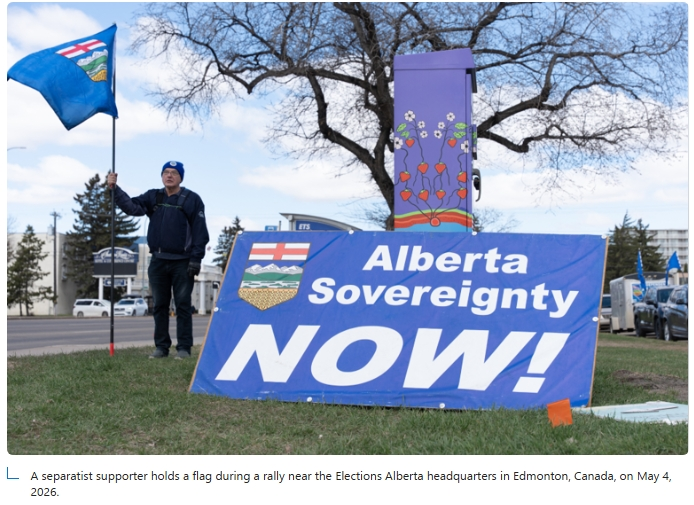
A couple of weeks ago, the BBC ran this story on the rise of separatism in Canada’s oil-rich western province of Alberta Alberta will vote on whether to remain part of Canada. What now? – AOL
The western Canadian province of Alberta will ask its citizens this October whether they want to remain part of Canada or kick-start the process of holding a binding referendum on separation, marking a major test of the country’s unity, the first in decades.
Alberta’s leader, Premier Danielle Smith, announced the coming vote on 21 May in a televised address.
She said she herself supports a unified Canada.
There has been a growing separatist sentiment in the oil-rich province in recent years, and plebiscite comes after 300,000 people signed a petition asking that a referendum be held on the matter.
The question being put to voters won’t be a simple “stay” or “leave”.
Instead, Albertans will be asked: “Should Alberta remain a province of Canada or should the Government of Alberta commence the legal process required under the Canadian Constitution to hold a binding provincial referendum on whether or not Alberta should separate from Canada?”
The referendum question is a result of a push by a group of Albertans who have been advocating for the province to be independent from Canada.
Over the past year, they held townhalls across the province to gauge interest from the public. They then launched a citizen-led petition to separate earlier this year, which garnered more than 300,000 signatures.
But the petition was blocked by an Alberta court earlier this month.
A judge ruled that Alberta, which authorised the gathering of signatures for a proposed independence referendum under a citizen petition law, failed to consult indigenous First Nations whose land would be affected should the province become an independent state.
At first glance, this seems surprisingly similar to the Brexit referendum in the UK called by the Conservatives back in 2016 that was ostensibly opposed by both the Tory and Labour leadership, but managed to narrowly pass anyway with massive covert propaganda and financial support from Putin’s Russia through the UK ‘Independence’ Party.
Fortunately, Canadians (and Albertans in particular) do not seem to be so easily deceived when it comes to breaking up the Confederation. Because of the constitutional objections raised by Alberta’s First Nations and a judge’s ruling, this vote in October will just be an ‘advisory’ vote as to whether Alberta should actually begin the legal process for a binding referendum on separation that would be held sometime in the future.
And the way things are progressing, it looks like the separatists will face an overwhelming rejection at the polls in October. Not only were 400,000 signatures submitted on an anti-separation petition called Forever Canadian (out of a total population of about 5 million Albertans), but more recent polling as reported in Newsweek is even more encouraging Support for Alberta separatism falls despite referendum: Poll
Support for Alberta independence has slipped even as the province moves closer to a referendum, according to new Ipsos polling that suggests separatist momentum is weakening as the prospect becomes more concrete.
Alberta separatism has periodically surfaced in response to tensions with Ottawa, but it has rarely translated into majority support. The latest data suggests that, as voters confront the practical implications, enthusiasm is softening rather than strengthening.
Darrell Bricker, CEO of Ipsos Public Affairs, said attitudes appear to be shifting as the proposal becomes more tangible. “It seems like the more that people contemplate this being real—the act of voting—we see the support for separatism softening,” he told Global News.
Opposition to separation also appears more entrenched. Among those backing Canada, 90 percent say their position is definite, compared with 70 percent of those supporting independence—an intensity gap that could shape turnout dynamics.
“What it shows is that people who really want Alberta to stay in Canada are really strongly motivated to vote for that,” Bricker said.
The real question here is just how much covert support the Trump administration is actually giving to this Alberta separatist movement, since potentially annexing a single resource-rich Canadian province might prove more profitable than trying to swallow the whole of Canada, and the idea of a truly ‘independent’ but land-locked Alberta is a virtual nonstarter — think of 1830’s Texas when it was still part of Mexico, but without any access to trade with the wider world.
Related Stories
 Canada
U.S. politicians condemn Trump’s ‘chaotic’ trade war against Canada
46 minutes ago
 Canada
Trump says Canada ’wants the benefits’ of being a U.S. state ’without being one’ as trade dispute deepens
47 minutes ago
 Canada
French-language, Quebec culture, non
1 hour ago
 Canada
Eastern Canada premiers renew buy Canadian calls as U.S. trade war ramps up
1 hour ago
 Canada
Police investigation underway into Lowertown death, fatal western Quebec crash
2 hours ago
 Canada
Transformer blowout in Kanata closes nearby businesses
2 hours ago
 Canada
‘We can’t run our businesses’: Canadian companies react to U.S. tariffs
2 hours ago
 Canada
Conservative MP urges government to release 'full details' of U.S. trade deal that was on the table
2 hours ago