
Canada's PM Carney says Gordie Howe bridge tolls won't be split with U.S. until the $6.4B of debt is repaid
Canada's PM Carney says Gordie Howe bridge tolls won't be split with U.S. until the $6.4B of debt is repaid
Net revenues will be split with U.S. for 15 years, Carney says Thursday in London, Ont.
Carney says splitting tolls from Gordie Howe bridge won't happen until 'all of the debt is repaid'
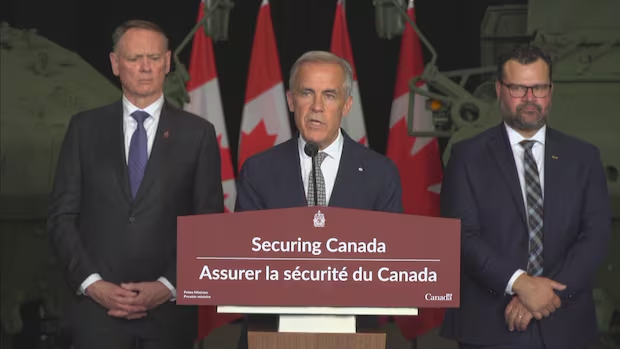
Prime Minister Mark Carney said Thursday that any money made from tolls on the Gordie Howe International Bridge won't be split with the United States until all Canadian investment in the project is repaid.
At an event Thursday in London, Ont., Carney was asked whether the $6.4 billion of investment made by Canada would be collected before profits from the bridge would be split with the U.S. side.
"It's not splitting the tolls of the bridge," Carney told journalists. "It is an agreement for 15 years to split net revenues.
"Any sharing of the toll revenue won't happen until all the debt, all of the debt, is repaid."
Carney's clarification comes after days of speculation over the state of the current deal.
The bridge connecting Windsor, Ont., and Detroit was due to open in June, but was delayed at the request of the U.S., Carney said at the time.
After weeks of talks between top officials on both sides of the border, on Friday evening, the Canadian government announced the bridge will open July 27 "with the support of the United States government."
The statement didn't provide any more information about the agreement, leaving some local opposition MPs with more questions.
"People here need to know what's going on and how is this deal supposed to work, and so far, we have scant details whatsoever," Windsor West Conservative MP Harb Gill told CBC News earlier this week.
Walking, biking across Gordie Howe bridge to start 10 days after cars, trucks
The Canadian government doesn't expect that the bridge will make a profit for some time, Carney told reporters.
The net revenues split with the U.S. will only be accrued after operational costs are accounted for.
"Those net revenues are after operational costs: it's manning the toll booths, it's maintenance, it's snow removal," Carney said. "We expect that after those costs, for the first few years, net revenues will be modest.
"In fact, we expect them to be negative as traffic ramps up."
'Underlying agreement remains the same'
Part of this agreement, Carney said, is "pro-cyclical," meaning the government expects half of the net revenue is to be reinvested into the region on the Michigan side.
"The underlying agreement we have with Michigan remains the same — no sharing of tolls until all the debt is repaid.
"It's a good deal for both sides. It gets things moving."
When pressed for detail as to whether the split of net revenues would be 50-50 between Canada and the U.S., Carney said: "The incentives are aligned here because the reinvestment in regional economic development on the Michigan side ... that's good for Michigan, but it's also good for Canada.
"It's a good deal for Canada and it's a good deal for the U.S."
Oliver Thompson is a writer, producer and musician. Originally from the UK, where he worked for the BBC, Oliver moved to Canada in 2018.
Related Stories
 Canada
Albertans head to polls in historic referendum on whether they want to stay in Canada
3 hours ago
 Canada
In the news today: four soldiers killed, Alberta referendum, AI privacy fears
3 hours ago
 Canada
How a grass fire at a Canadian military base killed four soldiers
3 hours ago
 Canada
How will household electricity rebate reduction, temporary winter pricing change impact Ontarians?
4 hours ago
 Canada
Residents told to boil tap water due to bacteria
4 hours ago
 Canada
Oil
5 hours ago
 Canada
Albertans vote on path to independence as Carney fights to keep Canada united
5 hours ago
 Canada
Two of 4 soldiers killed in fast
6 hours ago