
Canada’s research backbone at UVic receives a $16.7 million reboot
Canada’s research backbone at UVic receives a $16.7 million reboot
Published 5:45 am Tuesday, June 23, 2026
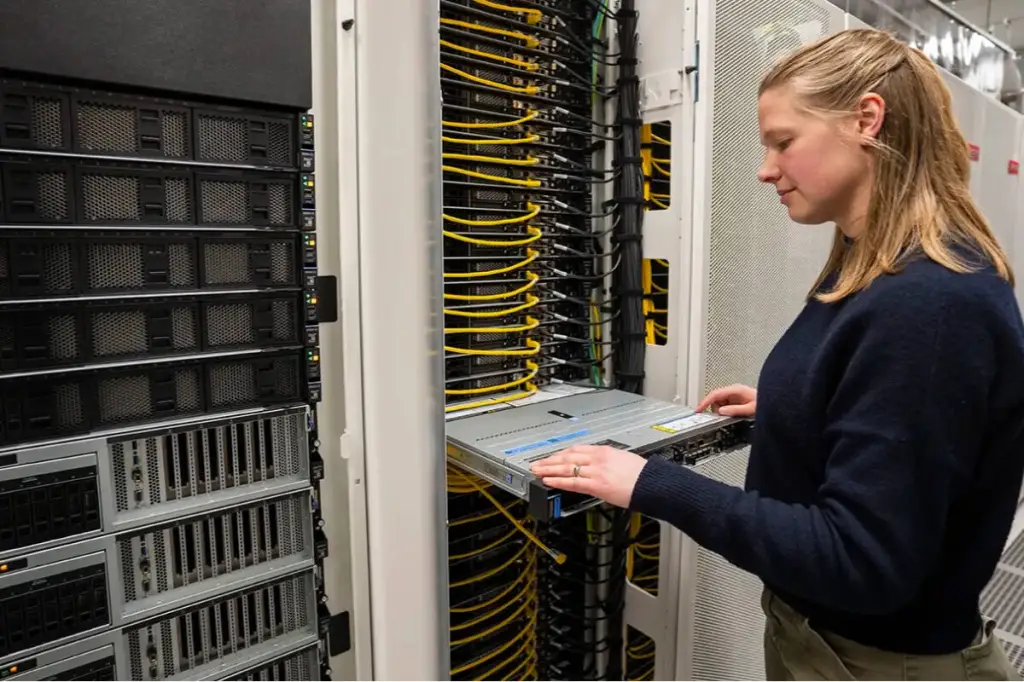
Sarah Huber at UVic Research Computing Services is part of a team that designed and built the Arbutus Cloud computing facility. (Courtesy of the University of Victoria)
University of Victoria’s Arbutus Cloud has served as a critical backbone for Canadian research since 2016, supporting thousands of projects ranging from prize-winning physics experiments to massive-scale astronomical data processing.
The cloud received a $16.7 million infrastructure reboot this spring, and the facility, which facilitates over three million user interactions annually, is now faster and more energy-efficient.
Arbutus Cloud originally grew from a precursor cloud called West Cloud in 2016. It is nationally funded with the contributions of the federal government, the provincial government, and through the Digital Research Alliance of Canada.
Apart from university students, faculty members, and librarians, the entire research community across Canada benefits from the cloud to conduct their research and store their data.
“We’ve got about a little more than 1,000 research projects that are hosted on Arbutus, and each of them has any number of contributors, so it’s probably closer to 3,000 or 4,000 individuals that are using the cloud service,” manager of advanced research computing infrastructure at UVic, Jeff Albert, told Saanich News.
Many of the users are running portals or shared services through the resources they received from Arbutus, which can have thousands of international users as well.
Director of research computing services, Ryan Enge, added that their annual reports show nearly three million unique users from around the world access their platform in a given year.
“And we expect that number is actually quite a lot higher than that. It’s just a very conservative number,” Enge added.
In Canada, there are very few other sites that are similar to the Arbutus cloud. Albert explained that there are a couple of regional clouds operated by other institutions regionally, such as the Juno cloud in Quebec, which is a bit smaller than the Arbutus.
Each of the other national hosting sites has a small cloud component to them, and internationally, the US Jetstream 2 cloud is somewhat comparable to Arbutus, which runs a similar software stack.
“I guess the Australian Nectar cloud would be a good comparator as well, similar software stack, about the same scale.”
Over the years, the Arbutus Cloud has contributed to significant international collaborations. One such major project the duo could think of was the Large Hadron Collider (LHC) physics project in Switzerland.
Since the project creates so much data that cannot be processed on the site in Switzerland, they distributed it internationally, including on Arbutus.
They are also working with the Canadian Astronomical Data Centre based in Saanich, providing them with computer resources to support astronomy research.
The cloud will be a part of creating the largest radio telescope ever made by humans by providing its services to the centre. They expect it will produce more research data than just about any scientific experiment ever.
A recent upgrade to the cloud has now been completed and rolled out into production for users in the spring this year.
Albert revealed that the $16.7 million investment helped replace all of their hardware equipment, which had been in use since its inception.
“It’s a very long time to keep equipment online. We do that because we want to keep that equipment available to researchers, keep them able to do their research on it, even though those machines are probably quite a bit older than you’d normally want to run.”
When this multi-year funding proposal was approved through the federal government and then through the alliance, they made plans to replace all of the equipment at once.
“One of the big benefits of the upgrade is that the system is a lot more energy efficient per the amount of compute power that we have,” Enge said.
“Now this is an opportunity to completely refresh the infrastructure and provide much more computing power to the researchers, but also in a more efficient way.”
“We’ve been strong proponents of having these types of services for Canadian researchers in Canada and running on open source software…things that are really key to the research ecosystem,” Jeff added.
Related Stories
 Technology
When Tech Companies Die, What Happens To The Products They Leave Behind?
6 days ago
 Technology
Two Finns supplying Russia with missile tech worth tens of millions
6 days ago
 Technology
Drones with pepper spray, four
6 days ago
 Technology
Micron Technology stock pre-market at EUR 800.50: memory storage - ad
6 days ago
 Technology
TAIEX Ends at 4
6 days ago
 Technology
ZAWYA: Technology, start-ups can double India
6 days ago
 Technology
Czech government to consider CZK 1 billion fund for startups
6 days ago
 Technology
GDIN Supports Eight Startups at CEATEC 2026 in Japan, Opens Door to Local Investor Collaboration
6 days ago