
Canada's spy agency shakes up hiring process to 'meet operational needs': documents
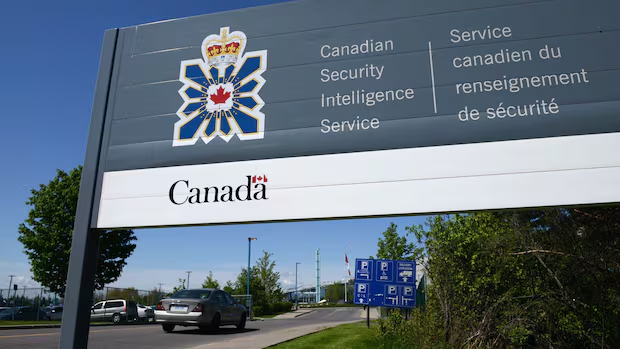
Canada's spy agency shakes up hiring process to 'meet operational needs': documents
Onboarding at CSIS can take 12 to 18 months
The Canadian Security Intelligence Service is shaking up its hiring process to meet operational needs, internal emails show — a signal the service continues to face recruitment issues.
CSIS brought in a suite of changes earlier this year to "meet operational needs and emerging demands," according to documents obtained by CBC News through an access to information request.
"These changes represent a shift in how we recruit, classify, deploy and empower our people," reads one of a series of emails sent to managers at CSIS.
"These developments and initiatives will enable us to be more efficient and effective … and better positioned to meet the demands of our changing, more challenging environment."
Most of the changes are aimed at addressing "structural bottlenecks," increasing external hires and making changes to shorten the time between recruitment and operational deployment, according to the documents.
CSIS may have misused power to commit offences: watchdog
Ottawa will look into screening processes amid NATO intern spying allegations
That includes setting up a new team dedicated to external recruitment to bring in people "efficiently and responsibly," the documents say.
As of March 2026, CSIS's hiring ratio is 85 per cent internal appointments to 15 per cent external hires, the documents show. The emails tell managers to strongly consider external talent for certain skilled positions.
Unlike other government positions, most jobs at CSIS require enhanced top secret clearance — a rigorous process diving deep into a candidate's personal background, character, family history and financial history that can take 12 to 18 months.
CSIS looking to outsource more tasks
While sections of the documents were heavily redacted, they also show a push to accelerate deployment.
Changes would see candidates apply directly to their region of choice which CSIS says would enable targeted hiring for regional vacancies. It's also bringing in adjusted official language requirements "where appropriate," and shortening training classes," according to the documents.
"It will empower us to recruit individuals who can fill critical vacancies in regions that will augment our operational capacity," reads one of the emails.
The documents show the secretive and often insular agency is looking to outsource recruitment steps including some screening, targeted recruiting and psychological assessment services.
Canadian NATO spying suspect raises questions about country’s security screening
The service has already increased its use of outsourced, standardized written testing tools to streamline the testing process. It's also restructuring how it bridges co-op students into full-time positions, it said.
CSIS is looking at acquiring new technology that "enables recruitment," but there are few details about what that could look like.
The service didn't answer questions about how many employees it needs to hire but said it's seeking to fill vacant positions for intelligence officers, engineers, analysts, IT and communications professionals "and more."
"CSIS faces growing demands due to evolving security threats, including espionage, foreign interference and terrorism," said spokesperson Magali Hébert.
"To date, CSIS has continued to have high levels of qualified applicants for its work, and recruitment efforts have garnered positive results."
Staff shortages pose risk: former analyst
Stephanie Carvin, a former CSIS analyst and now an assistant professor at Carleton University, said recruitment and retention "has for a long time been a priority concern" at the service.
"Its unique value is that it has human intelligence officers going out, speaking in the community, getting information, developing relationships, developing sources. It can't do that without people," she said.
"When you have staff shortages, you have people working overtime, they burn out, they get tired and that is a risk for the organization."
As an intelligence agency and Five Eyes partner, onboarding at CSIS is always going to be a long and "demanding" process, said Carvin, but "attempts to find efficiency are welcome."
"Someone can quit with two weeks' notice, but at the same time, it can take somewhere between a year and two years to replace them given the security requirements," she said.
"The demands on the service have probably never been greater, but at the same time, the ability to bring people in largely the same as they were in the 1980s."
A further sign the agency is worried about its staffing is its initial move to bar employees from taking the government's early retirement incentive. As CBC News reported in April, CSIS and other security agencies like the Communications Security Establishment, signalled to employees that it wouldn't accept applications citing "continued operational pressures and growth requirements."
The National Post reported that Privy Council Clerk Michael Sabia then stepped in, leading to both agencies walking back their approach. According to a source who spoke to the Post, Sabia sees the early retirement offers as "a golden opportunity to breathe fresh air into the mid- to senior-levels of the public service and promote younger bureaucrats."
CSIS Director Dan Rogers, who took the reins in late 2024, has made culture change one of his top priorities.
As part of changes to the service, he brought in a new executive lead in recruitment and staffing in February, the emails shared with CBC News show.
"Welcome to the new role, I hope I didn't scare you off earlier today :)," Rogers wrote in an email.
"Given that context, you've got a very important job for the service — so glad you decided to take it on."
Related Stories
 Careers
‘The enemy is tearing our city apart’: terror in Kyiv as Russia ramps up attacks
7 hours ago
 Careers
Witnesses detail horror of Tennessee woman’s botched execution: ‘None of it was normal’
13 hours ago
 Careers
Stop the Steel? Iowa approves $1.36 billion for foreign
15 hours ago
 Careers
Axe-wielding FlyDubai co
16 hours ago
 Careers
Prison chief in Christa Pike case oversaw five ‘botched’ executions, lawyers say
18 hours ago
 Careers
Flydubai co
19 hours ago
 Careers
Congress plans to bring INTUC back into Haryana mainstream politics
21 hours ago
 Careers
Woman in fake nurse case narrowly escapes arrest warrant after 6th postponement
1 day ago