
Canadians design bubbly floating solar for icy lakes
Canadians design bubbly floating solar for icy lakes
Also: Could cities recycle heat produced by data centres?
Welcome to our weekly newsletter where we highlight environmental trends and solutions that are moving us to a more sustainable world.
Hi, it's Emily. I've been interested in the idea of floating solar and disappointed that we never see it here in Canada. So I was excited to hear about Canadian researchers' new ice-resistant floating solar design.
Solar panels that float on lakes, reservoirs and other bodies of water are growing in popularity around the world, from Japan to France to Paraguay. They can generate clean energy without taking up valuable space on land.
Despite that, such "floatovoltaics" remain rare in Canada, although they have been tested. A previous issue of this newsletter examined the reasons, including the challenges posed by northern winters.
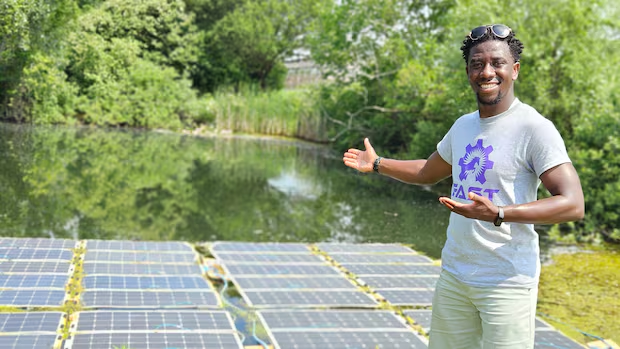
Koami Soulemane Hayibo, a postdoctoral researcher at Western University in London, Ont., said most floating solar installations around the world have been deployed in warmer climates.
In Canada, he said, "your main challenge is going to be winter ice formation."
Hayibo and his colleagues designed a floating solar system intended to prevent ice from forming. They tested it on an artificial pond in southwestern Ontario and published their results in the journal Applied Energy.
Hayibo said he became interested in solar because of its potential to bring inexpensive, clean energy to places such as Togo, where he grew up and where electricity was a luxury many people did not have.
But while the price of solar panels has fallen, the metal racks used to mount them on land remain expensive.
"That's where we can reduce the price more," Hayibo said.
Solar panels floating on water do not need metal supports, but traditional floats and anchors can also be costly. In Hayibo's experiment, the panels were attached to inexpensive plastic foam.
When ice builds up and weighs down the foam, however, it can extend over the panels and prevent them from generating electricity.
To avoid that problem, Hayibo and his team suspended bubblers — similar to those used to aerate aquariums — about 30 centimetres below the panels. The devices pushed warmer water to the surface and kept it moving, preventing ice from forming.
The researchers calculated that running the bubblers could consume up to 14.5 per cent of the electricity generated by the panels. However, floating solar panels typically generate more electricity than comparable land-based panels because the cooling effect of the water improves their efficiency.
The researchers estimated the net cost of the electricity generated at about three cents per kilowatt-hour, similar to other solar installations in Canada. That was despite the system's small size — seven kilowatts, roughly equivalent to a small rooftop array — and the fact that it had not yet been optimized for efficiency.
The researchers are now testing the water to determine whether the foam is shedding microplastics. They are also working to optimize features such as the angle of the panels to prevent snow buildup.
Hayibo said the technology could be scaled up and used to generate power at former mines or pumped-storage hydro facilities, as well as at reservoirs or ponds where evaporation is a concern, since the panels can reduce water loss.
It could also potentially be used on a smaller scale, such as in backyard pools and ponds that are not in use — "anywhere that people will need a tarp to cover a surface," Hayibo said.
Ibrahim Dincer, a professor at Ontario Tech University, has previously proposed using floating solar panels to power ferries in Toronto Harbour and provide local electricity to remote communities. He said the solution being tested by Hayibo and his colleagues is "really interesting."
Companies that make floating solar arrays already offer other solutions for cold climates, Dincer said, such as leaving a large gap between the panels and the surface of the ice.
Solar-powered aerators beneath floating panels have also been tested for other purposes, including aquaculture and improving water quality.
Whether this new variation succeeds, Dincer said, will depend on whether it can be commercialized.
Old issues of What on Earth? are here. The CBC News climate page is here.
Check out our podcast and radio show. In our latest episode: As Europe tallies thousands of deaths, there are calls for way more AC. In North America, where a heat dome is disrupting holidays, air conditioning is common — but it can also contribute to inequity and emissions. As a chief heat ambassador, Jane Gilbert is grappling with this paradox. She shares ways to protect lives as climate change heats our world.
What On Earth drops new podcast episodes every Wednesday and Saturday. You can find them on your favourite podcast app or on demand at CBC Listen. The radio show airs Sundays at 11 a.m., 11:30 a.m. in Newfoundland and Labrador.
Check the CBC News Climate Dashboard for live updates on record-breaking weather and current conditions across the country. Set your location to find out how today's temperatures compare to historical trends.
Last issue, we featured a story about street-legal electric carts.
Patt Dodd sees "many good uses" for such carts but asks: "What about winter and rainy weather?"
Tasha Maynard of HeYa carts said the open-air design is optimized for sightseeing, but the car's roofs, laminated windshields and windshield wipers offer protection from rain and winter weather.
"Our vehicles do not have doors or heaters because they were designed for tourism," she said. "In winter, tourists do still rent them, but a larger share of use shifts to logistics for large events, parking lot shuttles and film productions."
Cody Eaton from Albion Golf Cars said his company offers hard-cab door options for winter, as well as fitted soft-vinyl enclosures for rainy cities such as Vancouver. The vehicles do not have four-wheel drive, which limits their use to conditions with only a few centimetres of snow and arguably makes them more of a seasonal "city" vehicle, he added.
Glori-Jeanne Stephenson of Calgary wrote: "I don't think these carts are very safe. They are still on the road with regular vehicles, and the passengers have very little protection."
Eaton said: "These are street legal for a reason. They are designed to take crashes and impacts at certain speeds."
He noted that they can be driven only in zones where the speed limit is 40 km/h or less.
"In this environment, driving an LSV is a very safe and relatable auto substitute," he said.
Eaton said LSVs have rollover protection, which "normal" golf carts do not. They also have seatbelts, turn signals, hazard lights and brake lights.
Maynard said they also have mirrors, a horn and an emergency brake.
She added that safety should not be discussed solely from the perspective of the people inside the vehicle.
"We also need to ask what kind of vehicles we want moving through neighbourhoods full of pedestrians, cyclists, children and other vulnerable road users," Maynard said. "Vehicle size and speed matter, and for many short local trips, a smaller, lighter, speed-limited vehicle can be a better fit than a full-sized car, SUV or van."
Elizabeth Carswell of Uxbridge, Ont., shared a photo of an electric vehicle she uses in her garden she likens to a "tiny dump truck."
"I have a lot of garden and enjoy the work but some days have too many steps," she wrote.
The "quiet and clean smelling" garden vehicle helped her clean up bushes damaged by heavy snow last winter. The photo shows her husband, Don Carswell, using it to build the foundation of a playhouse for the couple's grandchildren.
Write us at whatonearth@cbc.ca (and send photos there too!)
The Big Picture: Lot full of bikes
If you wanted free parking near Toronto Stadium or the city's Fan Festival during the FIFA World Cup, you were in luck — provided you travelled by bike. The city offered bike valet service at three locations, with "unlimited docking capacity and extra bikes" from Bike Share Toronto.
The photo above shows two staff members at the Inukshuk Park valet on June 12, the day Canada played Bosnia and Herzegovina. They were there to help soccer fans easily pick up and park bikes. Personal bikes were also eligible for free valet service.
On each match day in Toronto, the valet locations handled about 2,000 rides.
"They were huge," said Rita Mezzanotte, a spokesperson for Bike Share Toronto.
Bike-sharing services have grown rapidly in cities across Canada, and Toronto's system was a key part of the city's strategy to manage traffic during the World Cup.
In addition to the bike valet service, it offered weekly bike-share passes that proved popular with visitors. Out-of-towners bought three-quarters of those passes, Mezzanotte said.
The strategy seemed to work. On June 12, cycling activity near Toronto Stadium was up 65 per cent compared with the previous four weeks. On June 13, Bike Share Toronto set a single-day record of 49,048 rides.
Transit ridership and pedestrian traffic also increased, while traffic volume on the city's expressways was 10 to 30 per cent lower than usual on match days.
Hot and bothered: Provocative ideas from around the web
As Hamilton and other communities grapple with how to manage data centre developments, concerns have been raised about the heat such facilities generate.
The densely packed chips within the structures that store, process and distribute digital information produce a lot of heat. Depending on the way data centres are cooled, that heat could be released into the surrounding area.
However, a McMaster University professor says that if managed correctly, the heat generated by data centres, restaurants, power plants and other buildings could be a valuable resource.
James Cotton, who's with the department of mechanical engineering, said reusing waste heat — or energy harvesting — is "an excellent decarbonization strategy" and "something that you're going to see an awful lot of" in relation to data centres.
At a May talk before parliamentarians and policymakers in Ottawa, Cotton said 70 per cent of the energy used by buildings in Canada goes toward space and water heating. Much of that heat, which comes from electricity and natural gas could be displaced by waste heat, he said.
Energy harvesting would mean retaining that excess heat in liquid and then piping it to other locations where it could be used to warm water or spaces.
Cotton co-directs the McMaster Institute for Energy Studies and leads Harvest Systems Inc., a company spun out of his research at the Hamilton university. Harvest focuses on reusing heat produced by cooking appliances at restaurants.
Cotton told CBC Hamilton he's previously worked with s2e Technologies — the company proposing a data centre to McMaster for the former newspaper building it owns on Frid Street. He also has a longstanding partnership with Hamilton Community Enterprises (HCE), which is supportive of a local industrial redevelopment that could include data centres.
Data centre proponents suggest reusing heat
With Hamilton city council working toward a pause on data centre development — in part due to community concerns about the rapidly growing sector — the near-term future of two proposed data centres in Hamilton is uncertain.
However, proponents of both have said they're interested in recapturing heat generated by future data centres that would be used elsewhere in the community.
Milfred Hammerbacher, CEO of s2e, previously told CBC Hamilton his company is looking at using waste heat from the data centre it wants to build to power neighbouring heat pumps. Cotton said that could be a research opportunity for him and his team.
Slate Asset Management, an infrastructure and real estate investment company, has also said it is "exploring data centre uses" for a portion of a waterfront development called Steelport. On its website, Slate says Steelport is working with collaborators, including city-owned telecom and energy company HCE, to study the possibility of recapturing heat generated by data centres "offering a cheap source of decarbonized waste heat for Steelport tenants, and with the potential to provide waste heat back to the downtown core."
HCE completed a study in 2025 that found reusing heat from Bayfront industrial buildings "is both technically feasible and commercially viable."
If designed poorly, Cotton said in the Ottawa talk, data centres could create heat islands, raising nearby temperatures. However, he said, a better way is possible.
Cotton said a massive data centre at Steelpot could be designed in a way to harvest waste heat for use in residential buildings throughout the industrial area and in Hamilton's downtown.
Energy harvesting slow in Canada
In an interview, Cotton said his team mapped 22 data centres globally, including in Markham, Ont., that are reusing heat. He noted a supercomputer in Waterloo, Ont., is also recycling heat.
A March 2026 report by the MaRS Discovery District looked at recovering waste heat as one of several ways of mitigating emissions from data centres, and "reducing system‑wide heating demand and emissions."
The report recommends that policymakers establish requirements for data centre projects to mitigate energy use using technologies including waste heat recovery.
Critics of data centre developments in Hamilton have voiced concerns about whether companies will really make use of the best technologies available to green their operations.
On June 24, Ward 3 Coun. Nrinder Nann — who moved the data centre moratorium motion — said pausing development will give time for municipal leaders to decide how they want data centre operators to do business. Sustainability and renewable energy should be baselines for new developments, she said.
Overall, Cotton said, energy harvesting has experienced slow adoption in Canada. In his Ottawa presentation, he said there are 217 thermal networks delivering heat as hot water, making up 2.2 per cent of the country's heating supply. Europe, he said, has more than 6,000, serving more than 100 million people.
"It's feasible. It just has to be done," Cotton told CBC. "I think that the opportunity to do it is right here in Hamilton and to be a leader for the entire country."
Thanks for reading. If you have questions, criticisms or story tips, please send them to whatonearth@cbc.ca.
What on Earth? comes straight to your inbox every Thursday.
Editor: Emily Chung | Logo design: Sködt McNalty
Related Stories
 Canada
Brits Take Home Pair of Titles at J300 Repentigny; Latak Surprises Boys’ Singles Field
32 minutes ago
 Canada
Japan cruise past depleted Canada in Niigata
32 minutes ago
 Canada
A Michigan Democrat wants to put Canada on the ballot during the midterms. Are voters listening?
33 minutes ago
 Canada
5 ex
1 hour ago
 Canada
Death threats reported in red route row
1 hour ago
 Canada
Sister denies detained Ontario university student is Chinese spy
2 hours ago
 Canada
Jerry Dobrovolny out as CAO of Metro Vancouver Regional District
2 hours ago
 Canada
Has Saskatchewan's government sufficiently addressed school concerns?
3 hours ago