
Carney courts Saudi Arabia as U.S.
Resumption of hostilities puts a crimp in PM's charm offensive
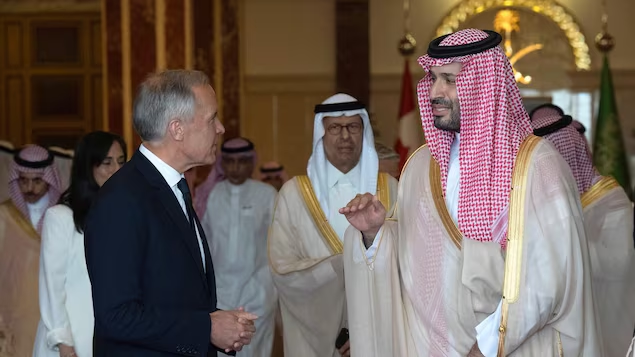
Prime Minister Mark Carne speaks with Saudi Arabia's Crown Prince Mohammed bin Salman on Thursday, the first visit by a Canadian prime minister to the country in over two decades.
Photo: The Canadian Press / Adrian Wyld
Murray Brewster (new window) · CBC News
Prime Minister Mark Carney held high-level talks in Saudi Arabia on Thursday against the backdrop of a crumbling ceasefire in the United States' war with Iran.
After meeting with Crown Prince Mohammed bin Salman, the prime minister argued that Canada needs to engage with key players in the region as hostilities between the U.S. and Iran resumed in recent days.
It's a very fragile, tense situation, Carney told reporters following his meeting with the country's de facto ruler.
One of the key influencers [in the region] is the Kingdom of Saudi Arabia. That's why we're here talking to them, not sitting in front of a lectern, lecturing them.
Carney suggested that there were ambiguities in the original ceasefire framework that may have contributed to its downfall.
The prime minister had called the agreement a "game changer" when he first saw it (new window).
Carney smiles as he takes part in a welcome ceremony in Jeddah on Wednesday.
Foreign minister Anita Anand delivered Canada's sympathy and support during a meeting with her counterpart earlier in the day following an attack Tuesday on a Saudi ship in the Strait of Hormuz. The tanker and a Qatari vessel were damaged in the missile strikes.
We have to make sure that peace is maintained and the Strait of Hormuz is open and freely navigable, said Anand, who spoke with journalists travelling with the prime minister.
There were other fresh confrontations overnight (new window) as the U.S. resumed its air campaign against Iran.
Kuwait and Bahrain both said their air defences responded to hostile missile and drone attacks early Thursday, only hours after the Iranian military vowed to respond to another wave of U.S. airstrikes against Iran.
Anand said she expressed Canada's unwavering support in her meeting with Prince Faisal bin Farhan Al Saud.
Canada agrees … that Iran's attacks on civilian vessels are completely unjustified, Anand said. They should not be allowed to stand.
WATCH | Carney visits Saudi Arabia:
Canada has very little, militarily, to contribute to the defence of the kingdom, but Anand said it remains ready to help with demining the strait once a permanent ceasefire is achieved.
She continued to hold out hope that a deal was still possible despite U.S. President Donald Trump's remarks at the NATO summit on Wednesday (new window), when he declared the ceasefire over and his lack of interest in speaking with the Iranians.
Trump said he will technically allow negotiators to continue talking, but dismissed further negotiations as a waste of time.
The resumption of those hostilities is putting a crimp in Carney's visit and the attempt to put Ottawa's relationship with Saudi Arabia on firmer ground.
Dennis Horak, a former Canadian ambassador to Saudi Arabia, who was expelled after the Trudeau government's human rights criticism of the Saudis, says ties between the two countries began to improve two years ago (new window) and that Carney's visit was meant to signify that we're back on normal footing.
Relations between the two countries went into a deep freeze in 2018 mostly over human rights.
The Global Affairs Canada Twitter account had published a tweet expressing grave concern over the arrests of civil society and women's rights activists in Saudi Arabia, specifically demanding their immediate release.
Canada framed the statement as an expression of its feminist foreign policy and universal human rights, but the Saudi Ministry of Foreign Affairs sharply rejected the view, calling it unacceptable and blatant interference in its domestic judicial affairs.
WATCH | Carney on relations with Saudi Arabia:
When pressed on human rights concerns in Saudi Arabia on Thursday, Carney argued that engagement is not endorsement but suggested it can affect change.
Lecturing countries from afar is an ineffective strategy. It's satisfying but it's ineffective. Engagement can be effective. It doesn't mean it's always, it doesn't mean it's decisive, but it can be effective, he said.
Anand said she raised human rights and consular cases during her meeting, the most high-profile of which involves blogger Raif Badawi who remains trapped in the kingdom and unable to be reunited with his Canadian family.
Carney suggested multiple times that he's hoping to court Saudi investment in Canada.
Jeffrey Steiner, of the Canada-Saudi Business Council, said there has been tremendous advancements by the kingdom over the last several years when it comes to women in the workforce and removing many ancient traditions.
It doesn't always get as much attention as it should, Steiner said. There is no question the Kingdom of Saudi Arabia has learned about certain Canadian values and when those are properly communicated in a friendly and trustful way. This is the way to influence our friends and neighbours.
Thomas Juneau, a Middle East expert and researcher at the University of Ottawa, said the kingdom has enormous regional clout and taking a pragmatic view seems to be Canada's current approach.
It is absolutely true that Canada, the United States, and our other allies have had a number of disagreements with Saudi Arabia over the years, said Juneau.
Human rights is one of them, but it is far from the only one. The United States has always come back to Saudi Arabia simply because it cannot avoid it. So the choice that governments in Canada or elsewhere have to make is whether they accept Saudi Arabia as it is or try to change it, which will not work.
Murray Brewster is the senior defence writer for CBC News, based in Ottawa. He has covered the Canadian military and foreign policy from Parliament Hill for over a decade. Among other assignments, he spent a total of 15 months on the ground covering the Afghan war for The Canadian Press. Prior to that, he covered defence issues and politics for CP in Nova Scotia for 11 years and was bureau chief for Standard Broadcast News in Ottawa.
Related Stories
 Canada
Measles outbreak declared over in Manitoba
28 minutes ago
 Canada
Most Albertans expect to vote on separation again, new polling suggests
28 minutes ago
 Canada
Ottawa threatens forced sale of Stelco’s assets warning ‘they must keep the jobs in Canada’
1 hour ago
 Canada
'I'm the first one in the family to kind of make this decision': The Brits who dreamed of Canada and finally took the leap
1 hour ago
 Canada
‘Albertans are not quitters’: Poilievre pushes referendum vote to stay in Canada
1 hour ago
 Canada
Trudeau government advised it would be expected to carry out ICC arrest warrants, including for Netanyahu
1 hour ago
 Canada
Supreme Court decision says sexual history relevant in some cases
2 hours ago
 Canada
PM Carney wraps up pro
2 hours ago