
Carney government introduces mega
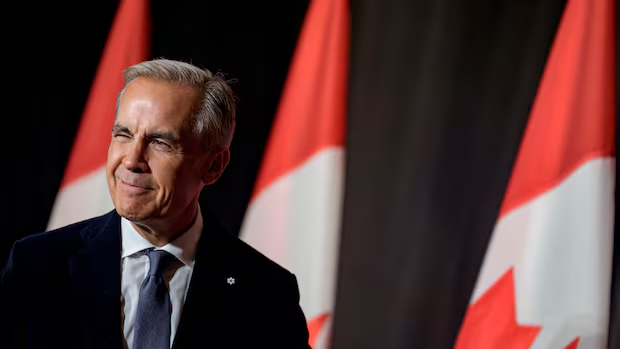
Carney government introduces mega-deduction tax measure to spur more investment
Announcement expands on previous tax deduction announced in last year's budget
The government announced a major tax reform at the Canada Investment Summit that will allow businesses to write off investments in a number of sectors.
The productivity mega-deduction will allow companies to expense the total cost of new investments across a number of sectors, including machinery, equipment, clean energy, zero-emission vehicles and more.
"Our goal is simple to make Canada the most attractive place in the G7 to invest," Prime Minister Mark Carney said at the summit.
The program is an expansion of the government's earlier productivity super-deduction outlined in last year's budget, which initially extended to a limited selection of investments in things like equipment, machinery and technology. That meant only about 15 per cent of possible investments were covered initially, but the prime minister said the expansion means two-thirds of assets will now be eligible.
In the past, Canadian companies have been able to recoup costs over the lifetime of a project, said Randall Bartlett, deputy chief economist at Desjardins. But this program gives that money back immediately, which could free up investors to put more money into new projects.
"This is meant to provide significant incentives for companies to invest and invest very quickly," Bartlett said.
He said that makes Canada very competitive on the tax front compared to other countries. The government says the change would slash Canada's marginal effective tax rate — a measure of tax on businesses used to compare tax competitiveness between nations — from 13 per cent down to 6.4, making it the lowest of any country in the G7.
And that could be a big help especially amid the trade war, Bartlett said. It could give companies a reason to stay in Canada, rather than moving production south of the border, and help them make investments they've been holding off on due to uncertainty.
But it will also cost an estimated $36 billion over five years. Bartlett said revenue brought in from high oil prices means the extra government spending isn't too much of an issue in the short run, but the government will have to make sure it has the coffers to sustain that kind of spending long-term.
Abby Hughes is a writer with CBC News based in Toronto. Originally from Orillia, Ont., she studied journalism at Toronto Metropolitan University. She covers news from the worlds of business, entertainment, health, science and education, and her favourite stories focus on the real people in those areas — the customers, fans, patients, citizens and students. You can reach her with story ideas at abby.hughes@cbc.ca.
Related Stories
 Canada
Jason Kenney links stunning UCP byelection loss in Calgary to Alberta separatism vote
31 minutes ago
 Canada
Canada to seek private investment in major airports, says Carney
59 minutes ago
 Canada
Captain Alphonso Davies, goalkeeper Max Crepeau to miss Canada's World Cup homecoming games
1 hour ago
 Canada
Restaurants are implementing these strategies to survive the trade war as tariffs eat their bottom line
1 hour ago
 Canada
Union warns workers paying price of Canada
2 hours ago
 Canada
Who pays for Canada’s tariffs on U.S. goods? Experts break down the real cost
2 hours ago
 Canada
Missing B.C. skyrunner 'remains among the mountains,' family says after search
2 hours ago
 Canada
Calgary man charged for alleged YouTube threat to kill Carney, RCMP says
2 hours ago