
Chemistry graduate student wins Fulbright Canada Scholarship
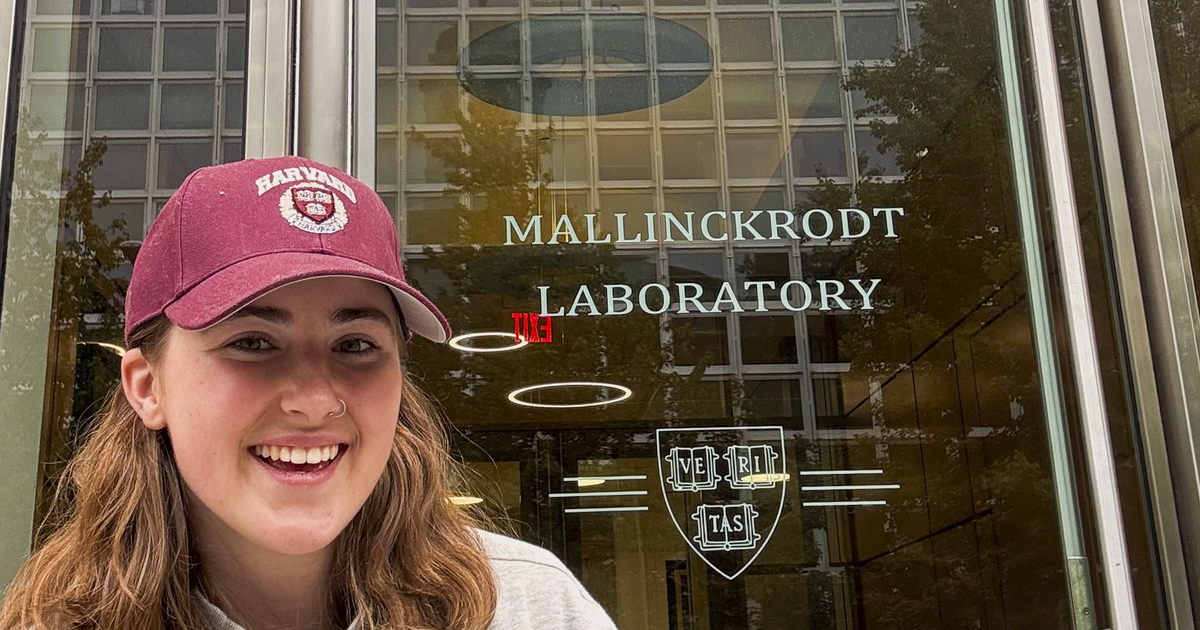
Chemistry graduate student wins Fulbright Canada Scholarship
A PhD student researching safer, more powerful batteries is one of the first from the University of Calgary’s Faculty of Science to win a prestigious Fulbright Canada Scholarship.
Alexandra Hankins, who recently completed her first year of studies in chemistry, has started her academic year on exchange at Harvard University in Cambridge, Mass.
“When I got the email saying that I had been accepted for this year’s cohort, I was really shocked,” says Hankins, who recently completed her first year of study with Dr. Gabriel Ménard, PhD, in the Department of Chemistry.
“I’m super psyched to go to Harvard. I’ll be working with Dr. Ted Betley, who’s well known in the field.”
The Fulbright Program is one of the most prestigious international exchange programs in the world. Based in the United States, international award winners receive scholarships or grants to study and conduct research at leading U.S. post-secondary institutions.
The program’s mission is to improve intercultural relationship through the mutual exchange of people, knowledge and skills.
During her exchange, Hankins will study safer alternatives for long-term energy storage.
“I’m focusing on redox flow batteries, which are built differently than the kind of battery people are generally familiar with,” she says.
Commercial lithium-ion batteries store power in solid form, which allows them to be compact and lightweight. However, these batteries have a limited lifetime and can be flammable or explosive under certain conditions.
Redox flow batteries store their energy in a liquid solution, which is a safer option for long-term energy storage.
“The solutions we use in these batteries can store massive amounts of power, but they need to be kept in these huge tanks, which is challenging to find room for,” Hankins explains.
Hankins will work off existing research being done at Harvard, where she will study pre-existing molecules invented by the Betley Lab.
“He’s got these iron clusters that he’s very famous for, and some structures where he’s really focused on designing specific features into molecules, so they have certain properties. They’re very energetically active, which makes them good candidates for these battery systems,” she says.
“It’s going to be a three-step process. First, I’ll make these molecules, then I’ll be testing whether they’ll be good candidates for this battery project, and if they are, I’ll be putting them into prototypes to see how they really work.”
Hankins will be spending eight months at Harvard, during which time she also hopes to train for — and run — the Boston Marathon.
“I’m a former varsity athlete in cross-country and track and field, and I guess I just don’t know when to stop!” she jokes. “I’m so eager to try to experience everything I possibly can.
“The Fulbright is something that I’ve been dreaming about for a while, ever since I heard about it for the first time. I knew early on that I wanted it to be part of my grad school journey.
“This year is looking very exciting for me, and I feel like all my hard work is coming to fruition.”
Related Stories
 Canada
Seven U of A standouts named to Royal Society of Canada
53 minutes ago
 Canada
Royal Society of Canada honours UVic scholars
1 hour ago
 Canada
Seven SFU researchers honoured by the Royal Society of Canada
1 hour ago
 Canada
'It's been an absolute nightmare,' says man whose daughter was killed in Manitoba crash
1 hour ago
 Canada
Vietnamese firm targets Canadians with fake AI news for profit, CBC/Rad-Can investigation reveals
1 hour ago
 Canada
‘Wicked’ Will Get the Orchestra Treatment on Live-to
1 hour ago
 Canada
Natalie Harp, White House aide known for carrying portable printer for Trump, receives US$45K gift
2 hours ago
 Canada
Canada faces more U.S. trade war escalation
2 hours ago