
Climate change past the point of no return, UN says, as worst impacts are now unavoidable
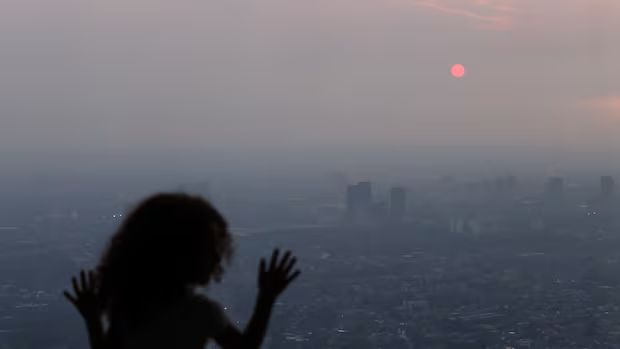
Climate change past the point of no return, UN says, as worst impacts are now unavoidable
Global warming guaranteed to exceed 1.5 C limit and stay that way for 'many, many decades'
In a strategic retreat in the fight against climate change, the United Nations has acknowledged that Earth has lost its chance to prevent some of the worst of global warming's harms. Officials say the world must now figure out how to get temperatures below the danger zone and back to safety.
The planet will soon exceed the safe temperature threshold agreed upon in the 2015 Paris climate accord because of warming from the burning of coal, oil and gas, according to a bleak first-of-its-kind report issued by the United Nations Environment Program on Wednesday.
Instead of giving up, scientists and UN officials recommend trying to limit excessive warming and then bring the temperature back down to the agreed-upon threshold. But it still will mean decades of increased weather-related disasters, rising seas, extinctions and melting ice and glaciers.
"Humanity is speeding past the limit to avoid climate catastrophe," United Nations Secretary-General António Guterres said.
If we've missed the 1.5-degree climate target, what’s next?
After a period of over-the-limit warming, the new strategy envisions getting back below the limit by ending fossil fuel use and developing some way to suck industries' carbon dioxide out of the air.
"It's a reality check. We have to live with this warmer world," said report co-author Richard Betts, a climate scientist at the University of Exeter. "But there's still a lot we can do to limit warming."
'Super' El Niño didn't cause this year's fires and heat waves, but it's about to take us on a 'wild ride'
'Just stop burning fossil fuels.' Scientists stress that our smoky skies have only one true fix
After the Paris climate accord, the United Nations ordered its climate science arm to study different warming limits. Scientists generally accepted a limit of 1.5 C above mid-19th century temperatures, after finding dramatic impacts that affect people and the planet at 2 C but not at 1.5 C.
The world is now at 1.4 C above pre-industrial levels, some scientists have calculated. The measure is based on a 20-year average, rather than a single year's temperatures.
Despite experts saying there's no way to limit warming to 1.5 C, UN officials long maintained the 1.5 C window was still open. Wednesday's report finally admitted that the world will cross the 1.5 threshold "in the next few years."
The report said the most optimistic scenario has warming peaking at 1.8 C around mid-century if countries pursue ambitious climate goals, but that governments' current policies should push temperatures to 2.6 C above pre-industrial levels by 2100.
The UN said it wants policymakers to "prepare for and navigate a future'' in which the globe crosses that limit and then corrects course and cools temperatures.
The report envisions that after exceeding 1.5 C, global temperatures will follow a hump-shaped path of more warming, peak, then gradually cool to below the 1.5 C mark, ideally by the end of the century. The report and experts call it "overshoot."
"Let's be very clear, 1.5 target is still the goal. But now we need to approach it differently from above," said UNEP Executive Director Inger Andersen.
The 1.5 C limit is not "some magical climate cliff" where it's just game over, said University of Victoria climate scientist Andrew Weaver, who wasn't part of the study. "Every tenth of a degree we avoid still means less damage."
Adapting to a deadlier, hungrier, thirstier world
During this overshoot period, more people will die or get sick because of the worsening climate change and its extreme weather, the report said. Food production will drop, people will go hungry, water shortages will worsen, economies will be hurt and species like coral will go extinct.
Although the triggers behind the recent deadly Nepal flooding that came as part of a Himalayan glacier dislodging are complex, Betts said "unfortunately we do expect to see more of such things and this is exactly why we need to limit peak warming."
Elisabeth Gilmore, an associate professor of environmental engineering at Carleton University in Ottawa, was a contributing author to the UNEP report. She said the report’s overshoot warning was sobering and pointed out that Canada was, on average, warming at twice the global rate — even more in the Canadian Arctic.
"So we should be really interested in further limiting this global warming temperature," Gilmore said. "Every additional fraction is going to mean escalating risks that we are going to have to manage."
Canada joins first summit focused on moving away from fossil fuels
Public funding for fossil fuel industry breaks another Liberal climate promise, advocates say
Gilmore worked on the sections of the report dealing with the adapting to rising temperature, as well as the financial consequences of crossing the temperature threshold. In a future beyond 1.5 C, she said, small improvements won't be enough to help people and communities dealing with weather disasters.
Gilmore said that what's needed is transformation adaptation — a rethink of how land is used or how infrastructure is built to prepare for a warming future.
“This pathway requires new thinking, new governance, new financial infrastructure and architecture,” she said.
The report warns of "tipping points" with irreversible and cascading effects, including the loss of the West Antarctic and Greenland ice sheets, the loss of the Amazon rainforest and the shutdown of the Atlantic Ocean circulation system that keeps much of Europe warm.
"Some locations might become more or less uninsurable or even uninhabitable," the report said.
The last phase in overshoot is cooling the planet by removing carbon dioxide from the air and storing it somewhere. The report said the traditional approach of this is planting more trees, but it says planting trees could, at most, shave a tenth of a degree off global temperatures. So the authors said more novel carbon removal approaches will be needed.
Other scientists called that unreliable and expensive.
"We were unable to stop the runaway train of global emissions to avoid 1.5 C of warming," said Stanford University climate scientist Rob Jackson, who wasn't part of the report.
"Now overshoot scenarios require us to stop the train quickly and to back it up. Is it our best hope? Absolutely. Is it likely? Absolutely not."
Related Stories
 World
World
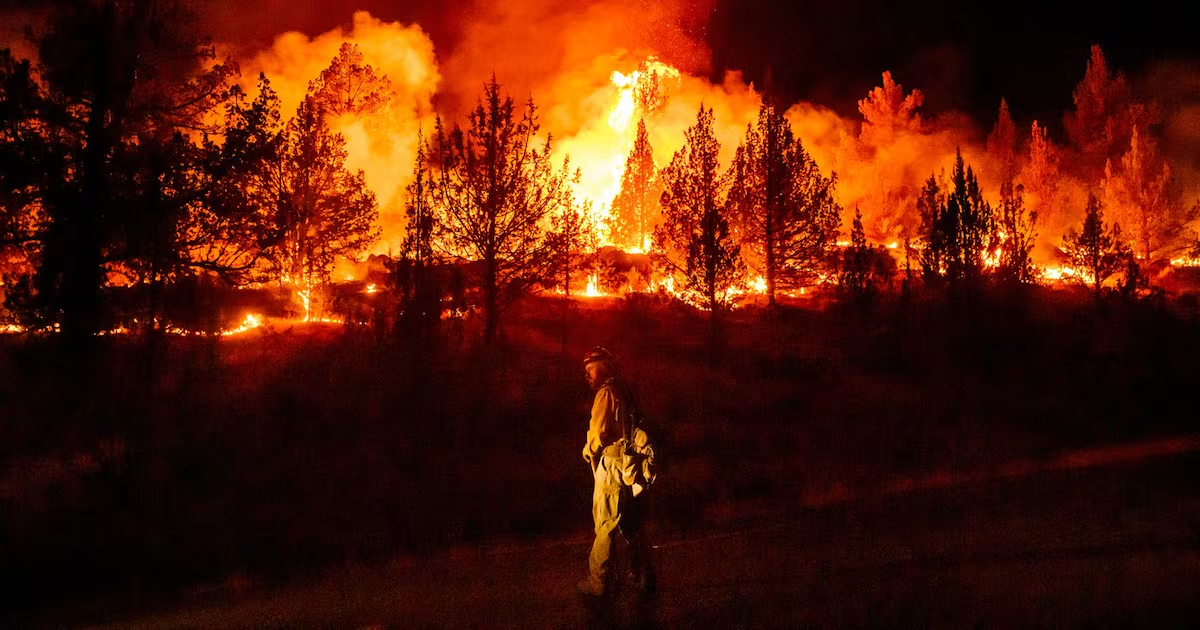
World must prepare for ‘reality’ of missing 1.5C goal: UN
53 minutes ago
 World
World
US and Iran exchange more airstrikes, fuelling fears of wider return to hostilities
53 minutes ago
 World
World
‘Wheel of Fortune’ announcer Jim Thornton suspended amid ‘allegations’
2 hours ago
 World
World
Trump says new Iran bombing won’t last ‘too long’ but US prepared to attack ‘any time we want’
2 hours ago
 World
World
Low flypast over Cape Town stadium to be reviewed, South Africa says
3 hours ago
 World
World
Winnipeg woman saves father and child from drowning: WPS
3 hours ago
 World
World
Pope at Audience: Church is called to serve humanity, unmask society's contradictions
4 hours ago
 World
World
Trump ally defends Venezuela oil deal amid ‘gunpoint diplomacy’ criticism
4 hours ago