
Climbers rescued from Mount Shasta after relying on AI chatbot to plan trip
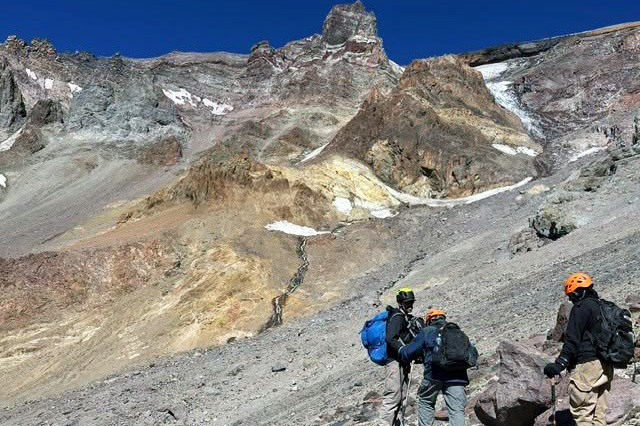
Three novice climbers told U.S. Forest Service rescue rescue rangers that they'd relied too much on AI chatbots to help them plan the logistics of their trip.
Three California college students had to be rescued from Mount Shasta on Monday during a poorly planned summit climb in which they overshot their itinerary, meandered off-route and ran out of food and water.
According to authorities with Siskiyou County and the U.S. Forest Service, the novice climbers, from Roseville, said they’d entrusted Google's AI chatbot, Gemini, to help them craft key logistics of their trip — from the best route up the mountain to the types of food they should pack and how much water they should carry with them. The county Sheriff’s Office called relying on artificial intelligence tools “a critical misstep.”
The role of AI in wilderness trip-planning has become a heated topic of conversation in California’s north state following a series of instances in which hikers and campers in the Shasta area became lost or confused after relying on chatbots to help them devise their adventures.
Article continues below this ad
Nick Meyers, lead climbing ranger with the U.S. Forest Service and director of the Mount Shasta Avalanche Center, said it’s a new but worrisome problem.
“This is the first year where we’ve started to have some AI fallout, if you will,” Meyers said. “People are using it for trip-planning — 'Hey, can I do this up here? ' It’s not always correct.”
Earlier this summer, rangers with Shasta-Trinity National Forest found a woman camping in an off-limits area on the south side of Shasta clearly marked with “no camping” signage, Meyers said. She told rangers she had asked ChatGPT where she could camp in the forest.
“AI told me I can camp here,” she said, according to Meyers.
Then in August, while hiking in Shasta’s popular Bunny Flat area, a man stopped rangers to ask for directions. He showed them a print-out map he’d been following and explained that he’d prompted ChatGPT to produce it for him.
“It was terrible — terrible — not even close to accurate,” Meyers said. “It had route lines and place names that were totally off — just ridiculous. We were like, dude, you gotta throw that away.”
The most potentially consequential instance occurred last weekend when the novice college-aged climbers got into trouble and called for rescue.
Mount Shasta seen in August 2022 nearly devoid of snow.
On Saturday, the trio of climbers, all from California, left from the Clear Creek Trailhead on Shasta’s southeastern side with a plan to camp partway up before making a summit push early Sunday morning, according to official reports. They’d asked Google Gemini for specific guidance, researched the climb on YouTube, and planned to use the AllTrails phone app to navigate the giant peak.
Clear Creek is a popular late-summer route because, when it melts out, it offers climbers a non-technical way up the peak — it can be done in hiking boots without ice axes or crampons. However, it’s an 8-mile journey that gains 6,500 feet in elevation, and guides caution that it is not to be taken lightly.
The climbers reached the summit Sunday evening — far later than the mid-afternoon turnaround time recommended by Shasta climbing experts. They’d clumsily navigated the mountain’s rugged volcanic terrain by following the line of a digital map in the AllTrails phone app, misreading it as the way of an established trail.
“Those are suggested routes, not trails,” Meyers said.
Things started to go wrong for them during their descent, according to authorities.
The phone they’d been using to navigate ran out of battery and the spare power bank they’d brought didn’t properly connect to the phone. By Sunday night, still high on the mountain, they wound up “well off-route,” according to a forest service report.
The group called for rescue but had to spend the night camping in the open.
Rangers reached them Monday morning and found them “exhausted, hungry and thirsty,” according to the forest service report. They were short on food and water, and light on appropriate mountain apparel and gear, authorities said. Also, they’d camped in a prohibited area near a freshwater spring and left trash and food scraps littered around their site.
“They were totally blowing it in all regards,” Meyers said.
The three college-aged climbers told U.S. Forest Service rescue rangers that they'd relied on Google Gemini to help them plan the logistics of their trip.
Rangers escorted them back to the climbers' base camp.
During the hike down, the young climbers revealed to rangers that they’d relied on AI chatbots to guide their planning. Authorities noted that as a “key factor” of their mishap.
The climbers “reported that AI recommended simple carbohydrates for their climb, rather than fats because they 'take too long to digest,'” according to the official report. “In their words, 'We relied too much on AI rather than our own critical thinking.'”
In its report, the forest service underscored the importance of seeking out reliable sources of information, starting with the Mount Shasta Avalanche Center.
Correction: A previous version of the story misstated the AI tool the climbers used to plan their trip. It was Google Gemini.
Related Stories
 AI News
AI payoffs, green transition shape France
32 minutes ago
 AI News
If I Could Only Buy 1 Artificial Intelligence (AI) Stock Before the Market Crashes, It Would Be This One
33 minutes ago
 AI News
Stockholm’s Vessla exits stealth with €2.94 million to bring AI agents to property management
1 hour ago
 AI News
Anthropic says it will commit 5% of its shares to 'public benefit fund'
1 hour ago
 AI News
Don't fall for this
1 hour ago
 AI News
Anthropic Turns to Lawyers to Teach AI Agents to Negotiate
1 hour ago
 AI News
From industrial revolution to artificial intelligence
1 hour ago
 AI News
Stripe will pay $7.5 billion for OpenRouter, the AI model traffic cop
2 hours ago