
Colorado tests new wildfire technology to give firefighters another way to attack difficult fires
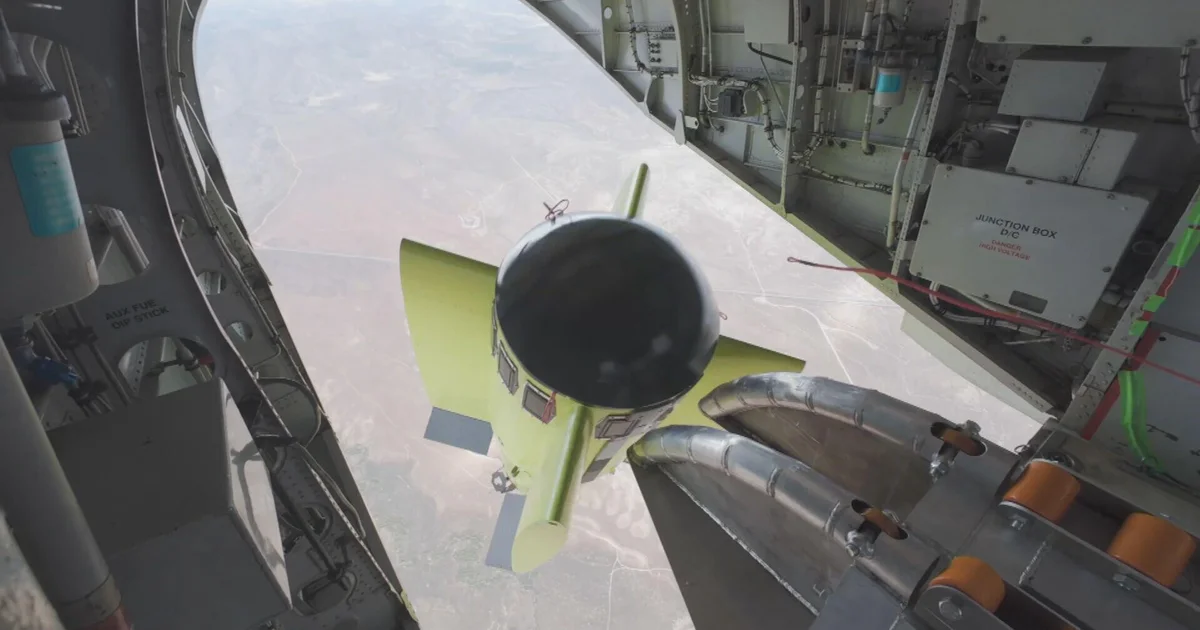
A new piece of wildfire technology being tested in Colorado could give firefighters another way to attack fires that are difficult to reach from the ground.
The technology is being tested by Colorado's Center of Excellence for Advanced Technology Aerial Firefighting, which is part of Colorado's Division of Fire Prevention and Control. CoE says the system is designed to deliver 110 gallons of water from planes or helicopters flying as high as 12,000 feet above the ground. When the device, also referred to as the Precision Guided Suppression Unit, or PGSU, reaches its target, the water is released in a concentrated burst.
"It is basically a giant trash can with fins and a brain, and it flies down contained in that trash can all the way to the ground, and then right at the last moment, it explodes and puts the water on the ground," said Ben Miller, the Director of the Center of Excellence for Advanced Technology Aerial Firefighting.
The tech is developed by Prime Minute, a public safety and natural disaster response technology company. The system is designed to drop the device from high above, but release water closer to the fire for a targeted approach to suppress a 35-foot radius.
"This isn't a replacement for firefighters. On the front side... firefighters are determining where this goes... and on the back side... I think these go in, they do their job, and eventually firefighters gain that ground," Miller said. "The idea is hopefully, hopefully that's 10 firefighters and not 1,000."
For years, aircraft have been used to drop water and retardant on wildfires. But the same conditions that can make wildfires grow rapidly can also make aerial firefighting more difficult.
Miller said that includes high winds, smoke, and darkness that can ground or limit traditional aerial operations.
"I think this could potentially give us an opportunity to access locations that we can't get to," Miller said. "The more tools in the toolbox that we have to respond to 'hard to get to fires', the better the outcomes will be."
The technology is still being tested, and in Colorado that includes controlled drops at High Lonesome Ranch near Grand Junction. The ranch is familiar with the devastation a wildfire can leave behind, as the property still has a burn scar from the Pine Gulch Fire in 2020, one of Colorado's largest wildfires.
"We lost all of the wildlife habitat and the fisheries in the aftermath of that fire. So, wildland fire is deeply rooted in what we do here," High Lonesome Ranch General Manager Travis Brooks said.
Brooks is now watching the technology being tested on the property and is hopeful it could eventually give firefighters another way to stop fires before they become much larger threats, welcoming the crews if they ever came by during a real wildfire.
"I would cheer them on. I would applaud them for their efforts. Thank them very much. I think, I think they're... gonna be able to attack it really well."
Miller says the system is not ready for widespread deployment yet. He added that the next phase in 2027 may involve scheduled fires in a more controlled environment, so researchers can measure how effectively the system performs.
"We think that potentially not this next fire season, but the one following that, we could potentially be putting this system on what we would call unscheduled fire.... And then the last phase would be to test it against real-world situations in operational environments where the phone rings and it's time to go to see if we can effectively get it there, get it on, you know, on station, and effectively put out a fire."
Miller said there is no clear cost yet, but CoE has taken a high-level assessment and sees it as a viable possibility if the technology becomes widely accessible down the line.
Related Stories
 Technology
Why Startups Can’t Access Enterprise Programmatic Platforms and How Managed Access Helps
50 minutes ago
 Technology
Securitas Technology Releases 2027 Global Technology Outlook Report
50 minutes ago
 Technology
Big tech claims it can fix loneliness, but can it really?
50 minutes ago
 Technology
Bill Gates bought a rare Porsche 959 but could not legally drive it in America; the car spent 13 years in
1 hour ago
 Technology
News Content Hub
1 hour ago
 Technology
J&K industrial push broadens as startups, MSMEs deepen investment cycle
2 hours ago
 Technology
Qualcomm, Arm resume legal battle over chip technology
2 hours ago
 Technology
Startup Qatar Investment Program Offers Tech Startups Up to USD 5.5M
4 hours ago