
Could Canada nationalize Stelco in Hamilton? Ottawa should consider it, legal expert says
Could Canada nationalize Stelco in Hamilton? Ottawa should consider it, legal expert says
Queens University law professor suggests Ottawa could step in to protect steel workers
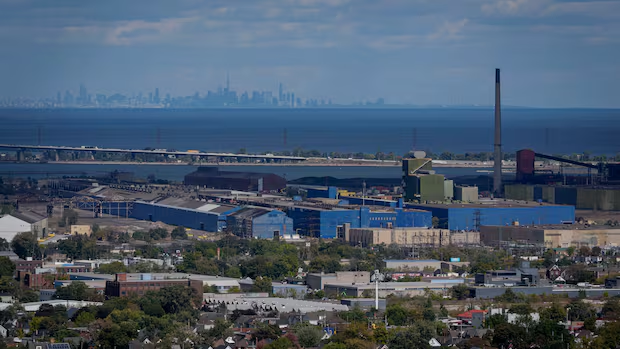
As more Hamilton steel workers receive layoff notices from the U.S.-owned plant Stelco, one legal expert is raising the possibility of nationalization, which could see the federal government take ownership of the company.
“The key question, ultimately, is could different management do better,” Nicolas Lamp, associate professor at the faculty of law and school of policy studies at Queens University, told CBC Hamilton.
Lamp questioned whethers Stelco was acting in the best interests of its Canadian workers or had an interest in the U.S. trade war against Canada.
“Clearly there's a conflict of interest here in the case of the CEO … or his perspective on the issue is at least distorted by the fact that he also has U.S. operations who are benefiting from the tariffs. So taking these factors together, the moment of uncertainty that we're in, the fact that we can't really trust the CEO, that made me think of that [nationalizing] as an option.”
Laid-off Stelco steelworkers stressed about company's future — and their own: 'We're being sold out'
Lamp says that Ottawa should consider stepping in before talent within the steel industry is displaced, adding that layoffs are difficult to reverse if individuals move away, relocate, retrain or retire.
“And at the moment when Canada is trying to build a lot of infrastructure, major plants, major projects, it's really a question of whether Canada should just let all that expertise kind of die.”
Layoffs at Hamilton's Stelco steel plant are already underway and are expected to impact between 300 to 350 employees.
Ron Wells, president of United Steelworkers Local 1005, says he’s open to the idea of nationalization.
“I'm not sure how it would work, but I don't think it would be a bad thing,” he told CBC Hamilton, pointing to Canada’s other crown corporations like CN and Canada Post as examples.
Stelco owner under pressure from legal deadline
The nationalization discussion is happening as Ottawa threatens legal action against Cleveland-Cliffs, which acquired Stelco in 2024.
On Monday, Industry Minster Mélanie Joly gave the company five business days to submit a plan on how it would keep its commitments to maintain Canadian jobs under the Investment Canada Act.
“The Government of Canada takes compliance with undertakings seriously,” Joly wrote in the letter, obtained by CBC News on Tuesday.
“Where an investor fails to comply with an undertaking, the act provides remedies for breaches, including an application to the superior court for orders that may include directing compliance, divestiture, or monetary penalties.
“I trust that such steps will not be necessary.”
Prime Minister Mark Carney was in Sherbrooke, Que., yesterday where he was asked if the government would be willing to nationalize Stelco if Cleveland-Cliffs doesn’t reverse the layoffs.
“They have a few days left to respond to the minister of industry's letter,” he said. “We'll await that response and take appropriate action afterwards.”
NDP MP Don Davies calls steel vital to Canada’s sovereignty and national security, and believes nationalization is worthy of exploration.
“You know, we're not making basketballs here. We're talking about steel that is the foundation of our country. So it's an option. It has to be looked at,” Davies told reporters at Parliament Hill on Thursday.
He also said that he thinks the Cleveland-Cliffs takeover should never have been approved under the Investment Canada Act.
How would nationalization work?
Lamp says that government ownership of Stelco is one potential outcome from Ottawa’s legal threat to Cleveland-Cliffs.
Joly’s letter includes reference to court-ordered divestiture, which could force Stelco to sell the company.
“Ideally there would be a private buyer who would pick it up,” Lamp said. “But if not, given the moment of uncertainty that we're in, that might be an opportunity for the Canadian government to step in and say, ‘Okay, we're going to buy it’.”
Will Ottawa really take Stelco to court? Here's what happened last time
Ottawa gives Stelco's U.S. owner 5 days to share plan to keep jobs
Lamp pointed to the purchase of the Trans Mountain pipeline from Kinder Morgan in 2018 as an example of the federal government gathering major infrastructure from a private company.
“I'm not saying we should definitely nationalize it,” he said. “I would say that the Canadian government really has to look very closely at what the reasons for these layoffs are and whether a company that was more sympathetic, that had the Canadian workers and also the Canadian national interest in mind, would act similarly.”
Meanwhile, the professional fate of 500 steel workers remains in limbo.
'This is scary times,' says laid-off Stelco worker | Hanomansing Live
Cleveland-Cliffs has stated the layoffs are necessary to “ensure the survival” of the company in a tough market, but Wells says he believes that motivations are political.
“We think it's politically motivated because of the midterms coming up in the States and because the CEO of Cleveland Cliffs is trying to pressure the Canadian government to make a trade deal.”
Still, he said he thinks the jobs could “absolutely” return to Hamilton.
“Just those statements from the CEO kind of proves our point that this was done to get a trade deal,” he said. “I don't think it was market driven.”
Lamp says there's a risk in making permanent decisions about industry talent during unusual circumstances.
“In law, we have the saying ‘hard cases make bad law’,” he said. “We wouldn't want to make a long-term decision about Canadian steel capacity that has permanent consequences under extraordinary circumstances.
“And that's why there might be a reason for the government to step in.”
Coleman Molnar is a CBC reporter and editor based in the Niagara Region. Previously he served as an associate producer with CBC Radio in B.C.'s Interior. He also works as a freelance writer, contributing regularly to publications like GQ and Autostrada Magazine. You can reach him at coleman.molnar@cbc.ca.
Related Stories
 Canada
Motorcyclist killed in crash with SUV
34 minutes ago
 Canada
Cleveland
34 minutes ago
 Canada
‘We feel very abandoned’: Mother and daughter from Montreal among Canadians stranded after Panama earthquakes
35 minutes ago
 Canada
Carney says U.S.
35 minutes ago
 Canada
Canada advises no travel to Riyadh airport after Houthi attacks, embassy remains open
1 hour ago
 Canada
Turkey gravy brand sold in Canada recalled due to undeclared mustard
1 hour ago
 Canada
Person dies after canopy collapses at Fairmont hotel construction site
2 hours ago
 Canada
Passenger terminal at Riyadh airport is struck again, a day after 12 were killed
2 hours ago