
Countries Are Starting to Compete Like Startups
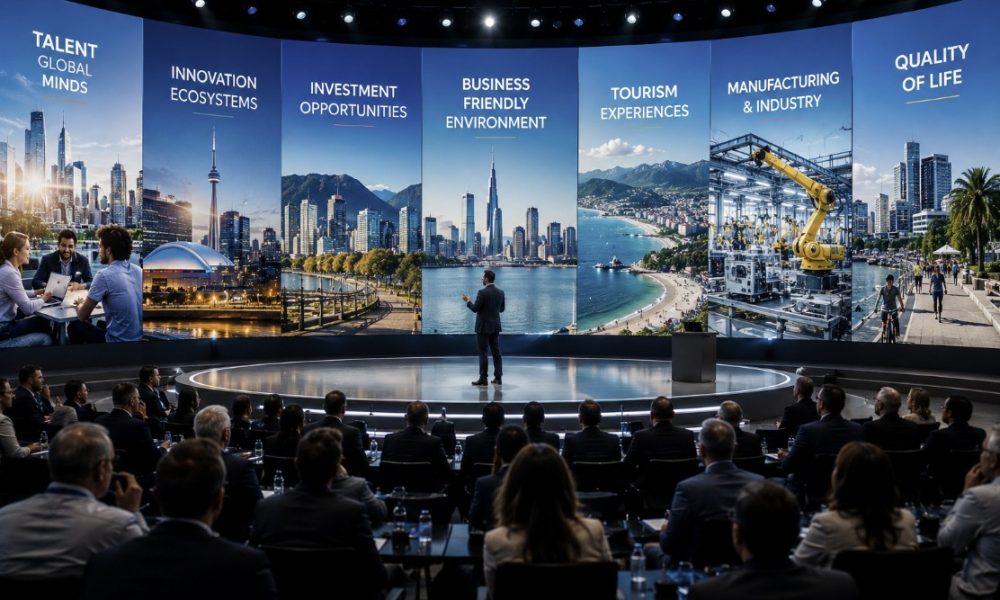
For most of modern history, countries competed through geography, natural resources, military strength, and industrial output. Today, a different kind of competition is emerging. Increasingly, nations are competing for many of the same things startups fight over every day: talent, investment, customers, attention, and market share. Governments around the world are investing heavily in attracting entrepreneurs, highly skilled workers, manufacturers, tourists, and multinational corporations. Tax incentives, startup visas, infrastructure investments, business-friendly regulations, and global marketing campaigns are becoming tools in an increasingly competitive marketplace.
The competition for talent may be the clearest example. Highly educated workers have become increasingly mobile, and many countries recognize that attracting engineers, scientists, founders, and skilled professionals can have enormous economic consequences. In many ways, countries are now recruiting people the same way technology companies recruit employees. Remote work has only accelerated this trend, allowing professionals to choose where they live independently from where they work and giving nations new opportunities to attract productive workers from around the world.
Investment has become another battlefield. Manufacturing facilities, technology campuses, semiconductor plants, logistics hubs, and research centers generate jobs, tax revenue, and long-term economic growth. Governments are offering incentives worth billions of dollars to convince companies to build within their borders rather than somewhere else. What was once a competition between companies is increasingly becoming a competition between countries trying to attract those companies.
Tourism has evolved as well. Many governments no longer view tourism simply as hospitality or leisure spending. Visitors effectively function as exports that arrive voluntarily, spend money locally, and then leave without requiring shipping containers, warehouses, or distribution networks. Countries increasingly invest in branding campaigns designed to shape global perception and attract visitors in much the same way businesses advertise products and services.
Supply chain disruptions, geopolitical tensions, and national security concerns have made manufacturing especially important in recent years. Governments that once focused primarily on services and finance are once again competing aggressively for factories, industrial investment, and strategic industries that were previously taken for granted. Economic resilience is becoming almost as important as economic growth, and countries are adjusting their strategies accordingly.
There is an interesting irony in all of this. For decades, startups tried to become global companies while countries largely remained passive participants in the global economy. Today, many governments are borrowing strategies directly from the startup world. They focus on branding, customer acquisition, incentives, competitive positioning, and growth strategies. The language of business is increasingly becoming the language of government.
The winners over the next decade may not necessarily be the countries with the largest populations or the greatest natural resources. Instead, they may be the countries that become the most attractive places to build, invest, work, and live. The future of global competition may look surprisingly familiar to anyone who has ever built a business. Countries, it turns out, are starting to compete like startups.
AI Copyright Lawsuits Are Becoming a Business Risk—What Every Company Using AI Needs to Know
Cenk Demircan is an entrepreneur, author, and business strategist who thrives at the intersection of innovation and efficiency. As the founder of Elite Coaching Circle, he has guided countless entrepreneurs toward success, blending mindset, strategy, and execution. His latest venture, Fire Your Employees, challenges traditional business models by leveraging AI and automation to streamline operations and maximize growth. With a relentless drive for transformation, Cenk continues to push boundaries, helping businesses evolve in an ever-changing digital landscape.
Artificial intelligence has quickly become one of the most valuable business tools available, but a new wave of copyright lawsuits is creating uncertainty for companies that build, buy, or rely on AI.
This week, legal battles intensified as media organizations and content owners continued pressing lawsuits against major AI companies over how their models were trained. At the same time, new copyright claims were filed against AI developers over the alleged use of copyrighted music and other creative works without permission. Legal experts say these cases could define the future rules of AI development for years to come.
For business owners, these lawsuits are about much more than Silicon Valley.
Many companies assume that once they purchase an AI platform, they are protected from legal concerns. That may not always be true.
As courts determine what qualifies as legal AI training data, software vendors may be forced to change how their products operate, increase licensing costs, or limit certain AI capabilities.
Businesses developing their own AI systems face even greater exposure if they train models using copyrighted documents, images, videos, or audio without proper authorization.
Business leaders should begin treating AI governance the same way they treat cybersecurity or data privacy.
– Review which AI tools your company uses.
– Ask vendors where their AI models obtain training data.
– Avoid uploading confidential or copyrighted materials into public AI systems without understanding the platform’s terms.
– Create an internal AI usage policy for employees.
– Work with vendors that are transparent about compliance and intellectual property protections.
AI adoption is accelerating across every industry, but the legal framework is still catching up.
The companies that will benefit most from AI over the next decade are unlikely to be those that adopt it the fastest. Instead, they will be the organizations that build AI into their operations responsibly while reducing legal and compliance risks.
Just as cybersecurity became a boardroom priority over the past decade, AI governance is rapidly becoming the next competitive advantage.
The message from this week’s legal developments is clear: businesses should not stop using AI—but they should start asking tougher questions about how the technology was built and whether it is legally sustainable.
As courts continue shaping the future of artificial intelligence, one thing is becoming increasingly certain: AI is no longer just a technology issue. It is now a business strategy issue.
Microsoft’s CEO Says Every Company Should Build Its Own AI Model. Here’s Why That Changes Everything.
For the past two years, businesses have largely approached artificial intelligence by subscribing to services like ChatGPT, Claude, or Gemini. But Microsoft CEO Satya Nadella believes that approach won’t be enough for companies that want to stay competitive.
Speaking this week, Nadella argued that every business should eventually build its own AI model using its own data, processes, and institutional knowledge instead of relying entirely on generic AI systems. His comments signal what may be the next major phase of enterprise AI adoption.
The Shift From Using AI to Owning AI
Today’s AI assistants are excellent general-purpose tools, but they know nothing about how your business operates internally.
A custom AI model can understand your company’s products, pricing, customer history, documentation, operating procedures, compliance requirements, and internal workflows. Instead of simply answering questions, it becomes a digital employee trained specifically for your organization.
This represents a major shift from buying software to building proprietary business intelligence.
Why This Matters for Businesses
Companies that create their own AI models gain a competitive advantage that competitors cannot easily copy.
Imagine a law firm with an AI trained on decades of case files, a manufacturer with an AI that understands every production process, or a real estate brokerage with an AI that knows every listing, transaction, neighborhood, and client interaction.
The value isn’t just in the AI itself—it’s in the unique business knowledge embedded within it.
This Doesn’t Mean Starting From Scratch
Nadella isn’t suggesting that every business should build a foundation model like OpenAI or Anthropic.
Instead, companies should customize existing AI models using their own data and workflows. Modern AI platforms make it increasingly practical for organizations of all sizes to create specialized AI assistants without investing billions in research.
For small and medium-sized businesses, this could become just as important as having a website or CRM.
The first wave of AI adoption was about learning how to use AI.
The next wave will be about ownership.
Businesses that rely solely on public AI tools may improve productivity, but businesses that develop AI systems trained on their own expertise will create a competitive advantage that becomes stronger over time.
As AI rapidly evolves, the companies that treat artificial intelligence as proprietary infrastructure—not just another subscription—may be the ones that lead their industries over the next decade.
Five Eyes Warn AI-Powered Cyberattacks Could Hit Businesses Within Months
Artificial intelligence is no longer just transforming marketing, customer service, and software development. This week, one of the strongest warnings ever issued by Western intelligence agencies signaled that AI is rapidly becoming one of the biggest cybersecurity threats businesses will face.
The Five Eyes intelligence alliance—a coalition consisting of the United States, United Kingdom, Canada, Australia, and New Zealand—warned that advanced AI systems could enable sophisticated cyberattacks against businesses within months rather than years. The agencies urged organizations to treat cyber resilience as a boardroom priority instead of simply an IT responsibility.
For business owners, this warning represents a major shift. Until recently, discussions around AI focused on productivity, automation, and cost savings. Now executives must prepare for a future where attackers use AI to discover vulnerabilities, write malware, automate phishing campaigns, and launch attacks at unprecedented speed.
Unlike traditional cybercriminals who often required technical expertise, AI dramatically lowers the barrier to entry. Criminal groups can increasingly automate reconnaissance, generate convincing emails, create fake voice recordings, and search for security weaknesses much faster than before.
Companies adopting AI should not become fearful—they should become prepared.
Organizations that continue treating cybersecurity as an annual compliance exercise may find themselves increasingly exposed. Businesses should instead view cybersecurity as an ongoing operational investment that evolves alongside their AI adoption strategy.
Experts recommend that companies:
– Eliminate outdated software and unsupported systems.
– Enable multi-factor authentication across all business accounts.
– Regularly update and patch infrastructure.
– Train employees to recognize AI-generated phishing attempts.
– Invest in AI-powered security monitoring tools capable of detecting unusual behavior in real time.
AI Creates Both Opportunity and Risk
Ironically, the same technology making cybercriminals more capable is also becoming one of the strongest defensive tools available.
Modern AI security platforms can monitor millions of events per second, identify abnormal activity before humans notice it, and automatically respond to suspicious behavior. Businesses that embrace AI defensively may gain a significant advantage over organizations relying solely on traditional security methods.
The AI race is entering a new phase.
Winning with AI will no longer be measured solely by who automates customer support or generates content the fastest. Increasingly, success will depend on which organizations can securely deploy AI while protecting their customers, employees, and intellectual property.
For business leaders, cybersecurity is no longer a technical discussion reserved for the IT department. As AI becomes more powerful, cyber resilience is becoming a competitive advantage—and one that companies cannot afford to ignore.
AI Companies Launch $500 Million Workforce Initiative. Why Every Business Should Pay Attention
For years, businesses have wondered when artificial intelligence would begin reshaping the workforce. This week, the AI industry sent one of its clearest signals yet that the transition is no longer a future problem—it’s a present business priority.
A new initiative called Raise US has launched with an initial $500 million in funding to help workers adapt to AI-driven changes across the economy. The nonprofit is backed by major technology companies and AI leaders, including OpenAI, Anthropic, Microsoft, Amazon, and IBM, with plans to work alongside state governments, employers, and educational institutions on workforce development programs.
Rather than focusing solely on building faster AI models, the industry’s biggest players are now investing heavily in retraining employees, career coaching, wage insurance experiments, and new credentialing programs. Pilot programs are expected to begin in several U.S. states as organizations test practical ways to prepare workers for increasingly AI-assisted workplaces.
For business owners, the significance extends well beyond corporate philanthropy.
The largest AI companies are effectively acknowledging that artificial intelligence will reshape many job roles over the next several years. Instead of asking whether AI will affect your business, the better question is whether your company will prepare before your competitors do.
Forward-thinking organizations should begin identifying repetitive administrative work that AI can automate while simultaneously investing in training employees to work alongside these new tools. Companies that successfully combine human expertise with AI productivity are likely to gain a meaningful competitive advantage.
This shift is particularly relevant for small and midsize businesses. AI-powered customer service, appointment scheduling, lead qualification, document processing, marketing content creation, and internal reporting have become increasingly accessible without requiring enterprise-level budgets.
The launch of Raise US marks an important milestone in the AI era.
Only a year ago, much of the discussion centered on whether AI would replace jobs. Today, the conversation has evolved toward how businesses, governments, and workers can adapt together.
That change in tone matters. When the companies creating AI begin investing hundreds of millions of dollars to prepare the workforce, it suggests that AI adoption is accelerating beyond experimentation and becoming a permanent part of how organizations operate.
Businesses that start building AI skills today will likely find themselves better positioned as the technology continues to transform every industry.
The question is no longer whether AI will change the workplace. The question is how quickly your business is prepared to change with it.
Using an Aerial Platform Lift safely at Height in Different Seasons
Boom lifts are popular pieces of heavy equipment used in various industries for aerial work. They are highly regarded for their safety and stability. While many models offer advanced features for smooth operation and worksite security, operators need to know how different seasons and weather conditions can affect their usage. They should adopt best practices across seasons to reduce risks and perform their tasks smoothly. Whether you want to rent or buy an aerial platform lift, you must determine the best way to operate it for the specific season. So, here are a few insights on operating boom lifts in different seasons.
This season is marked by rain and wind. Both these factors can affect the equipment’s stability and the operators’ visibility. Since spring gusts can cause mobile elevating work platforms to tilt, one must check wind conditions and follow the equipment’s wind tolerance limits. Due to rain, ground surfaces and platforms can become slippery. Even control panels can be affected. You can use anti-slip mats to prevent slips. At the same time, you must look after the drainage system. Electrical components of aerial lifts must be protected from moisture damage. Spring can cause sudden thunderstorms. There must always be a backup plan to address these conditions.
Excess heat or sun exposure can be harmful for both equipment and operators. Operators must inspect tires and hydraulic fluids to ensure everything is in good condition. Heat can overinflate tires and expand fluid. Metal surfaces can become overheated due to prolonged exposure to the sun. During work breaks, it is best to keep equipment in the shade. Operators should drink enough fluids and wear UV-blocking sunglasses and hats. They should also take regular breaks to prevent heat fatigue.
Rain, temperature drops, and windy conditions are common in this season. To avoid the risk of tip-overs, you should not use the equipment on unstable, soft, or muddy terrain. Fallen leaves can become a slip hazard. Hence, they should be cleaned. Since daylight hours are shorter in the fall, operators and other staff can use reflective markers and functional lights to improve visibility. There should be a plan to tackle fall storms.
Low temperatures, snow, and ice describe the season and the hazards caused during aerial lift operations. Due to extreme cold, fluids can become viscous, hampering the hydraulic function of the units. You must keep suitable antifreeze and winter-grade lubricants handy. Ice can increase fall risks by making surfaces slippery. Using controls can be challenging as well. Operators must de-ice everything to prevent these scenarios. They should also wear layered clothing and insulated gloves to keep themselves warm. Since tires may not get proper traction on snow and ice, you should rent an aerial lift designed for all types of terrain, or make arrangements for proper ground support to ensure stability.
To rent a boom lift, you can visit here. Online platforms usually maintain large fleets, making it easy to find a suitable model for your project. When using the unit, make sure to follow the manufacturer’s guidelines for safe operation. You should also check your aerial lift regularly for maintenance needs or other issues. At the same time, there must be adequate arrangements to use this equipment safely in different seasons as needed.
Unlocking July 2026: The Month the Sky Pauses Before It Changes Everything
Events For July: Summer Hits Its Stride
Pride Takes Center Stage in Times Square and Broadway
My Masterpiece: Music City Brings Nashville Soul to Midtown
Related Stories
 AI News
Bill Gross bets AI can help mass
6 days ago
 AI News
Nigeria records 93% rise in AI micro
6 days ago
 AI News
The Italian gelato maker using AI to invent new flavours
6 days ago
 AI News
Closing the Gap Between Agentic CX Pilots and Production
6 days ago
 AI News
New Brunswick data centre debate highlights cross
6 days ago
 AI News
How to Structure an AI Agent Referral Fee Agreement Between Startups
6 days ago
 AI News
No, AI didn’t delete a Swedish reality TV series
6 days ago
 AI News
There is no AI in Armageddon. Artificial intelligence is a tool, not an apocalypse
6 days ago