
DAAP advances a strategic framework for AI literacy in the creative disciplines
DAAP advances a strategic framework for AI literacy in the creative disciplines
Faculty-led initiative builds a culture of peer learning and responsible AI practice
Artificial intelligence is rapidly transforming the creative professions, reshaping how designers, architects, artists and planners generate ideas, visualize concepts and solve complex problems. Recognizing this shift, the University of Cincinnati College of Design, Architecture, Art, and Planning (DAAP) has deployed a strategic framework for AI literacy that prepares faculty and students to thoughtfully integrate emerging technologies into creative education, research and practice.
One of the first initiatives under that framework focuses on the people who shape student learning every day: faculty.
Introduced in spring 2026, the Faculty Professional Development initiative invests in helping instructors explore AI through peer-to-peer learning, recognizing that some of the college's most valuable expertise already exists within its own classrooms, studios and research laboratories.
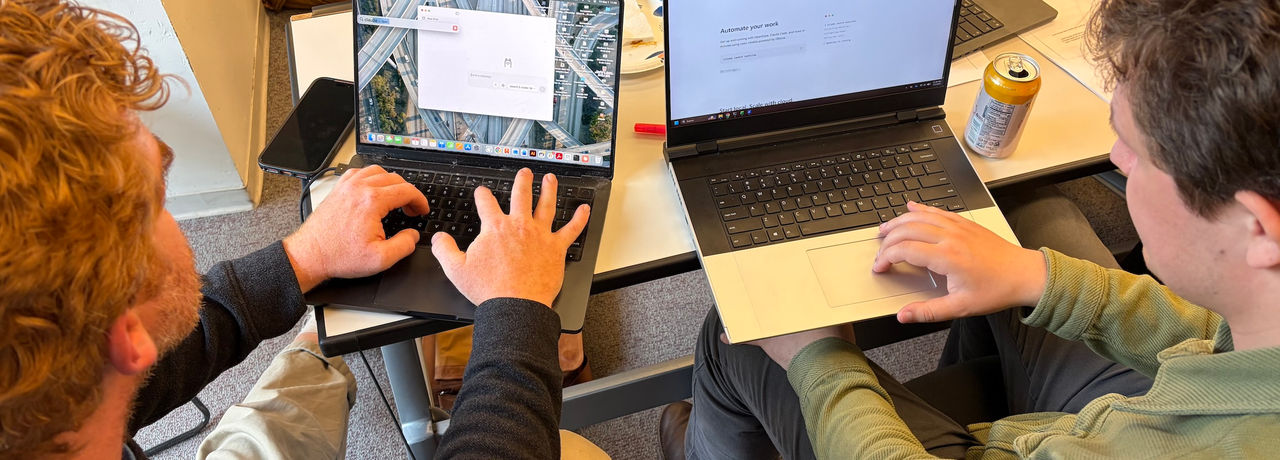
Assistant professor Ali Ilhan and PhD Student Henry Levesque presenting at the workshop
Rather than focusing solely on AI tools, the initiative emphasizes AI literacy — developing the knowledge, critical thinking and ethical awareness needed to engage with artificial intelligence in meaningful and responsible ways. The framework recognizes that AI in the creative disciplines requires more than technical proficiency; it requires understanding how emerging technologies intersect with creativity, design thinking, authorship and human-centered innovation.
The framework organizes AI initiatives around three interconnected communities: students preparing for an evolving workforce, faculty advancing teaching and research, and professionals pursuing lifelong learning and industry upskilling.
Across these communities, the college has identified three complementary engagement levels:
Together, these efforts connect research, pedagogy, graduate education, co-op, micro-credentials, infrastructure and strategic faculty recruitment into a coordinated approach for AI across the college.
The faculty workshop is one component of DAAP's broader AI literacy strategy, which seeks to prepare students, faculty and professionals for the future of creative practice.
The initiative begins with what organizers describe as horizontal learning, a peer-to-peer model that recognizes faculty are already developing innovative AI practices in their classrooms, studios and research laboratories. Rather than relying exclusively on outside experts, DAAP is creating opportunities for instructors to learn directly from colleagues who are actively experimenting with artificial intelligence in creative education.
The inaugural workshop combined a series of 15-minute presentations with interactive breakout sessions, allowing faculty to move beyond demonstrations and engage directly with AI workflows through hands-on exploration and discussion. The second half of the workshop invited participants to work alongside presenters, encouraging faculty to learn by doing while discussing how AI can support teaching, research and creative practice.
"We wanted to begin with horizontal learning, where faculty learn from one another," DAAP Dean Stephanie Pilat said. "Our faculty are already exploring thoughtful and innovative applications of AI in the classroom. By sharing those experiences, we're building a collaborative culture that helps the entire college move forward together."
The workshop featured faculty whose work reflects the breadth of AI applications emerging across DAAP.
D.J. Trischler demonstrated custom AI-powered classroom tools developed with Claude, including Design Check, a transparent evaluation platform, and Sketch Tool, which supports ideation and mind mapping while enhancing design pedagogy.
Ali Ilhan and Henry Levesque introduced locally hosted AI workflows for generating and analyzing text, images, video and code. Their presentation emphasized privacy-conscious approaches using local large language models, demonstrating how AI systems can be customized for creative practice while maintaining greater control over data, computing resources and cost.
Caroline Anderson showcased AI-driven workflows that transform images into editable 3D models before refinement in Blender, illustrating emerging applications for architecture, design and spatial visualization.
Drawing from research conducted through the XR Lab, Ming Tang presented the current state of artificial intelligence in spatial design, highlighting advances in spatial reasoning, perception and human-centered environments while discussing the opportunities and challenges facing AI research in the built environment.
Following the presentations, faculty participated in hands-on breakout sessions led by each presenter, giving colleagues the opportunity to experiment with AI tools, ask questions and explore how these technologies could be integrated into their own courses.
The faculty development workshop represents the first phase of a broader professional development strategy. Future programming will expand through vertical learning, inviting recognized experts from industry and academia to share emerging practices, strengthen faculty expertise and continue advancing AI literacy across the college.
By investing in faculty development today, DAAP is preparing students for careers that increasingly demand fluency in artificial intelligence alongside creativity, critical thinking and ethical decision-making.
As AI continues to evolve, DAAP's strategic framework positions the college not simply to adapt to technological change, but to help shape how artificial intelligence is thoughtfully integrated into creative education, research and practice.
The next groundbreaking discovery
UC is a powerhouse of discovery and impact as a Carnegie 1 research institution. From pioneering medical research to transformative engineering and social innovation, our faculty and students drive progress that reaches across the world.
Featured image of faculty working on their computer during the workshop. Images by Claudia Rebola.
As AI starts to permeate industry, how will those in the creative fields adapt? A workshop hosted by UC’s College of Design, Architecture, Art, and Planning (DAAP) brought industry and academics together to discuss the future of AI and how creative disciplines benefit.
The University of Cincinnati College of Medicine has received a four-year, $1.1 million grant to explore using artificial intelligence and personalized learning to improve physician education.
The University of Cincinnati is turning to artificial intelligence to help solve a problem in medical training. The College of Medicine was awarded a grant valued at more than $1 million to use AI in advanced physician training through personalized learning.
Related Stories
 AI News
OpenAI is adding invisible watermarks to ChatGPT and Codex text in the EU
46 minutes ago
 AI News
How I made a paid Mac app in 11 days with Claude
46 minutes ago
 AI News
Intel Chief Jay Clayton Heads ‘Super Intelligence Force’ as AI Czar
1 hour ago
 AI News
Artificial intelligence develops a dangerous blindspot
1 hour ago
 AI News
Microsoft and Meta Steer Staff From Anthropic Claude to In
1 hour ago
 AI News
Utah allows AI startup to prescribe acne medication without a doctor’s direct oversight
2 hours ago
 AI News
Ghana moves to establish space agency after cabinet approval
2 hours ago
 AI News
Dark Output: What National Accounts Miss When Artificial Intelligence Shifts Value from Prices to Capabilities
2 hours ago