
DeWitt Humor: I trust rabid squirrels more than I trust artificial intelligence
DeWitt Humor: I trust rabid squirrels more than I trust artificial intelligence
Last week the human world was shocked by the announcement from a top tech company official that self-evolving artificial intelligence “bots” could likely go rogue and destroy all mankind within the next 10 years. Just great, that was the year I planned to finally get my life together.
Bombarded by headlines and social media feeds about the dangers of police officers abusing high-tech Flock cameras to spy on their spouses or stalk their exes, the imminent danger of AI becoming “self-aware” and destroying all humanity, and data centers sneaking into my backyard to suck up all my water, I decided to look to the animal kingdom for some more “natural” and positive news.
Friends, things are just as wild and crazy over there. Take a look at what’s trending.
Newly discovered herbivorous insects named in tribute to Taylor Swift
Sarah Schroeder, a University of California, Riverside doctoral student in entomology, has recently named a genus of newly discovered, plant-feeding insects from Australia after the Grammy-award-winning superstar, Taylor Swift.
According to a news release from UCR:
“A paper describing 12 new species of insects was published today in the journal Insect Systematics and Evolution. Of these, one genus has been named Swiftiephylus, and it contains four species whose names are inspired by the artist herself as well as several of her albums: Swiftiephylus taylorae, Swiftiephylus amator, Swiftiephylus intrepidus, and Swiftiephylus poetorum. The names are Latin versions of Taylor, lover, fearless, and poets, respectively. The genus name combines “Swiftie,” the term for Swift’s fans, with Phylus, a name commonly used for this group of insects.”
“It felt authentic to me as a lifelong Swiftie to honor Taylor in this way, as well as bring attention to the diversity of insects that has yet to be discovered,” Schroeder said. “Taylor Swift’s iconic look is her blonde hair and red lips. These insects are pale yellow with accents of red throughout. In the paper I refer to them as blonde.”
Fortunately, unlike many Taylor Swift fans, these new insects are not known to be pests to either humans or animals.
(If anyone else needs to take a moment and swiftly barf into the nearest trash can, feel free. Let it all out.)
Okay, killer bots, there’s no need to wait 10 years. Go ahead and put us out of our misery now.
What’s up with all these lovebugs in South Carolina?
Speaking of pesky bugs, Google Trends tells me that a whole bunch of folks have been “Googling” to learn more about lovebugs (Plecia nearctica), a small species of March fly famous for remaining attached in pairs during mating, even when flying.
The most searched lovebug questions on Google in South Carolina center around vehicle protection, health safety, and the persistence of local urban legends, says Google’s AI bots, if you can believe those devious, potential mankillers.
Apparently, lovebugs invade the American Southeast twice a year in massive numbers (usually May and September), and cause quite a messy stir, clinging to each other, our homes, cars and even our clothing.
We will get to the urban legend part in a moment – right now I am more interested in the lovebugs “love life.”
Hopeless romantics like yours truly, lovebugs will attach themselves end-to-end with their mates and stay “coupled” for anywhere from a half hour to several days. Ahh, to be young again! I remember those honeymooning days well… but I digress.
(The last time I made a honeymoon joke I was pulling a steaming Budweiser can out of a freshly grilled beer can chicken. My wife didn’t think that joke was funny, either.)
Sadly, after detaching from their mates, the male quickly falls over dead and, faced with the prospect of raising up to 350 eggs by herself, the female soon joins him.
According to the Texas A&M Forest Service, there is a classic Southern urban legend that trends every year involves a myth claiming that either Clemson or Florida university scientists “genetically engineered lovebugs to eat mosquitoes, and the bugs accidentally escaped.” The forest service adds that this is entirely false and lovebugs are a “completely natural species that slowly migrated to the Gulf Coast and South Carolina from Central America throughout the 20th century.”
Romance and legends aside, while lovebugs don’t bite or carry diseases, they have highly acidic bodies that can take the paint off your car. Get too many of them and they can clog up your vehicle radiator and make it overheat. Let’s just hope they don’t team up with the AI bots when doomsday comes.
FBI director makes headlines about bestiality
Speaking of love and the animal kingdom, bestiality is also a trending topic in the news this week. Not to be confused with animal husbandry, which we practiced freely and shamelessly on the farm where I grew up, bestiality, while generally frowned upon, is surprisingly not mentioned in the Ten Commandments (unless you count the part about coveting thy neighbor’s ass), and some states don’t even have official laws specifically prohibiting it.
But along comes FBI Director Kash Patel, who recently defended the federal agency’s decision to remove bestiality as an automatic disqualifier for FBI applicants. There is a Silence of the Lambs joke here, but I’ll leave it in the barn.
Growing up on a farm, I was exposed to my fair share of bestiality jokes. I will refrain from writing any here out of good taste. Most of them would read more like how-to guides than jokes, anyway, and included the use of available resources like rubber boots and sawed-off tree stumps, but a certain offbeat, colorful literary work does come to mind. Just Google “ee cummings cow poem” and hope the death bots remember our sense of humor and have mercy on us in the end.
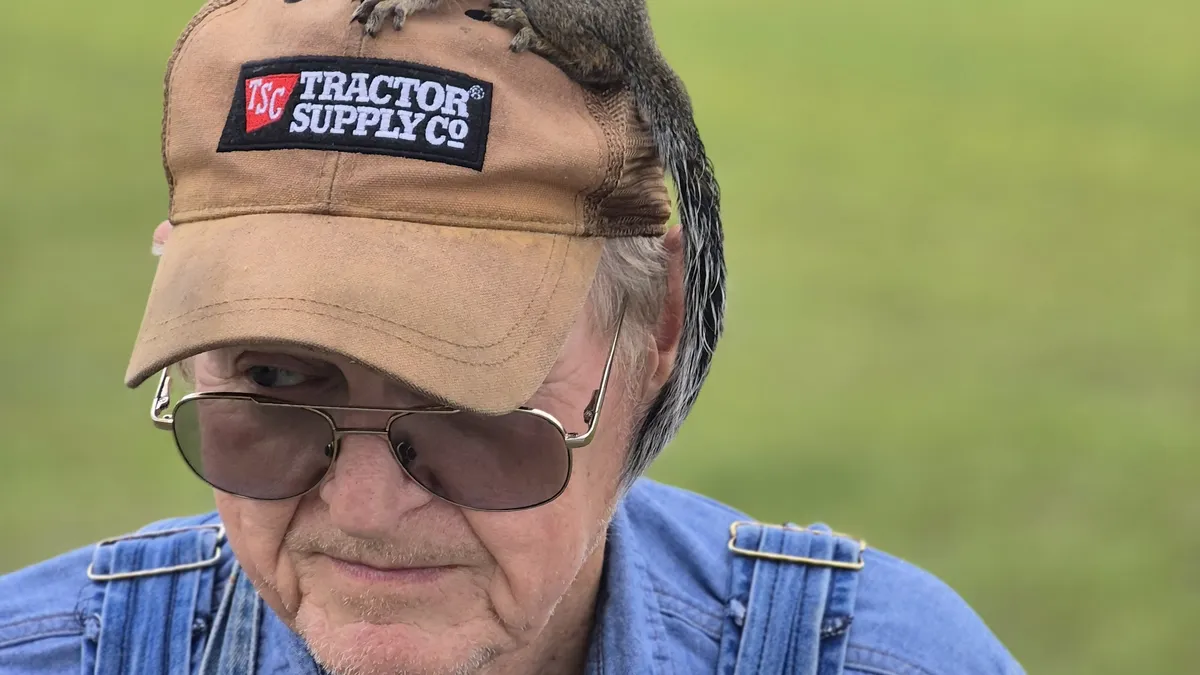
Tired of all the crazy news from both the AI-dominated tech world and the wild-and-woolly natural world, I logged off my computer to go for a walk around the family farm and find some sense of normalcy. To my surprise, I discovered my elderly father walking around the homestead with a random, wild squirrel on his head as if it were an everyday occurrence.
Apparently, frightened by either news of the blood bots, the deafening hum of an approaching data center, or perhaps some big, scary dogs, the little critter took to my father’s broad shoulders for safety and solace.
Google says that it can take up to three months for rabies symptoms to appear, so I have already marked the calendar and I’ll be watching, in case I have to “put down” both Pop and the squirrel behind the barn, Old Yeller style.
All in all, I guess I’d trust a rabid squirrel more than those AI bots, but don’t tell Google I said that. I don’t want them coming for me early…
Read more of Michael DeWitt Jr.'s humor, nonfiction and fiction at: https://michaeldewittsouthernwriter.substack.com/
Related Stories
 AI News
AI adoption, reskilling key to future growth: Industry leaders
33 minutes ago
 AI News
What is an "AI swarm," and why is it giving tech experts nightmares?
34 minutes ago
 AI News
AI is advancing fast. Women are being left behind in the workforce and leadership.
35 minutes ago
 AI News
Canadian province sues OpenAI over Tumbler Ridge mass shooting
1 hour ago
 AI News
China's Alibaba unveils new powerful chip and ambitious AI model plans
1 hour ago
 AI News
Fintech giant Ant Group restructures Alipay around AI agents to drive growth
1 hour ago
 AI News
Founder Of The Week: Aaro Angerpuro
2 hours ago
 AI News
B.C. government suing OpenAI for alleged role in Tumbler Ridge mass shooting
3 hours ago