
Diver hospitalized after great white shark attack off Quebec’s Gaspé coast
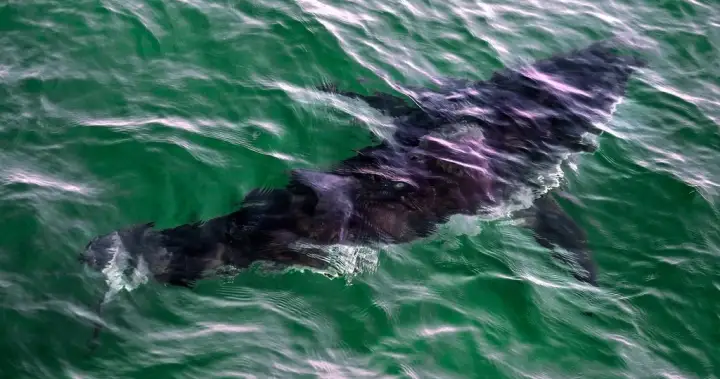
A diver was sent to hospital after an encounter with a great white shark off the Gaspé coast on Wednesday morning, prompting a local diving operator to suspend all diving activities for the remainder of the season.
In a statement, scuba diving centre Plongée Percé said the incident occurred during a diving activity.
The company did not provide details about the diver’s injuries or the circumstances surrounding the encounter, citing privacy concerns.
“Out of respect for the privacy of the person concerned, no additional details will be communicated on this matter,” the statement said.
Plongée Percé said emergency response measures were activated immediately after the incident. The diver received first aid at the scene before being transported to hospital for further assessment.
Plongée Percé said it has received confirmation that the individual’s life is not in danger.
The Canadian Coast Guard confirmed the incident to Global News.
“This morning, at approximately 10:27 EDT on September 16, 2026, the Maritime Joint Rescue Coordination Centre (Québec) was alerted that a diver from the YODA—a private vessel which is also part of the Canadian Coast Guard Auxiliary—had been bitten by a shark,” media relations officer Craig Macartney said.
“Ambulance services were dispatched to tend the victim when the vessel arrived in Percé, Québec.”
As a precaution, Plongée Percé announced that all diving activities have been suspended for the rest of the season.
The incident occurred in waters near Percé, a popular tourist destination on Quebec’s Gaspé Peninsula known for its marine wildlife and diving opportunities.
The incident comes amid an increase in reported great white shark sightings in the Gulf of St. Lawrence in recent years, including in waters off Quebec’s Gaspé Peninsula, the Magdalen Islands and Atlantic Canada.
Four of these sharks are being tracked by OCEARCH, a global non-profit research organization.
An 8-foot, 10-inch long, 456 lbs. juvenile female great white shark named Brookes was last pinged by researchers on Aug. 18 at 8:03 a.m., swimming in the river north of Sainte-Anne-des-Monts and west of Anticosti Island.
She was first tagged in September of 2025 off of the Mahone Bay, Nova Scotia and has traveled the length of the Eastern Seaboard and into the Gulf of Mexico.
Goodall, a 13-foot-long adult female great white shark weighing in at 1,393 lbs. was last pinged on Aug. 11, at 6:01 p.m. in the Gulf of St. Lawrence. She was also tagged off Mahone Bay in September of 2025.
In August, the recent shark sightings off Nova Scotia beaches caused enough concern among beach-goers that some were calling for new monitoring measures as officials stressed existing safety precautions.
Several Nova Scotia beaches temporarily closed following shark sightings in recent years. Martinique Beach was shut down for several hours in July after a reported sighting, while Queensland Beach was closed for a period last summer for the same reason.
The sightings prompted discussion about whether Atlantic Canada should adopt other technology used in other jurisdictions to monitor for sharks.
Experts say human behaviour often plays a role in shark bites
While shark bites on humans are very rare, a 2020 study at the University of Technology in Auckland noted an increase in trends such as the ‘wildlife selfie,’ which it says requires close proximity to unpredictable animal species and has been gaining popularity in a way that may “contribute to wildlife harassment” or provoke animal behaviour that could “pose a hazard for people.”
There is no information that would suggest the diver in Quebec was shark diving or taking an underwater selfie.
In July, fishing influencer Henry Gibbs was creating content in Fiji and almost lost his leg after being bitten by a reef shark. Similarly, in February last year, a Canadian tourist in Turks and Caicos lost both her hands while trying to get a photograph of a bull shark.
In April of 2025, the remains of a snorkeler in Israel who was reportedly swimming with a “selfie stick” were found after being killed by sharks while trying to snap photos, the BBC reported.
The New Zealand study also found that influencers and photographers were most likely to ignore safety instructions during shark-diving expeditions, though shark attacks are still extremely uncommon.
The University of Florida’s International Shark Attack File (ISAF) reports that the odds of being bitten by a shark are incredibly low. ISAF recommends ocean swimmers stay close to shore, avoid swimming at dawn or dusk and avoid excessive splashing.
The ISAF investigated 105 alleged shark-human interactions worldwide in 2025, with five total cases coming from the Bahamas.
ISAF confirmed 65 unprovoked shark bites on humans and 29 provoked bites, which occur when a human initiates interaction with a shark in some way.
The 2025 worldwide total of 65 confirmed unprovoked cases is in line with the most recent five-year (2020 to 2024) average of 61 incidents annually, according to the ISAF.
–with files from Rachel Goodman
Related Stories
 World
World
Maye Musk on raising the world's first trillionaire: Elon "just wants to do good" but steps "on a lot of toes"
34 minutes ago
 World
World
House approves sweeping Russia sanctions bill, sending it to Trump
34 minutes ago
 World
World
Families of Jimmy Lai, Min Zin plead in Washington for their release ahead of Xi’s visit
1 hour ago
 World
World
Fact
2 hours ago
 World
World
Watch: Leaked photos reveal extensive damage at US bases in Gulf
2 hours ago
 World
World
U.S. accuses Russia of plot to kill a prominent dissident in Washington
3 hours ago
 World
World
The T. rex had a body temperature similar to our own, study finds
3 hours ago
 World
World
UN chief urges global AI co
3 hours ago