
Doug Ford’s giant Lake Ontario sign cost $25K, premier’s office confirms
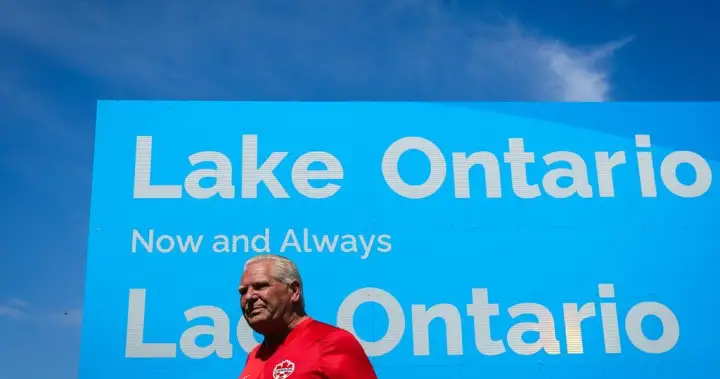
Taxpayers shelled out $25,000 to print and erect an oversized “Lake Ontario” billboard just east of Hamilton, the premier’s office confirmed, allowing Doug Ford to take a symbolic stand against U.S. President Donald Trump.
The sign, which reads “Lake Ontario now and always” in both English and French, was unveiled over the weekend, just days after Trump signed an executive order declaring the body of water as Lake America amid the ongoing trade dispute between Canada and the U.S.
“President Trump can call it whatever he wants, but I can tell you the rest of the world will always call it Lake Ontario,” Ford told reporters after unveiling the sign in Winona, Ont.
Ford’s visual response was the latest in an ongoing, and escalating, war of words with Trump that has seen the two politicians trading personal insults over Canada’s decision to walk away from tariff negotiations in late August.
While Ford’s Lake Ontario sign has garnered international news coverage, the premier’s political critics are questioning whether his approach — from the insults to a series of interviews on U.S. television networks — is helping the overall negotiations.
“I just think we’re giving President Trump what he wants,” said Interim Liberal Leader John Fraser.
“These are serious times; it’s a trade war. You need a plan, you need a strategy. We don’t need to be talking to Americans on American television. If the premier wants to be talking to people, he should be talking to Ontarians about what his plan is to protect Ontarians.”
The Ford government already announced its billion-dollar financial support program would be expanded to allow additional industries to apply for “tariff-related working capital challenges,” including help with payroll, lease and utility payments.
While the money was initially aimed at the steel, aluminum, auto and copper sectors, additional industries targeted by Trump’s tariffs, including mechanical equipment, plastic products, beverages, paper and packaging, leather and footwear, beauty and personal care, and furniture producers, will be allowed to apply.
The program, however, required businesses to have at least $2 million in revenue and 10 employees, which has raised concerns that small businesses might not be eligible.
“Two out of three jobs are from small businesses; they’re as impacted,” Fraser said. “So we have to protect all jobs.”
NDP Labour Critic Jamie West also questioned whether provincial funding comes with guarantees preventing employers from triggering layoffs.
“In Sault Ste. Marie, when the steel plant was being hit with those tariffs, the federal government and provincial government handed over hundreds of millions of dollars,” West said. “They still ended up laying off people. There are no strings attached”
West said Ford may not be employing the right strategy in the face of a mercurial president.
“I understand that the premier has tapped into the frustration people are feeling. We would all like to tell the president of the United States off at this point,” West said.
“But if you’re trying to get a deal done … imagine if you’re gonna buy a car and you showed up at the car lot swearing at the person who’s selling it. It’s gonna be tough to get a good deal on a car, right?”
Still, Ford’s approach is being endorsed by some in the business community, targeted by Trump’s trade war.
“No question, there’s been some emotions running high around what happened,” said the Ontario Chamber of Commerce CEO Daniel Tisch.
“I think people appreciate the fact that leaders are there to articulate the concerns of the people that they lead.”
Related Stories
 Canada
U.S. Pentagon defends Pete Hegseth’s post about Canada’s cadet program
52 minutes ago
 Canada
6 more byelections on horizon will test Liberal momentum, pressure other parties
52 minutes ago
 Canada
Schumer to introduce U.S. bill targeting Trump’s latest tariffs on Canada
52 minutes ago
 Canada
Canada's living standards 'languishing' behind U.S. as gap in economic performance widens: study
52 minutes ago
 Canada
Australian police find meth hidden inside McMuffin breakfast sandwich
1 hour ago
 Canada
Here's what Mark Carney said when asked if he would run in the next federal election
1 hour ago
 Canada
‘Loss of support is not boding well’: What the byelection results mean for Poilievre
1 hour ago
 Canada
Yorkton
2 hours ago