
Exclusive: Startup café was never permitted to open in S.F., city says
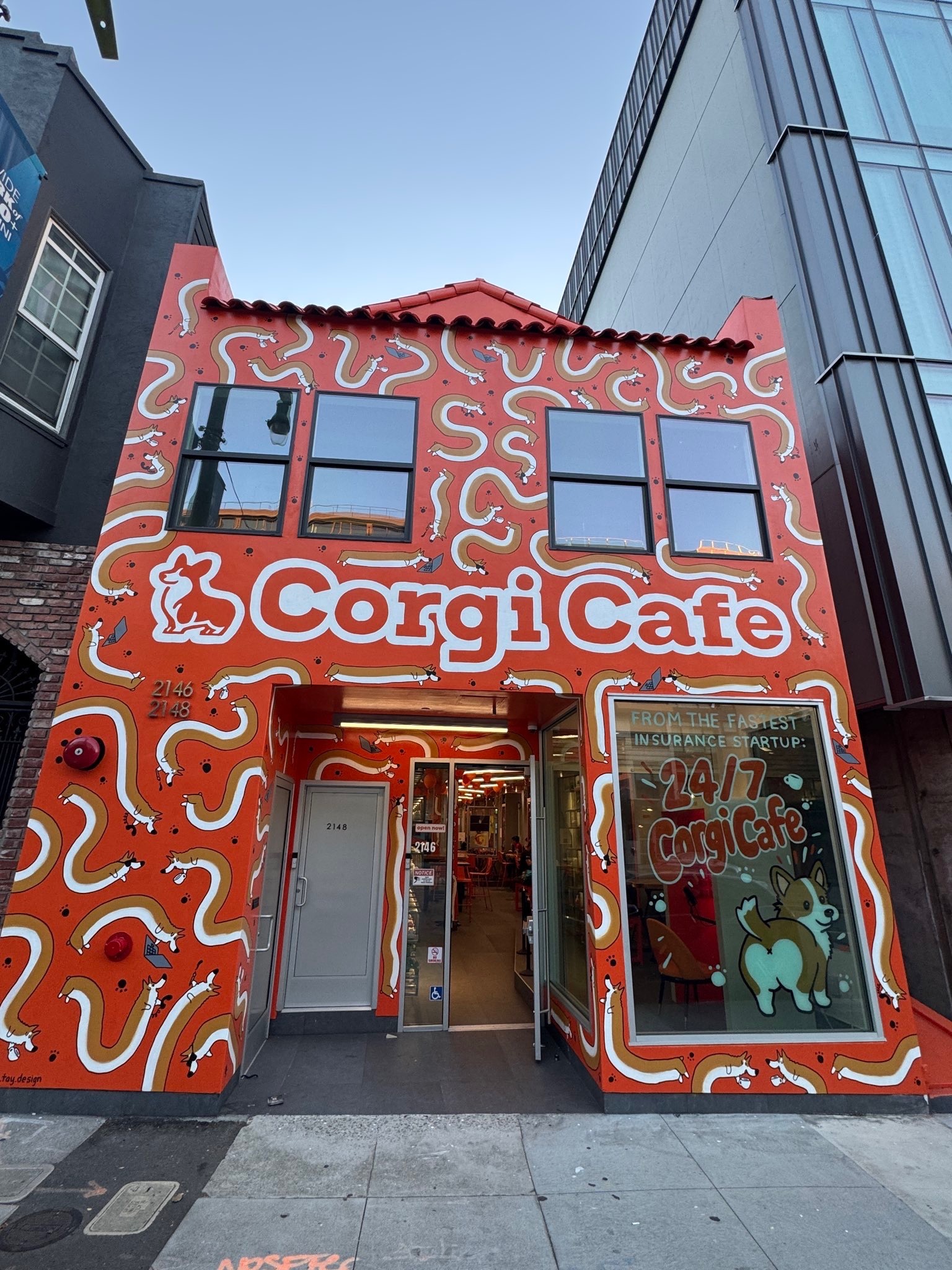
The Corgi Cafe in the Financial District, on Bush Street at Claude Lane, remains open.
This week in the Financial District, Corgi Cafe hummed with young customers bent over laptops and chatty crowds gathered outside to catch the company’s shuttle to startup accelerator Y Combinator.
The busy scene stood in sharp contrast to the company’s Dogpatch café location, which remains dark after it was ordered shut by health inspectors last month amid turbulence surrounding the company’s ambitious expansion plans.
Corgi insisted this week it has not paused its push to open 100 cafés across San Francisco — even though it laid off key members of its expansion team last month and scuttled more than a dozen nearly signed leases. It has also faced renewed scrutiny after a recent report described complaints about its cafés including exposed wires and a privacy booth that trapped someone inside.
Article continues below this ad
Corgi may look like a café or coworking space. But its main business is selling insurance to startups. The company says that creating cafés as social spaces for the AI industry helps build a customer base for its insurance services. But this dual approach has also created confusion, resulting in an appeal of one of the permits for its Dogpatch café.
The company’s familiar Silicon Valley impulse to move fast is colliding with the slower, more exacting systems that govern physical space in San Francisco. City permit officials told the Chronicle that the Dogpatch location should never have been occupied, and Public Works is now asking Corgi to remove a mural on the street in the Financial District that the city says constitutes unpermitted advertising.
In early September, Corgi opened its second San Francisco café on the ground floor of a three-story building on Third Street. Lining the walls were orange chairs and glass-fronted privacy booths — miniature offices furnished with desks, chairs and charging stations.
But just two weeks later, a city health inspector ordered the Dogpatch café closed for operating without a valid health permit. This week, the bright orange storefront emblazoned with cartoon corgis remained locked to the public.
Inside, construction churned on: A separate permit issued by the Department of Building Inspection a week later allows for café-related tenant improvement work, including changes to the basement level, which the company has said is reserved for employees.
The Corgi Cafe at 2146 Third St. in San Francisco’s Dogpatch neighborhood has been closed for weeks. A permit issue is now clouding its reopening.
But on Wednesday, a neighbor appealed that work permit — arguing that Corgi is using the Dogpatch café as a ground floor office — a use the appellant says is prohibited under the property’s zoning. The appellant called the location an “office masquerading as a café.”
The distinction matters because the area’s zoning was specifically put in place to protect its industrial history, allowing a mix of public-serving shops, arts and other uses serving blue-collar and creative trades while restricting offices to upper floors.
The company’s representatives insist that coffee, smoothies and other beverages are the primary draw.
“We are not using our cafés for office space. Our cafés are cafés, and our office space is office space,” a company representative said.
The appeal suspends work authorized by that permit, and a hearing is scheduled for December.
But even if the work is allowed to move forward, a separate, unresolved building permit could keep the Dogpatch café closed.
That permit for renovations to the three-story property was issued in 2024, before Corgi leased the space, but never finalized, city building officials confirmed to the Chronicle.
The city will not schedule a final inspection until Corgi submits required reports from third-party engineers who were supposed to inspect the work as it progressed. During an inspection in February, officials found the project close to complete, though some accessibility work remained. Corgi has not requested another inspection since, the department said.
The company never applied for a temporary certificate of occupancy, and therefore city officials said Corgi should not have occupied the space before the renovation permit was finalized.
To operate the café, Corgi also needs a separate health department permit and inspection. That permit can be issued only after the renovation permit is finalized, the building department said.
Corgi said it had inherited the unfinished permits when it leased the space at the start of the year. The building’s landlord previously hired a contractor to convert the space and failed to close out the permits, its spokesperson said.
By the time Corgi launched in its Dogpatch space, the company had obtained temporary permits from the health department on Aug. 31 to operate its café. But those permits expired a week later and could not be renewed.
“We’re an insurance company. We want to do everything by the books,” Corgi’s spokesperson said. “As much as we want to go fast and break things and do great things.”
That pledge now faces another street-level test at Corgi’s Financial District café. Public Works directed the company Wednesday to remove a 480-square-foot mural painted directly on the alley asphalt of Claude Lane. The city considers it unpermitted advertising on public pavement, and said it must be removed within 30 days or Corgi will face fines.
“The San Francisco Municipal Code and longstanding City policies prohibit applying, painting or affixing commercial advertising onto roadways,” Public Works spokesperson Anne Yalon said.
Corgi’s representatives told the Chronicle they are in discussions with the city to “work that out” and characterized the artwork as “freedom of expression.” Yalon said the design remains advertising because it retains Corgi’s color scheme, logo and likeness.
Public Works also received previous complaints alleging “graffiti” on Corgi’s facade, which has been abated, and that a Corgi-branded trailer was blocking Claude Lane while employees were handing out business cards from within. A complaint filed on Sept. 28 accused Corgi of “excessive advertising” at its shuttered Dogpatch location.
Corgi, founded in 2025 by 26-year-old Nico Laqua and 24-year-old Emily Yuan, has more than $400 million in reported funding. Beyond insurance and cafés, the company has also branched into reinsurance, real estate insurance and exchange-traded funds.
Earlier this year, Laqua told the S.F. Gazetteer that the landlord of the company’s Claude Lane café required him to lease the vacant retail space below Corgi’s fifth-floor office. He had applied for the office alone, he said, and the former hair salon had been empty since 2019. “I thought that making something for the startup community could be cool,” he said. That around-the-clock ethos extended upstairs: Forbes reported that most conference rooms had mattresses for employees who needed a place to crash, while Laqua often slept in a room called the “Founders’ Room.”
The café opened in February as a 24-hour gathering place for founders. Corgi’s spokesperson said the company had not initially planned to expand. But the first location became a “really great community hub for founders” and a venue for company events, and so Corgi began considering cafés in as many cities as it had offices.
As Corgi’s expansion team scouted storefronts across San Francisco, an email obtained by the Chronicle set an aggressive goal over the summer: 100 cafés in six months.
The city has asked Corgi Cafe to remove a mural on the street outside its Financial District spot, saying it constitutes unpermitted advertising.
The retreat came quickly. Corgi paused new leases before laying off members of its expansion team last month, leaving 16 deals near signature and landlords and the company’s brokers in limbo. Three new leases were signed, but none of those cafés has opened, and when — or how — Corgi will operate them remains unclear. At 260 Church St., operating around the clock would require special approval; at 968 Columbus Ave., North Beach zoning bars business operations during those hours.
The push was unfolding as Corgi’s flagship location began showing cracks.
Customer reviews were mixed: Some praised the Wi-Fi, staff and work-friendly setup, while others complained of crowding, noise, odors and overwhelmed baristas.
On Aug. 31, the city cited the café’s privacy booths for failing to meet city rules requiring them to be anchored to the floor or walls. A more recent complaint describes exposed wiring and nonfunctional electrical outlets.
“I was told by another customer to use exposed and loose power strips that ran behind the walls to plug my computer in. When I did so, sparks were emitted and I was afraid,” the complaint reads. “I attempted to leave the call booth, but the handle broke off and I was trapped inside.”
The Dogpatch café closure comes as the area attracts AI businesses and San Francisco is also trying to make permitting easier for businesses, consolidating the Planning Department, Building Inspection and Permit Center. Corgi’s case raises a question for a city courting tech companies: Can it speed up approvals while consistently enforcing rules on how commercial spaces are used?
Corgi’s other fast-growing businesses are demanding resources. “If something ends up really sticking and growing fast, you want to put your best people on that,” a company spokesperson said.
The spokesperson lamented that recent discussion had focused heavily on the company’s “hiccups.” The café’s original aim, the representative said, was to give startup founders, builders and operators a place to meet, have coffee and make connections. “What makes us unique is that we understand startups.”
Despite putting the brakes on its café expansion, the spokesperson said Corgi’s goal remains unchanged. “We still want to do 100.”
Related Stories
 Business
Police force 'inadequate' at investigating crime
6 minutes ago
 Business
ZAWYA: Riyada data finds surge in Oman’s startup ecosystem
8 minutes ago
 Business
Record Startup Shutdowns And A Market That Is Moving Forward - Contracts and Commercial Law
1 hour ago
 Business
5 startup ideas requiring less than ₹5 lakh capital: For a tea cart to hair salon
2 hours ago
 Business
State A.I. regulation bills stalled after Trump funding threat
5 hours ago
 Business
Buffalo energy bar company among five winners at the final 43North competition
6 hours ago
 Business
Ethiopia launches drone attack against Eritrean troops who crossed into Tigray
8 hours ago
 Business
Canadian investor, philanthropist Stephen Jarislowsky dies at age 101
10 hours ago