
Experts warn Albertans should prepare for more smoky skies this summer
Experts warn Albertans should prepare for more smoky skies this summer
Wildfire smoke exposure has physical and mental health impacts, doctors say
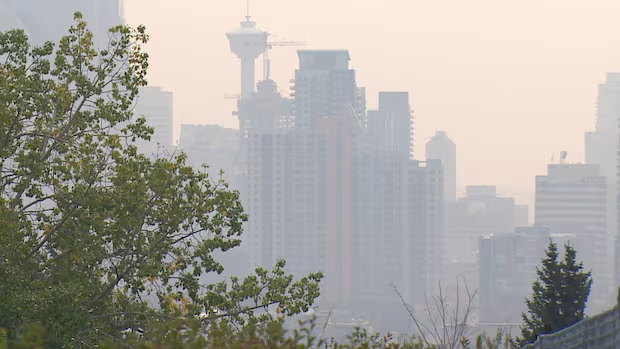
As Albertans brace themselves for what could be another smoky summer, health experts are warning there is no safe level of exposure.
A haze that settled into the Calgary area earlier this week due to wildfires in northern Saskatchewan and Manitoba has dissipated for now. But it is unlikely to last.
According to meteorologist Brian Proctor, recent rain has lowered the forest fire risk in most of Alberta.
“But B.C. is sort of poised to raise its head and cause us a little bit more smoke grief moving forward,” said Proctor, who is with Environment and Climate Change Canada.
Southern British Columbia is experiencing drought conditions and a very significant forest fire risk, according to Proctor.
“If they get an outbreak of dry thunderstorms we're going to be getting smoke back across southern Alberta from those moving forward."
According to Environment and Climate Change Canada, 2023 was the smokiest year in recent memory for Calgary, when 512 smoke hours were recorded, followed by 2021, when there were 439.
"It really is one of the biggest public health threats we have in Canada," said Dr. Courtney Howard, an ER physician and wildfire researcher based in Yellowknife.
"Unfortunately, it's becoming ever more clear that wildfire smoke is really bad for our health. It's a toxic mixture of many products of combustion, and it really depends on what's burned, what's in there."
Symptoms can include headaches, mild cough and eye irritation. Some people are hit with dizziness, wheezing, shortness of breath and other problems.
And the impacts can be far more severe, in some cases leading to heart attack, stroke or premature death, according to the Public Health Agency of Canada.
The particulates found in wildfire smoke can travel into the lungs and even cross into the bloodstream, causing inflammation, said Howard.
People with underlying health conditions, seniors, babies and pregnant people are at highest risk from exposure.
"We in the hospital will see increased levels of asthma exacerbation, chronic obstructive pulmonary disease exacerbations. A couple of days in we'll start to see increased levels of cardiac events,” said Howard, who is also president-elect of the Canadian Medical Association.
“So, if you have chest pain, don't just assume it's your cough. Do go get checked out in the emergency department."
There can also be reproductive and developmental impacts, health experts warn.
“There have been a couple of studies that showed increased risk of preterm birth,” said Howard, adding there are also concerns that very young children can end up with more ear and respiratory infections after exposure.
The BC Centre for Disease Control cautions there is also growing evidence of a link between wildfire smoke and health problems like gestational diabetes and low birth weight.
“There's no known safe level of exposure” to some of the pollutants found in wildfire smoke, the Public Health Agency of Canada website states.
In addition to physical health impacts, there is a mental health toll from wildfire smoke, according to Howard.
It can impact a person’s mood (similar to seasonal affective disorder), it impacts sleep, and it can trigger a sense of dread, she said. That dread, Howard explained, stems from knowing that "wildfires are becoming increasingly made worse by hot conditions, drought ... driven by our changing climate."
“We know that eco-anxiety is a normal response to a real threat," she said.
Howard is encouraging people to exercise in an effort to boost their mood, eat healthy food and work with others to decrease the threat of climate change.
During smoky conditions, doctors recommend staying indoors, closing windows, turning off outdoor air intakes and using a HEPA filter to remove particulates from the air, if possible.
Experts also recommend wearing an N95 mask if you do have to be outside.
“The only thing you should be breathing in is clean air,” said Dr. Kerri Johannson, a Calgary-based pulmonary physician.
She's urging people to learn about the short- and long-term impacts of wildfire smoke exposure.
"It's a risk. And it's a risk that we are studying but haven't well defined. But it can't be good for anybody," said Johannson, an associate professor at the University of Calgary.
She encourages people to monitor the air quality health index and take proactive steps to protect themselves, particularly if they have underlying heart and lung conditions.
“People kind of slip up and they might not be taking their inhalers, but now is the time to make sure that you’re acting preventatively and taking your regular inhaled medications, taking your blood pressure medications, monitoring your symptoms,” she said.
“There’s some thought that air pollution … reduces your ability to fight viruses and bacteria. So that puts you at risk of an infection , which really is a big thing that tips a lot of people over the edge."
People should also take steps to reduce compounding risk factors such as smoking, vaping and having campfires, according to Johannson.
Jennifer Lee is a Senior Reporter for CBC News based in Calgary. She covers health stories for CBC's web, radio and video platforms. If you have a story to share, let her know.
Related Stories
 Canada
Albertans head to polls in historic referendum on whether they want to stay in Canada
10 hours ago
 Canada
In the news today: four soldiers killed, Alberta referendum, AI privacy fears
10 hours ago
 Canada
How a grass fire at a Canadian military base killed four soldiers
10 hours ago
 Canada
How will household electricity rebate reduction, temporary winter pricing change impact Ontarians?
11 hours ago
 Canada
Residents told to boil tap water due to bacteria
11 hours ago
 Canada
Oil
12 hours ago
 Canada
Albertans vote on path to independence as Carney fights to keep Canada united
12 hours ago
 Canada
Two of 4 soldiers killed in fast
13 hours ago