
Farmers' interest in pesticide
Farmers' interest in pesticide-spraying drones surges after regulation change
Some say the tech could be cheaper, more effective than existing methods
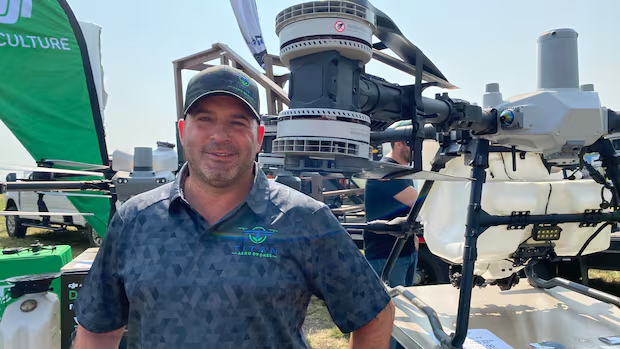
Last year, salesman Ryan Crumly predicted farmers would rush to adopt drone technology once it became legal to use them to spray insecticides and fungicides on crops.
At the end of June, Health Canada lifted its restrictions to allow drones to spray approved pesticides. That change "opened the floodgates" for farmers seeking the tech, said Crumly, who works for Titan Aero Drones.
"My phone has never been so busy," he said.
"We probably had close to 80 drones and they sold out in a matter of days."
Farmers and drone dealers welcome the policy change, saying the flying machines can be more effective than ground sprayers and planes. The uptake on pesticide-spraying drones is expected to be significant, with several farmers saying they're looking to buy one in the coming years.
Pesticide-spraying drones are touted as a new technology with a slew of benefits.
For one thing, they beat planes and helicopters because those can only fly during the day and can't get close to trees or powerlines, Crumly said.
This year, he also heard from farmers who were particularly interested in a drone because flooding meant their ground sprayers were getting stuck in the mud.
They're also easy to use, Crumly said. Farmers can map out where and how they want the drone to spray, and the machine will fly largely autonomously.
"You're just a babysitter that changes batteries and fills the tank," Crumly said.
Greg Hill, who runs a farm and ranch in southeast Saskatchewan, said he foresees drones having a "really big impact" in agriculture.
Even with narrow tires, ground sprayers can trample 22 to 24 acres of crop while working, Hill said. That could mean losing almost $15,000 worth of canola crop. Drones wouldn't have that issue.
"It doesn't take long to pay for the drone," Hill said.
Spray drones can cost tens of thousands of dollars. But that's cheap compared to ground sprayers, which can cost hundreds of thousands, Crumly said.
Operational costs are also lower — about 83 cents an acre to run a drone, compared to $10.50 an acre for a high-clearance ground sprayer.
But farmers aren't exactly looking past the price tag.
"Probably my biggest hesitation is, my chequebook isn't quite big enough yet," Hill said.
While he said the drones are "the way of the future," Hill said the tech may not be able to spray many acres at a time and likely needs a bit more development. Still, he's seriously considering getting one.
2 Sask. research farms slated to close will now stay open
Sask. farmers long for warmer days as crops suffer from severe weather
Raymond Phillips, who runs a farm in Alberta northwest of Lloydminster, said he's also watching how the tech improves. He's mindful of how much having a drone could cost beyond the initial sticker price, he said.
Regulation change brings renewed interest in pesticide-spraying drones
"You need a mixing system, you need a generator, you need a pilot's licence," he noted. "There's lots of pieces to the puzzle to do that before you say, yeah, I'm buying one today."
But Phillips said he foresees himself getting one in the next two or three years.
"They're still in the development stage," he said. "But I believe that it's a coming thing."
Maia Tustonic is a journalist covering local and provincial news in Saskatoon. She previously reported national health, business and politics stories for CBC News. She would love to hear your story — reach her by email at maia.tustonic@cbc.ca.
Related Stories
 Technology
Google bets on local hubs to source AI startups
1 hour ago
 Technology
A new defense tech initiative will serve Baton Rouge startups, small businesses
1 hour ago
 Technology
Some chips are built to withstand radiation and extreme heat. Microchip bought their maker.
3 hours ago
 Technology
Microchip Technology acquires VORAGO Technologies
3 hours ago
 Technology
Chandigarh University Hosts National Incubator & Capital Summit and ISBACON 2026, Bringing 400 Incubators, 80 Investors & 100 Startups Together to Strengthen Indias Startup Ecosystem
4 hours ago
 Technology
A 20
4 hours ago
 Technology
Why American investors love European defense startups
5 hours ago
 Technology
News Content Hub
5 hours ago