
Food inspection agency warns of paralytic toxin in shellfish in Quebec's North Shore
Food inspection agency warns of paralytic toxin in shellfish in Quebec's North Shore
Shellfish from some harvesting areas could cause health problems, even death
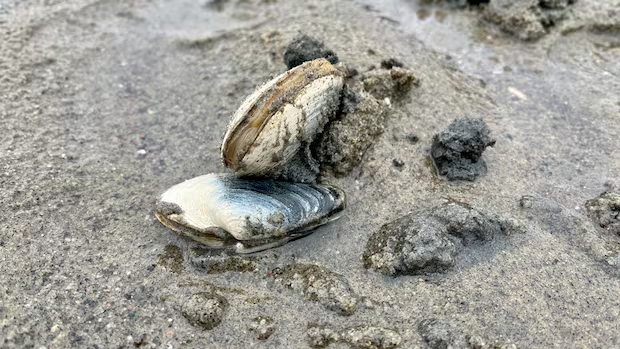
The Canadian Food Inspection Agency (CFIA) is warning people in parts of Quebec’s North Shore of the presence of a paralytic biotoxin in mussels, clams, scallops and oysters harvested in some areas.
Tests carried out by the agency earlier this month revealed high concentrations of biotoxins in bivalve shellfish collected in some approved harvesting sectors.
On July 3, the Department of Fisheries and Oceans Canada posted a warning on Facebook saying consuming this shellfish could cause severe health problems and even death.
On its shellfish harvesting map — Shelli — the government outlines, in red, zones where harvesting shellfish is now unauthorized.
These sites are concentrated between Tadoussac and Forestville, Que., said David Fortin, inspection adviser with CFIA for the food safety program.
"We don't monitor every site or every beach … that exists along the North Shore of the St. Lawrence River, it's just too wide of a territory. So we have a few sectors that we monitor like every week," he said.
"The very best way to prevent shellfish poisoning is to go harvest inside of approved and open harvesting areas."
No telltale signs of toxin's presence
Part of the risk with this toxin — one of three causing shellfish poisoning — is there are no telltale signs or visual indicators of the toxin’s presence, said Fortin.
The other two toxins outlined by the CFIA are diarrhetic shellfish poisoning — causing nausea vomitting and diarrhea — and amnesic shellfish poisoning — causing memory loss, nausea, vomiting and disorentiation.
These toxins are also not destroyed by cooking. The first symptoms of paralytic shellfish poisoning can appear within a few minutes and up to 10 hours after eating a contaminated species.
These symptoms include a tingling sensation or numbness of the lips that gradually spreads to the face and neck, prinkling sensation in the fingers and toes, drowsiness, headaches, dizziness, as well as difficulty swallowing.
In the most severe cases, muscle paralysis can lead to fatal respiratory arrest.
Presently, there are no known antidotes to the toxin, says Fortin.
Harvesting local shellfish can be a great way to save money, but officials are warning about contamination
He said some concentrations of the paralytic toxin could be found in lobster tomalley — which functions as the crustacean's liver and pancreas.
"When you break the tail off of your lobster, there's sometimes a little bit of a greenish brownish paste," he said.
He says lobster lovers shouldn't be too concerned if they happen to eat trace amounts, but advised people not to consume large quantities often.
Rachel Watts is a journalist with CBC News in Quebec City. Originally from Montreal, she enjoys covering stories in the province of Quebec. You can reach her at rachel.watts@cbc.ca.
With files from CBC's Quebec AM
Related Stories
 Lifestyle
Learner drivers still waiting 20 weeks to book tests
20 hours ago
 Lifestyle
Whose food is ‘dirty’? Politics of purity, impurity on India’s plate
22 hours ago
 Lifestyle
Protesters, police clash in Albania over Trump
23 hours ago
 Lifestyle
If You Loved 'The Bear,' There's One Movie You Need to Watch Next
2 days ago
 Lifestyle
US Diesel Prices Hit Record High
2 days ago
 Lifestyle
Peaches from Japan's Fukushima delight people in Taiwan
3 days ago
 Lifestyle
Beyond food and politics: Why Ganga Dhaba matters to generations of JNU students
3 days ago
 Lifestyle
University of Hawaiʻi receives $2M for development of artificial intelligence tools to protect food production systems
4 days ago