
Ford government to begin ripping out, reconfiguring Toronto bike lanes following court of appeal ruling
Ford government to begin ripping out, reconfiguring Toronto bike lanes following court of appeal ruling
Vehicle lanes on sections of Bloor Street W. to be 'immediately' restored, province says
Ford government to begin Toronto bike lane removal. Here's what you need to know
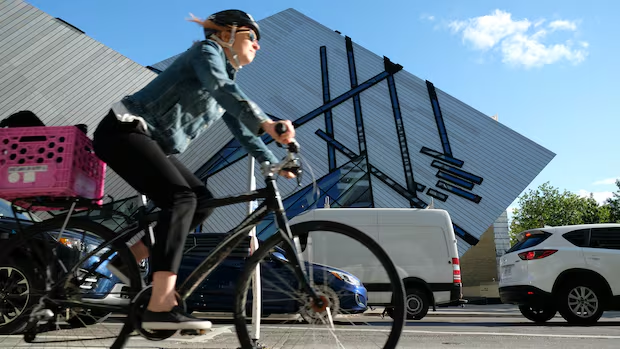
The Ford government is going ahead with bike lane removal and reconfiguration on some of Toronto's busiest roads, the province announced Tuesday.
Tuesday's news release says that the provincial government is going to begin the process of "restoring motor vehicle lanes" that were previously removed to make bike lanes on Bloor Street, Yonge Street, University Avenue, Queen's Park, Queen's Park Crescent and Avenue Road.
The release says the province has also issued a request for proposals to "study and provide design options" for restoring vehicle lanes along some "sections" of Toronto's busiest streets. These proposals would look into options for retaining or reconfiguring bike lanes, according to the release.
Ontario Court of Appeal says Ford can rip out Toronto bike lanes
Ontario aware bike lane removals may not reduce congestion, could make people less safe: internal documents
"The province is also immediately beginning to restore motor vehicle lanes on Bloor Street W., starting east of a 600-metre section at Clissold Road where vehicle lanes were restored in December 2025," the news release said.
The announcement comes after Ontario's court of appeal ruled in August that the Ford government can rip out 19 kilometres of protected bike lanes in Toronto, reversing a lower-court decision made in July 2025.
Restoring vehicle lanes stops congestion, transport minister says
When asked about bike lane removals at an unrelated news conference Tuesday, Ontario Transportation Minister Prabmeet Sarkaria was firm in saying that bike lanes in areas like Bloor Street W. is the reason for gridlock and congestion in the city.
"Getting these bike lanes out of the way, restoring vehicle lanes, will allow us to get people moving quicker and faster in one of the busiest cities in the world," he said.
Sarkaria went on to say that he had spoken to "many community members" about the bike lanes. He said their instalment has impacted local business and is causing less people to go downtown.
"We need to restore the vehicle lanes to stop the congestion," he said.
In a separate interview Tuesday with CBC News, Sarkaria said the 600-meter section the province is looking to "immediately" remove along Bloor Street W. would "require the least amount of work" to bring back car lanes.
When asked about how the province will decide to remove or reconfigure the bike lanes it identified, Sarkaria said "the vehicle lane gets the priority."
"In some circumstances where both could coexist, we'll consider that and look at that," he said.
Where will cyclists go if Toronto loses major bike lanes?
When asked about safety concerns once the bike lanes are removed, Sarkaria said the rules of the road will still apply to cyclists and drivers.
"We expect, just like the hundreds of thousands of other streets in Ontario where both the vehicles and cyclists can coexist, that that will continue to happen on the streets that we are specifying right now," he said.
Sarkaria also said secondary streets, such as King Street and College Street, would be better alternatives to the bike lanes the province looks to remove or reconfigure.
Internal documents from the transportation ministry that were made public as part of a court challenge to Bill 212 — the legislation that gave the province sweeping control over municipal bike lanes — cast doubt on some of Sarkaria's statements.
Those documents include a report prepared by engineering and urban planning firm CIMA+, which said collisions for all road users could increase upwards of 54 per cent if bike lanes are removed, based on existing research.
A 2024 briefing note on from the cabinet office committee also said the proposed bike lane removals may not achieve "desired outcomes," saying that current data and research "does not confirm that removing bike lanes that occupy a lane of traffic would significantly alleviate congestion."
Ontario appeal court says Ford can rip out Toronto bike lanes
Bike lanes a municipal election issue
Bike lanes are already proving to be a contentious municipal election issue. Mayoral candidate Brad Bradford previously vowed to remove the Bloor Street W. bike lanes should he become mayor, despite initially being one of the councillors who voted in favour of them.
Mayor Olivia Chow, who is seeking re-election this fall, issued a statement Tuesday saying the province should be focused on dealing with Trump and helping families and workers, rather than "picking endless political fights with the City of Toronto."
"I resist any argument that pits road users against each other because it makes everyone less safe. Pedestrians, cyclists and drivers all deserve safety on our roads," Chow said.
Tell us what’s at stake for you in Toronto’s municipal election
Bradford vows Bloor Street W. bike lanes are 'coming out' if he's mayor
Mayoral candidate Chris Alexander said the province's actions are evidence of "governance failure" at city hall, and as mayor he'd table a transportation plan that "actually works."
"A competent city works with the province and designs solutions that have neighbourhood support. Toronto needs to get things right the first time, instead of getting stuck in costly court battles for years," Alexander said.
Ontario Green Party leader Mike Schreiner also weighed in on the province's announcement, calling it "performative politics" that "doesn't address the root cause of congestion."
"What we actually need is more dedicated bike and transit lanes and investment in transit that allow for more people to get around more affordably and efficiently," he said in a social media post.
Related Stories
 Canada
NBA clears way for Leonard
20 minutes ago
 Canada
Thunderstorms, rain looming for Toronto as heat warnings hit southern Ontario
20 minutes ago
 Canada
Republicans are blaming Canada for Trump's trade war
21 minutes ago
 Canada
U.S. admiral compares military action against Canada to fighting extraterrestrials
21 minutes ago
 Canada
'That moment was glorious': How a Blue Rodeo hit became a rallying cry for Lake Ontario's name
21 minutes ago
 Canada
Severe thunderstorms, tornado possible in Waterloo region and Guelph Wednesday
21 minutes ago
 Canada
George Clooney slams Pete Hegseth for mocking Canadian cadet program
21 minutes ago
 Canada
Donald Trump mistakes Bank of Canada for retail bank
1 hour ago