
Former Israeli news star builds startup to destroy Hamas, Hezbollah tunnels
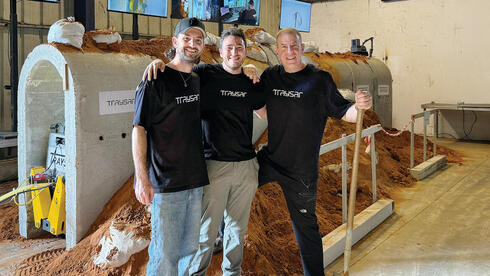
Gilad Adin was once one of the most recognizable faces in Israeli television news. A well-known reporter and anchor, he was considered at the height of his media career one of the country’s senior journalists. He later held major management and editorial roles, including editor of a prestigious Friday night news program and CEO of Channel 10 News, the previous incarnation of what is now Channel 13.Now, at 60, he is making a surprising turn. For the first time in his life, Adin is becoming a startup founder, and not just in any field, but in one of the hottest sectors in the global market: defense tech.Gallery(R-L) Gilad Adin, Asher Katz and Yadin Sofer (Photo: Traysar)“When my friends are already thinking about retirement, I feel like I’m at the beginning of the road,” Adin says. “In some sense, I’m going back to the start. A not-so-young man with two partners in their 30s, who takes his laptop in the morning and happily walks to work.”Last week, at a major industry conference in Detroit, Traysar, the new startup Adin co-founded with two partners, was unveiled for the first time. It is one of the first companies in the world developing and manufacturing systems designed to operate below ground: for dismantling and destroying tunnels and bunkers, rapidly penetrating the earth’s crust and protecting critical infrastructure at those depths.So far, the company has revealed only two systems. The first is a kind of small autonomous D9, a reference to the armored bulldozers used by the IDF, designed specifically for tunnels and controlled remotely by fiber-optic cable. The small vehicle is built to fit the dimensions of tunnels like those used by Hamas and Hezbollah. It can “run” through them, pass sandbags, blast doors and mines, reach the end of the tunnel and then dismantle it while moving backward.The second system is deployed from a command-and-control trailer in the field and allows forces to strike facilities buried underground without using airstrikes.Traysar, which is only one year old, has already raised $25 million from some of the most respected funds in the industry, at a valuation of more than $100 million.“We know how to build underground facilities quickly, and we want to control the entire underground value chain,” Adin says. “In Iran there are huge underground bases where vehicles drive inside. The West has no solutions for that today, and that is where we will be.”Adin says the idea required a different way of thinking about warfare below the surface. “When people say ‘surface-to-surface missile,’ they mean a missile that comes out of the ground and returns to the ground, but there is no missile in the world that moves through the ground,” he says.The first formal encouragement came from MAFAT, the Directorate of Defense Research and Development in Israel’s Defense Ministry. “When we came to our first meeting at MAFAT, all the relevant department heads gathered in the room,” Adin says. “When we finished the presentation, there was silence, and then one of them said just one sentence: ‘At last, we have someone to talk to about the underground.’”MAFAT is in close and regular contact with DARPA, the U.S. Defense Department’s advanced research agency. “With the feedback that we were heading in the right direction from both those bodies, we set out,” Adin says.They met at a Shabbat dinnerAdin entered the business world with a master’s degree in economics and business administration and an intelligence background in the IDF, where he served as a commander and reservist in Unit 8200, Israel’s elite signals intelligence unit. Together with his son-in-law, Yadin Sofer, a serial entrepreneur married to Adin’s daughter Maayan, he opened a large production company that, among other things, brought TED conferences to Israel, featuring short lectures by figures from science, the humanities, art and politics.“The new chapter began after October 7, when I got a call from Yadin, who had been living with my daughter in New York in recent years,” Adin says. “He had founded a startup there, made an exit and was looking for the next thing. Maayan and Yadin had created a kind of institution in their New York home: Friday night dinners for Israelis. There they became very close with Asher Katz, a reservist who had served for a long period in the Gaza Division’s tunnel detection and identification laboratory.”Katz had also founded a youth movement for young Jews in New York for billionaire Edmond Safra. Together, the three began developing the idea of a company built around countering Hamas tunnels.“We couldn’t find other companies in the world or in Israel working in the field, and usually when you reach a place where no one else is, it’s probably not by chance,” Adin says. “But Yadin insisted, and I sat down to study the subject.”(Photo: Traysar)What he found, he says, was a military reality that had moved underground faster than the West had prepared for it. “Very quickly it became clear to me that more than 10,000 military facilities around the world are now dug underground. While the West, including Israel, controls the air, the axis of evil is digging in. It is not only Iran, Hamas and Hezbollah that have gone underground. Drug cartels have dug cross-border tunnels from Mexico into the United States. The Chinese have been investing for many years in underground facilities and hiding everything below ground. India faces cross-border tunnels from Pakistan, Spain faces tunnels from Morocco. South Korea has also uncovered huge tunnels that North Korea prepared for an invasion, and more.”Traysar was founded last summer with two centers. Its main headquarters are in Austin, Texas, where Sofer currently serves as CEO and handles investor fundraising in the United States and financial management. Katz manages research and development from the U.S. In Israel, a subsidiary was established, from which Adin manages strategy, marketing and sales, and is responsible for ties with Israel’s Defense Ministry and MAFAT. His son-in-law Sofer will soon join him in Israel, returning with his family.Battle deep undergroundThe company’s first move was to recruit engineers who could combine military experience, mining and tunneling knowledge, and the kind of hardware thinking more often associated with aerospace or infrastructure than with software startups.“The first thing we did was recruit the best engineers,” Adin says. “In Israel, we recruited people who had worked in the IDF’s special units, because they have both strong engineering understanding and practical experience. In the United States, we turned to engineers from SpaceX and from Elon Musk’s tunneling company, The Boring Company, which builds underground tunnels in the U.S. to reduce traffic congestion. Everyone basically received one challenge: defeat the laws of physics. It is hard to move inside the earth’s crust.”A few months later, the company had already presented its capabilities at a secret facility in central Israel to a delegation from DARPA and other U.S. bodies, including the Navy and Border Patrol. “Today we have 20 employees, about half of them in Israel, more than 90% of them engineers, and we are constantly hiring,” Adin says.The company is now looking at scenarios that until recently sounded almost fictional: deep underground targets, hardened facilities and even possible ways to collapse buried military infrastructure without relying only on bombs dropped from the air.“Yes, unequivocally,” Sofer says, asked whether the company’s methods could one day penetrate deep underground sites where sensitive military assets might be hidden. “This is not theoretical. DARPA published just last month what is called an RFI, a request for information, seeking initial proposals for the possibility of ‘non-kinetic penetration’ to strike deep underground targets. You read it and it is completely clear what they are talking about: They expect a rethink of how to create collapse inside an underground facility, because they think, and we of course agree, that bombing from the air may not be the optimal way to destroy facilities buried at such depth.”“So we are now writing the documents we will submit to DARPA. We were born exactly to solve problems like these. And the amazing thing is that only a year ago, people still looked at us as if we were a little crazy.”Sofer stresses that such capabilities are not expected to be ready overnight. “The U.S. Defense Department is also not asking to test such missiles tomorrow, and even if it were, it is not clear whether they already have budgets for it. Right now, the money is going to classic bunker-busting bombs.”Katz says the sense of urgency inside the company is real. “We are very mission-driven on this. I wrote to all the employees: You need to understand that to the extent the United States and Israel have the ability to do this, it will change the West’s deterrence capability and, in effect, the entire world order. This is a mission that speaks to people on the most personal level. And I tell them, guys, we are under time pressure. These facilities need to be collapsed as quickly as possible.”A Hamas tunnel near the border with Egypt (Photo: IDF)Sofer says that before the war, what they were discussing sounded highly theoretical. “Suddenly everyone understands that the war with Iran does not end simply because we do not have capabilities to strike the underground. I think that change is also evident in the level of the investors behind us. They are not just people with money, but people with a very strong voice at the highest levels of government. And those voices eventually trickle down.”Traysar now has about 20 early-stage developments in the pipeline, but began with two systems it sees as most urgent in the field. The first is an autonomous breaching and destruction system, a miniaturized D9 that can be inserted into a tunnel opening in Gaza or Lebanon.“What is special about the vehicle is that it is very durable, can absorb blows and pass obstacles, whether sandbags or blast doors,” Sofer says. “It first reaches the end of the tunnel, then drives backward and dismantles it from the inside out. That can also include drilling small holes at tactical points inside the tunnel and filling them with explosives that will be activated later.”Katz says the system draws heavily on civilian and industrial knowledge. “The vehicle clears the path it needs to move through. There is a power component required in designing the vehicle, and it is critical in engineering. We are not reinventing the wheel here. The world of tunneling and the underground is hundreds of years old. In mining, tools have been developed for more than 100 years that can perform very violent operations underground to clear paths. We are learning from that world and asking ourselves how to bring it into today’s tactical military world.”The vehicle is operated remotely by fiber-optic control, with autonomous components that allow it to keep functioning if communication is lost, something that happens often in tunnels. Sometimes, Katz says, the fiber itself gets stuck. Repetitive actions, such as drilling and inserting explosives, can also be automated: “It is enough to press a button and the machine knows how to do them by itself.”The goal is not to leave such tools only in the hands of special units. “We are thinking about how to bring capabilities like these to the entire army,” Katz says. “In every maneuvering combat engineering battalion, for example, this tool would be part of the maneuver force, and heavy-equipment operators would know how to operate it without waiting for special forces.”The second system is very different. It resembles a tool known as HDD, short for horizontal directional drilling, which is already used in civilian markets to move infrastructure such as electricity and communications through the ground.“This is a system that can move explosives, sensors and one day, when the diameter grows, even people, through the underground,” Sofer says. “You can also think of it as a missile, an underground torpedo: a system that can dig its own path very quickly and explode at the end. In the United States they call it ‘non-kinetic penetrator munition.’ Another possible use one can imagine is in the trench war now taking place in Ukraine, the ability to move equipment from point A to point B on the battlefield, underground.”The equipment is heavily dependent on soil and geology. “We encounter that in the United States,” Sofer says. “Here in Texas, for example, there is one geology, and in the western part the soil is completely different.”That challenge pushed Traysar to combine Israeli military engineering experience with American tunneling expertise. “As soon as we encountered that problem, we understood that we needed not only our engineers from Israel, who came from special units, but also engineers from Boring, who had experienced it and know how to deal with different geologies,” Katz says. “Their company was deployed once in Las Vegas, once in Texas and once somewhere else. It was a very interesting process, creating a common language that connects our Israeli team, which speaks the military language of ‘logistical signature,’ ‘thermal signature’ and so on, with the American team. In the end we actually built a dictionary that the engineers use when writing the product specifications. What is required here is a shared language that combines parameters from the military world and the civilian world.”Traysar is also working on underground protection. Sofer says the company will announce several developments in that field in the coming months, but for now he will speak only about the principle: moving critical systems underground quickly and efficiently.(Photo: Traysar)“What distinguishes a military environment is rapid maneuverability,” he says. “When talking about the underground in a defensive context, we are talking about the need to lower something below ground as quickly and efficiently as possible, whether it is a command-and-control post or a server farm.”A conversation with the CEO of a company that manufactures data centers and works with the Pentagon helped sharpen the opportunity. According to Sofer, the executive told him that over the past six months, Pentagon officials have repeatedly asked whether his company can move facilities underground. American bases and large server farms were hit by missiles in the Middle East, leading officials to conclude that infrastructure may be safer below the surface. But, the CEO told him, “No American company wants to do that for them.”“This is America, and the Pentagon can assign the mission to the U.S. military, but they do not have the capabilities or tools to do it quickly and efficiently, with a low logistical signature,” Sofer says. “That is what we bring to the market in protection.”Katz says there is growing criticism in the United States that American critical infrastructure is exposed to attack. “They run their training under giant tents. And when you look at Ukraine, for example, you don’t see tents exposed to drones. The criticism is that the U.S. military is still training for a war that no longer exists, and that training also needs to move underground. That is where we come in.”At its core, Sofer says, Traysar is creating machines that can move, carry or position things inside the ground. That can mean a pipe allowing access from one point to another, or a way to move something underground, from a fighting force to a command-and-control trailer or a data center. The technology draws from tunneling and drilling, two industries whose differences are often a matter of diameter, meaning the width of the “hole” through which something must pass.“Until today, when you want to dig a tunnel, you first need to dig a huge and deep pit, a process that takes months, and then, from below, operate a tunnel boring machine, a TBM,” Sofer says. “When our engineers were still working at Elon Musk’s company, they built a truck that can launch such a machine into the ground within a few hours without needing to dig, simply at a certain angle.”Adin says the company can also build underground facilities quickly, but does not see itself as only a tunnel company. “We want to control the entire underground value chain, but not only tunnels. I remind you that in Iran, for example, we are talking about huge underground bases where vehicles drive. The West has no solutions for that today, and that is where we will be.”Some of the company’s work is still years ahead, but some is already moving toward field demonstrations. Sofer says the American procurement system ultimately shapes the development schedule. Funding for U.S. defense startups is divided between long-term budgets allocated by Congress and short-term budgets for immediate development, with enormous sums at stake.“They call it TRL, technology readiness level,” he says. “TRL 1 can be a product at the idea stage only, and TRL 7 means a product ready to go into the field. We are trying to capture development grants, so over the past year we focused on developing the two systems we discussed, with which we have already reached TRL 7. We are already running forward to the demonstration stage, prototypes we can show in the field, and those products have different configurations, such as adaptation for tunnels in Gaza or tunnels in Lebanon.”Beyond that, Traysar has dozens of products at TRL 1 to TRL 3. The company is now building a sales team in the United States, working mainly with the U.S. Defense Department, in order to align its priorities with Washington’s.Katz gives one small example of the kinds of problems units are already raising. One unit, he says, needed to disperse energy centers among many underground points without placing a generator or battery at each one. “We told them, ‘What if you had a tool that knows how to lay electricity infrastructure from one point to all the others?’ For them, it sounded like a dream.”The company has already carried out trials, Katz says, both in facilities in Israel and in Hamas tunnels in Gaza, in cooperation with MAFAT, Yahalom, the IDF’s elite combat engineering unit, and the Combat Engineering Corps. All of them, he says, serve as a source of knowledge and help define operational needs.The next warAdin’s new startup fills him with energy. After finishing his role as CEO of Channel 13, he left journalism. Older Israelis still remember him for delivering the first announcement on Israel’s public broadcaster about the assassination of Prime Minister Yitzhak Rabin. Younger Israelis may recognize his voice from the Ben-Gurion Airport announcement warning passengers not to leave objects unattended.In the years since leaving the media, he founded a production company and also began a lucrative career in strategic and communications consulting for world leaders. The intermediaries were former friends from Unit 8200 who became major figures in the intelligence world. For 13 years, he hopped between flights in East Asia, Africa and Europe, becoming the discreet confidant of senior figures in exotic countries, including some that do not have relations with Israel.“In January 2020, I decided I wanted to focus only on consulting and transferred the production company to my employees,” Adin says. “A month later, in mid-February, COVID arrived. Everyone suspected I had advance information, because production companies were hit hardest during COVID. I was lucky. That is how I survived.”Unlike a high-tech company that can produce algorithms quickly, Traysar is building hardware, and hardware takes time. Katz says that is exactly why Israel needs to change direction.“I think one of Traysar's important messages is that we in Israel need to make a shift toward physical products,” Katz says. “The world is moving in that direction, and if we do not know how to join the trend, we will be left far behind. We are pushing our products very quickly, and we believe people will understand the need for this fast. You will still see us with white hair and heart attacks because we cannot keep up with the production pace. I know it will come.”For Sofer, the future battlefield may look less like the high-tech air campaigns of recent decades and more like a return to an older, harsher kind of war.“If I had to describe our future war, in my view it will resemble World War I,” he says. “You see it in Ukraine: size and money do not necessarily affect superiority on the battlefield. Lethal capabilities are going to move all of us into trench warfare, and that means that in the end, the ability to protect yourself and survive battle over time is what will decide the next war. So in my opinion, our ability to enable maneuver, or alternatively rapid protection underground, is arriving at the perfect time.”Adin goes even further. “Albert Einstein already said that he did not know with what weapons World War III would be fought, but World War IV would be fought with sticks and stones,” he says. “I think that today we at least know that World War III will not be fought only in the air, at sea and on land, but also inside the earth’s crust.”
Related Stories
 World
World
Manchester United weigh up stunning move for Real Betis and ex-Tottenham forward Troy Parrott
2 days ago
 World
World
Israeli police arrest 10 following weekend attacks by settlers on journalist and diplomats
2 days ago
 World
World
Trump says suspension of Russia sanctions is to keep peace negotiations going
2 days ago
 World
World
Ukrainian drones strike St. Petersburg oil facilities | NHK WORLD
2 days ago
 World
World
Victoria Falls stadium in Zimbabwe nears completion for CWC27
2 days ago
 World
World
‘The world will be amazed:’ Iran’s commanders prepare for further war
2 days ago
 World
World
Festival opens with musket salute in Sakai, Osaka
2 days ago
 World
World
Trump's new pitch for Republican candidates — they're really good
2 days ago