
From Shah Bano to Waqf
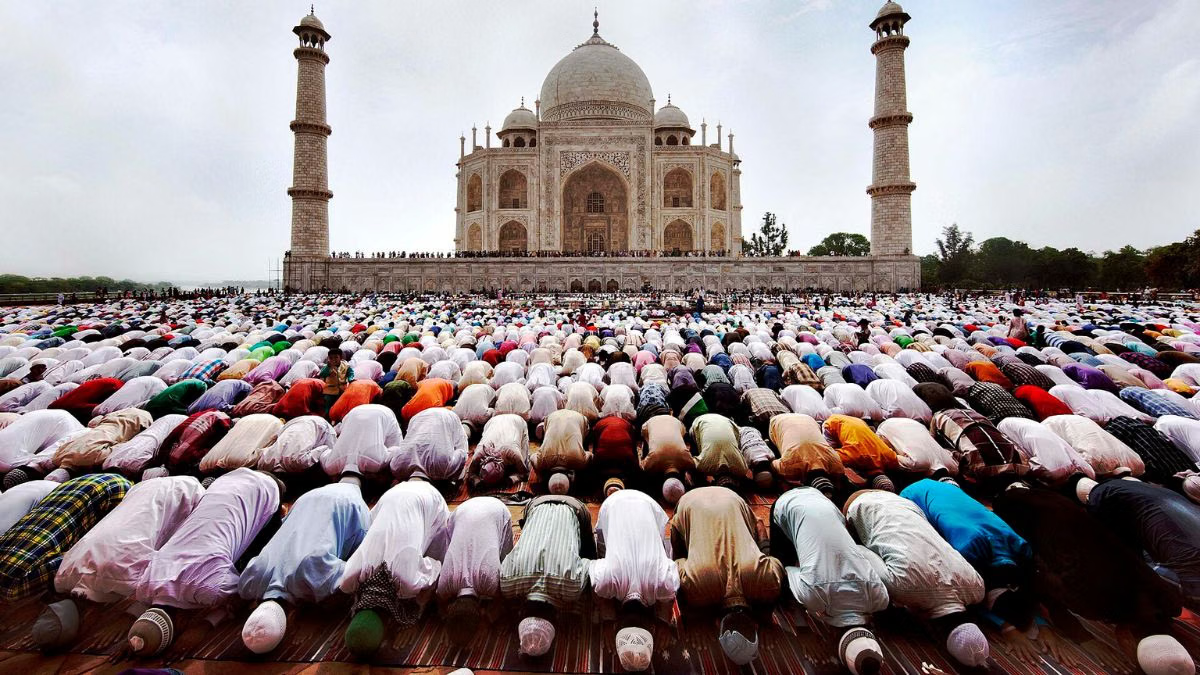
Most Indian Muslims love to brandish the badge of backwardness. It’s a political narrative, aimed at indicting India for pushing them backward. They cite the Sachar Committee report to corroborate their allegations.
Without going into whether this backwardness is real or mythical and whether every class of Muslims is lagging behind the comparable group in the Hindu community, there is one particular area where their backwardness is most visible, but least recognised: intellectual backwardness. The Muslim community doesn’t have an intellectual class. That a community of about 20 crore, with a literacy rate of 79.5 per cent, should have no intelligentsia worth the name, and few intellectuals worth their salt, is shocking, to say the least.
The most glaring proof of the absence of an intellectual class among them is that, in public discourse, the Left-liberal Hindus represent them. If they could speak for themselves, why would they need attorneys—who, in the process, steal their seat at the table and keep them out of the conversation forever? For the Left-liberals, Muslims are the proverbial “mute millions” who, lacking the ability to speak for themselves, must be represented by them.
In her landmark essay, philosopher Gayatri Chakravorty Spivak rhetorically asked: “Can the Subaltern Speak?” The Left-liberal intelligentsia could be said to be asking, “Can the Muslim Speak?” And much like Spivak answered the poser—“no, the subaltern cannot speak”—the Left-liberals too answered it with the same categorical vehemence: “no, the Muslim cannot speak, and therefore they should be spoken for”.
In their view, Muslims lack the values, concepts and vocabulary for the secular and democratic discourse. Therefore, the discursive representation of the Muslim community remains their responsibility—their exclusive dominion.
However, it may be added that there is an exotic group within the community that regards itself as the natural intelligentsia of Muslims—former bureaucrats. Ever since IFS officer Syed Shahabuddin (1935–2017) resigned from diplomacy to plunge into politics in 1979 — and, with a cavalier disregard for the ethic of the Republic, brought the closet discourse of the Muslim League out into the open—it has been the dream of many a Muslim bureaucrat to provide intellectual leadership to a people awaiting their next Quaid.
Shahabuddin and the Muslim Personal Law Board made Rajiv Gandhi—the then prime minister with the highest mandate ever—dither, waver, and capitulate on the Shah Bano judgment, and went on to get Salman Rushdie’s The Satanic Verses banned. Most importantly, he and other Muslim leaders pitted Hindus and Muslims against each other on the Ram Janmabhoomi-Babri Masjid dispute. Furthermore, with his journal, Muslim India (a title borrowed from the Muslim League’s lexicon), he institutionalised the Victimhood psychosis among Muslims and elevated it to an ideology of disaffection. The Sachar Committee report could be said to be the official version of Muslim India’s catalogue of grievances.
Yet, endowed as these bureaucrats are with a profound sense of entitlement, it never occurred to them to justify their claim to leadership by explaining the link between the bureaucratic profession and the intellectual function. This group’s desperation for relevance is the most pathetic and evokes pity, contempt, and disdain.
Intellectual function is not merely about possessing intellect. Therefore, to say that Muslims lack an intellectual class is not to say they lack individuals of high intellect and scholarly calibre. There are lakhs of scientists, economists, historians, litterateurs, writers, journalists, poets, lawyers, podcasters, politicians, and bureaucrats among them. But high intellect and professional accomplishment do not make one an intellectual.
“Intellectual” is a technical term, denoting a person who thinks deeply about his society, critically engages with its affairs, participates in public debates, questions the orthodoxy and status quo, challenges the hegemonic order, and, in short, speaks truth to power. Above all, he keeps his own community in a state of constant introspection.
In his Prison Notebooks, the neo-Marxist thinker Antonio Gramsci calls such a person an ‘organic intellectual’, distinguishing him from the ‘traditional intellectuals’—established categories such as scholars, clergy and bureaucrats who see themselves as autonomous from particular social classes but whose historical position, Gramsci argues, is rooted in existing class relations.
Edward Said, the founder of postcolonial theory, in Representations of the Intellectual, highlights the difference between the professional and the amateur intellectual. He criticises the professionalisation of intellectual life, where both academics and technocrats serve the existing order. According to him, a true intellectual must remain an “amateur” — driven by passion and moral responsibility rather than institutional reward. For Said, the intellectual’s natural stance is one of “metaphorical exile”—standing outside orthodoxy and resisting alignment with religious dogma or sectarian lines.
One often hears the lament that Muslims are leaderless. It is inevitably followed by an even more heart-rending lament—the reason for their leaderlessness. With poignant solemnity, it is stated that their natural leaders—the Ashrāf of UP—went to Pakistan after partitioning the country.
The manner in which this opinion is conveyed evokes the imagery of an army which, bereft of its officer corps, is lying in disarray. What is implied is that if the natural leaders hadn’t left for Pakistan, Muslims would remain a better war machine. While it’s understood who they would fight, surprisingly, there is no anger and sense of betrayal against those who left the community “orphaned”.
Significantly, this conversation is invariably about political leaders, and never about thought-leaders, so much for the intellectualism in the community. In the realm of thought, there is hardly any discussion except whining and wailing over the imagined victimhood—about how the Muslims are reeling under “fascist majoritarianism” and a “genocidal” regime. One wonders how the activism for establishing Hukumat-e Ilahiya (Islamic rule) continues without let or hindrance under fascism.
Also read: Kerala journalist Aparna Kurup’s ordeal shows how free speech is silenced without censorship
An evolved community nurtures a broad spectrum of thought—diversity and complexity—existing in dialectical tension with one another, in a continuous process of growth. It has a centre, a left, a right, a left-of-centre, a right-of-centre, a far-left, a far-right, and even fringes on both ends. Hindu society has a broader and more variegated range than this.
The Muslim community, on the other hand, is an undifferentiated lump of thoughtlessness. Its complexity is theological, and its diversity is sectarian—Shia, Sunni, Deobandi, Barelvi, Wahhabi, Tablighi, etc. One doesn’t hear of a left wing or a right wing or a far left or a far right among them. That’s because there is no centre either. Like a unicellular organism, it has no complexity. Its intellectualism begins and ends with wallowing in victimhood.
The reason Muslim society doesn’t have an intellectual class is that it doesn’t have a civil society. It doesn’t have a civil society because it hasn’t gone through the process of secularisation—which creates the public sphere where religious thought, legal norms, and social customs can be subjected to rational critique. This specific deficit was first identified with clarity by Ambedkar in his book Pakistan or the Partition of India.
In ‘The Structural Transformation of the Public Sphere’, philosopher Jürgen Habermas focuses on how civil society created the structural space for democratic deliberation, where an intellectual class emerged not primarily to serve a class interest, but to operationalise communicative rationality, facilitating an open and free debate where the “unforced force of the better argument” prevails. Intellectuals help translate complex social issues into public awareness without imposing authoritarian dogmas.
Without secularisation, the deep structure of Muslim thought has remained unchanged since its tribal origins and military expansion. The community expects an individual to conduct himself much as an army expects a soldier: no questions and total conformism. Any deviation from the dominant narrative is treated as treason, and since the only language it speaks is religion, such deviation becomes apostasy, making one liable to death.
A Muslim intellectual is not a thinker, reformer, or conscience keeper of the community. He must always act as a defence counsel for the Qaum. The community—or more precisely, its ideological establishment—has its task cut out for those fond of intellectualising:
So long as one doesn’t question Muslim communalism, and keeps taking hardline positions in support of identity politics, vote bank, personal law, Waqf, and radicalisation, one is free to sup with the “devil” and pursue the politics of self-aggrandisement. By radicalising the community, one gets certified for harbouring ‘dard-e millat’ (the community’s anguish) in their heart, and earns the representative status to make deals with the powers that be.
Thus, the “intellectual” starts praising what he has so far been condemning, without so much as caring to explain the shift. Worse still, he may praise Hindutva in Delhi in the morning, and condemn it the same evening in Aligarh.
Also read: 25 years after 9/11, we are still stuck with blaming and defending an entire religion
This kind of opportunism epitomises the instinctive response of the centuries-old ruling class—the Ashrāf — to remain relevant through the vicissitudes of time. Since they have so far controlled Muslim religion, culture and politics, they successfully elevate their petty class interests into the entire community’s concerns. Their interest becomes the community’s interest. That’s how the controversy about the minority character of Aligarh Muslim University gets magnified into a life-or-death issue for every Indian Muslim.
The community has been conditioned to indulge such an “intellectual’s” mendacious manoeuvres to scrounge crumbs from the high table. If he manages to wheedle some position like a seat in parliament, the chairmanship of a commission, the vice-chancellorship of a university, or the governorship of a state, the entire community basks in his reflected glory.
In their public morality, there is ample justification for this kind of devious behaviour. It’s known as “Maslehat”, a Fiqhi term which originally meant “public welfare”, but can better be rendered as “strategic prudence” in polite language, and plainly called “Makkari” (deceit) in unadorned language.
The tragedy is that the community doesn’t even feel indignant at its own dispensability. An Urdu couplet that circulates in its discourse encapsulates the Muslim attitude toward their own sellout:
Bikne par par jab aa hi gaye the oonche mol to bikte hum; Humko hamare rahbar lekin sasta bech kar aaye hain (If we were bound to be sold, we would have fetched a king’s ransom; but alas, our own leaders traded us away for a pittance.)
Muslim thought-leaders have so twisted the conscience of the community that it has no problem with its own sellout. All it wants is a good price—not for itself, but for its leaders. A gain for the leader appeases the entire community—and that was the crux of the politics of appeasement. Indeed, it didn’t benefit the Muslim masses, but they delighted in the power bestowed and honours showered on their leaders.
During the secular raj, such leaders had an all-too-familiar modus operandi. They would keep the community in a constant state of agitation over non-issue after non-issue, and arm-twist the state with the threat of unleashing the horde if they didn’t get their pound of flesh.
In the post 2014 situation, however, no longer enjoying the licence to intimidate the state with an adversarial posture, they are presenting themselves as the bridge between the government and the Muslim community. The fact, however, is that they are the real chasm between the two—the greater their strength, the wider the chasm. They are a perfidious, self-serving lot whose loyalty is neither to the country nor to the community.
Unless these self-appointed intermediaries are removed, Indian Muslims cannot identify with the Indian nation without being bogged down in such questions as whether they are Indian first or Muslim first.
Ibn Khaldun Bharati is a student of Islam, and looks at Islamic history from an Indian perspective. He tweets @IbnKhaldunIndic. He can be reached by email at ibn.khaldun.bharati@gmail.com. Views are personal.
Editor’s note: We know the writer well and only allow pseudonyms when we do so.
Related Stories
 Community
Plans for 250 homes and supermarket on golf course
14 hours ago
 Community
Tributes paid as murder investigation continues
15 hours ago
 Community
Ebola outbreak in DRC has peaked, say authorities, as infection rates slow
2 days ago
 Community
RCMP investigating after dogs maul miniature horses near Kindersley, Sask.
2 days ago
 Community
Detainee releases raise concerns over Chinatown being used as a ‘dumping ground’
3 days ago
 Community
Man, 21, killed in animal attack in western Manitoba First Nation last week
3 days ago
 Community
Hyrox athlete sparks debate for pushing through race after soiling herself
4 days ago
 Community
Members of Regina's Iranian
4 days ago