
Future Talks: Technology Speeds Food Industry Change
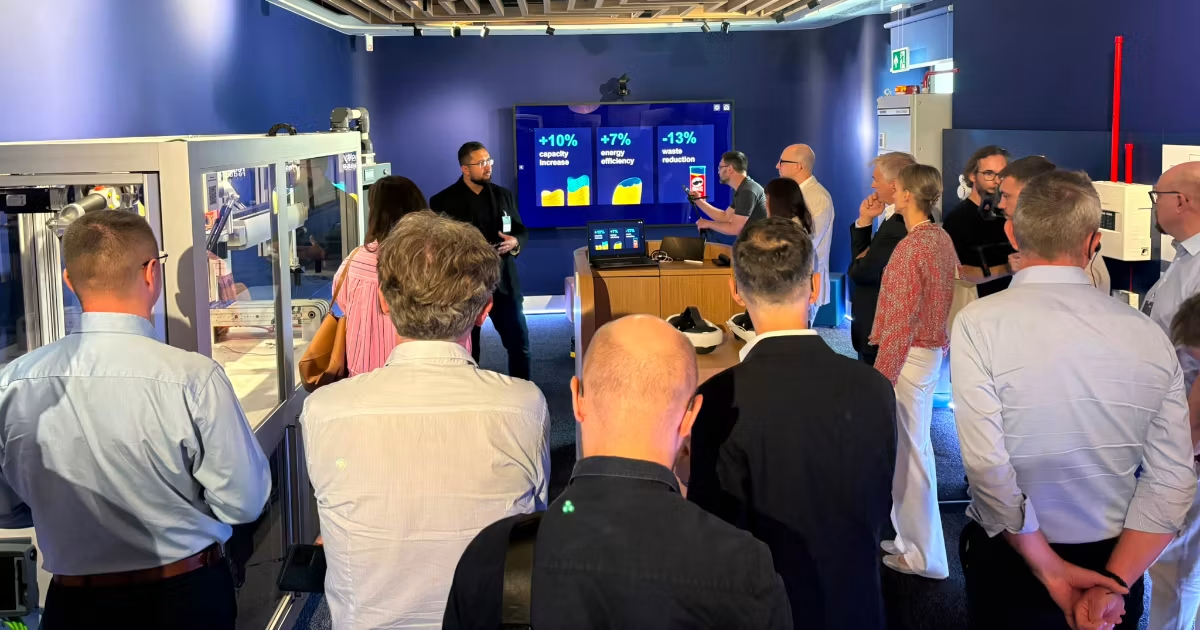
Food Industry in Times of Uncertainty
Opening the event, Maciej Zieliński, CEO of Siemens Poland, pointed out that the food industry is now operating in conditions where uncertainty has become a daily element of doing business. Among the challenges facing the sector, he mentioned geopolitical tensions, supply chain disruptions, and energy price volatility. He emphasized that while companies cannot influence many external factors, they can decide how to prepare for them.As Zieliński noted, only a few years ago business success was driven primarily by scale, cost, and efficiency. Today, resilience, flexibility, and speed are equally important, and in the years ahead, the ability to continuously learn and adapt will become even more critical. Technology, he argued, should serve as a practical business tool that supports productivity, more efficient use of resources, waste reduction, and data-driven decision-making.
The scale of the challenges facing the sector is particularly evident in the area of costs. Roman Sitko, manufacturing senior director, Mondelēz Poland, noted that the turbulence experienced since the pandemic has been unprecedented and that companies are still operating in an environment of constant disruption. He highlighted cost inflation and rising raw material prices as key factors. Cocoa, a critical ingredient for chocolate manufacturers, has seen its price increase three- to fourfold over the past two to three years.However, cost pressure is not the only force driving change. Participants at Future Talks emphasized that the sector’s transformation is also being fueled by evolving consumer behavior. Today’s consumers expect not only quality and product availability but also convenience, functionality, transparency, and greater environmental responsibility from manufacturers.
Consumers Are Becoming More Demanding
Joanna Hecht, portfolio director, Tetra Pak Eastern Europe, identified the growth of functional foods as a major trend, including beverages enriched with protein, vitamins, and other ingredients that provide additional benefits to consumers. Another important area is packaging functionality—how products feel in hand, how easily they can be opened, closed, transported, and consumed on the go. A third key factor is sustainability. Consumers increasingly pay attention to packaging materials, recyclability, and the overall environmental impact throughout a product’s lifecycle.These changing expectations quickly affect manufacturing. Producers must reformulate products more often, redesign packaging, introduce shorter production runs, and manage increasingly complex portfolios. Kamil Ciepiela, digital transformation lead, Nutricia Danone, explained that the company currently manages a portfolio of approximately 1,500 products, many of which change within a two-year cycle. Every such change requires hundreds of pieces of information to flow across multiple people, departments, and systems.
For this reason, one of the most important development directions is becoming the “data-driven factory.” The Nutricia Danone representative stressed that employee experience remains important, but must increasingly be supported by facts, analysis, and real-time information. Data enables faster detection of demand changes, improved planning, reduced risk of errors, and allows employees to focus on tasks that truly require decision-making.Digitalization is also changing approaches to production flexibility. Nutricia Danone sometimes manufactures batches of as few as 500 units for highly specialized customer groups. While such small production runs may appear difficult to justify from a business perspective, they play an important role in certain specialist markets. Their successful execution requires efficient systems, properly configured equipment, and teams capable of responding quickly to change.Technology is therefore no longer an addition to manufacturing—it is a prerequisite for competitiveness. Participants highlighted the growing importance of artificial intelligence, digital twins, predictive maintenance systems, automation, and advanced analytics. These solutions help increase productivity, reduce downtime, improve quality, optimize energy and raw material usage, and accelerate decision-making.
A New Era of Management in the Food Industry
Ronny Matthijs, plant director, Kellanova Kutno, stated that traditional management models based primarily on reacting to events are becoming insufficient in a world where consumer expectations, climate conditions, retailer requirements, and cost realities are changing ever more rapidly. In his view, technology enables companies to move from reaction to prediction—from responding to problems to identifying and preventing them before they occur.He also noted that the industry will increasingly shift from decisions based mainly on experience to decisions supported by data and artificial intelligence.Mauricio Contreras, marketing director, Tetra Pak Eastern Europe, also stressed the importance of technology. He pointed out that more than one-third of all food produced globally is lost or wasted, while the world’s population is expected to exceed 9 billion in the coming decades. In this context, production efficiency, food safety, packaging quality, and waste reduction become not only cost issues but also matters of responsibility for the entire industry.
Technology Drives Sustainability
Digital technologies are becoming increasingly connected with environmental goals. Companies are investing in solutions that reduce energy, water, and raw material consumption while simultaneously improving cost efficiency. Roman Sitko noted that Mondelēz’s three factories in western Poland reduced energy consumption by approximately 30% over a two-year period. The company is also expanding its own energy sources, with photovoltaic installations totaling 6.5 MW across the three facilities.In the packaging sector, sustainability has become a major driver of innovation. Joanna Hecht explained that new solutions are being developed not only in response to consumer and business needs but also to evolving regulations. As an example, she cited the development of paper-based packaging solutions designed to reduce aluminum usage while maintaining protective properties against oxygen, bacteria, and light. Such innovations support recycling, emissions reduction, and compliance with future regulatory requirements.
Regulations Are Changing the Rules of the Game
Regulation was another major topic of discussion. Dr. Jacek Czarnecki, director of public affairs, Nestlé; vice-president, Lewiatan Food, highlighted growing legislative pressure related to packaging, waste management, producer responsibility, consumer information, and measures against greenwashing. He emphasized that effective regulations should protect consumers and support economic development while also taking into account industrial competitiveness and the realities of the entire value chain.
Transformation Starts in the Field
Transformation does not end at the factory gate. Relationships with raw material suppliers and the quality of agricultural production are becoming increasingly important. Prof. Maciej Wojtczak, president of the Association of Sugar Technicians, pointed out that key priorities in the sugar industry include technologies supporting production efficiency, water management, circular economy practices, and the use of by-products such as beet pulp. He also emphasized the potential of biogas and biomethane to strengthen the energy independence of production facilities.Wojtczak noted that digitalization is important not only in factories but also in agriculture. Precision farming, improved crop monitoring, and tools supporting growers can improve raw material quality and the overall economics of production. He also observed that despite public debate often focusing on reducing sugar consumption, average consumption in Poland remains around 40 kilograms per person annually. What is changing is the pattern of consumption: less sugar is purchased directly by households, while more is consumed through processed foods.
Despite the growing role of data, automation, and artificial intelligence, participants emphasized that people will ultimately determine the success of the transformation. Modern manufacturing requires employees who understand technological processes, can work with data, operate advanced systems, and make decisions in dynamic environments.The food industry also faces an image challenge. Food manufacturing is still often perceived as traditional manual labor, while modern facilities increasingly rely on robotics, digital management systems, analytics, and AI-based solutions. Demonstrating this transformation is particularly important for attracting younger talent.This message was particularly evident in Prof. Wojtczak’s closing remarks:“Let us invest in people and in human capital, which is essential in the era of digitalization.”Kamil Ciepiela echoed this sentiment, noting that if companies can build teams that embrace innovation, problem-solving, and new technologies, implementation will be significantly more effective.The conclusions from Future Talks show that the food industry is entering a stage where cost, regulatory, and environmental pressures are no longer viewed solely as threats. Increasingly, they are becoming catalysts for process modernization, business model transformation, and technology investment. Success will depend on combining several key elements: a deeper understanding of consumers, more flexible production, effective use of data, investment in digital technologies, and the continuous development of human skills. This combination will determine the competitiveness of food companies in the years ahead.
Related Stories
 Lifestyle
Farm Boy, L'Ancêtre and Life Smart organic cheeses recalled for possible Listeria contamination
15 hours ago
 Lifestyle
Cyberattacks on fridges in French supermarkets spark food security fears
1 day ago
 Lifestyle
4 Innovative Startups Tackling Global Food Waste
1 day ago
 Lifestyle
Investigators hunt hackers who heated French supermarket fridges, sparking fires and spoiling food
1 day ago
 Lifestyle
Erling Haaland: Man City star and father buy Abu Dhabi properties on Premier League club's development
2 days ago
 Lifestyle
Hackers force French supermarket fridges to heat up to 50C in ‘unprecedented’ cyber
2 days ago
 Lifestyle
Fire destroys Marché des Enfants Rouges, ‘coolest market in Paris’
2 days ago
 Lifestyle
How Share-ify Helps Restaurant Teams Handle Food Recalls
3 days ago