
Government dialling back number of temporary residents it allows into Canada
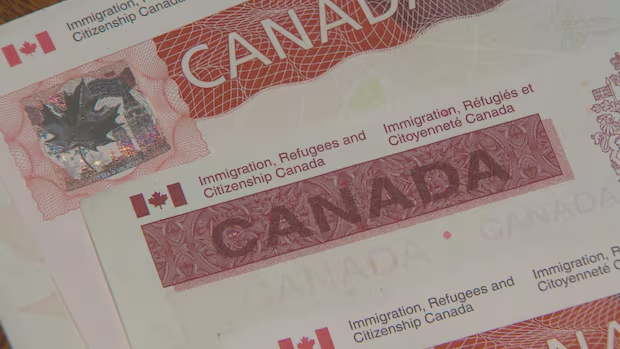
Government dialling back number of temporary residents it allows into Canada
Tuesday's budget shows Canada aims to admit 385K temporary residents next year — 43% less than 2025 target
The federal government is significantly reducing the number of temporary residents it allows into Canada over the next few years.
Canada will aim to admit only 385,000 temporary residents next year — about 43 per cent less than the 2025 target — and 370,000 in the following two years, according to numbers in Tuesday’s budget.
The target for 2026 is down by about a quarter compared to the immigration plan released last year, which had said Canada would welcome more than 516,000 temporary residents.
The new targets suggest the government is shifting its focus to temporary residents as it attempts to reduce the number of immigrants Canada welcomes.
Finance Minister François-Philippe Champagne said the government is aiming to bring immigration to “more sustainable levels.”
“I think Canadians understand that we had reached our capacity — or sometimes even exceeded our capacity — to welcome [newcomers],” he said during a news conference before the budget was tabled.
The government under former prime minister Justin Trudeau had begun cutting immigration after it rapidly increased during the post-pandemic labour shortage.
Prior to Prime Minister Mark Carney taking office, the Liberals had already indicated it was aiming to shrink temporary residents' share of Canada's population.
Last year’s plan was the first to include targets for temporary residents.
Tuesday’s budget said that the number of temporary foreign workers had already been halved this year compared to 2024, and there has been a 60 per cent reduction in the number of international student arrivals. Asylum claims have also been reduced by about a third this year compared to 2024.
The government is looking to grant permanent residency to 380,000 immigrants in each of the next three years — roughly in line with what was outlined last fall.
The new targets come as Canada has seen significant shifts in attitudes toward immigration in recent years.
An Environics Institute poll released last month found that 56 per cent of Canadians say Canada is admitting too many immigrants — a number that has moved sharply higher in the last five years.
Have Canadians' attitudes toward immigration soured?
Tuesday’s budget suggests that the government will be focusing on economic needs when it comes to immigration.
“On one hand [we’re] saying, ‘Yes, we’re getting back to sustainable levels.’ On the other hand, we’re really focusing on attracting the best and brightest,” Champagne said.
For the permanent resident stream, the budget says the government is aiming to boost the share of economic migrants from 59 per cent to 64 per cent over the next three years.
The unemployment rate for recent immigrants was 11.1 per cent last year, about double the rate for those born in Canada — and according to Statistics Canada, immigrants are more likely to be working in a field "unrelated to their education or training than their counterparts who were born in Canada."
The Liberals announced last week that they’re reallocating $97 million toward accelerating the recognition of foreign credentials.
Tuesday’s budget includes a proposed one-time measure to quickly approve the permanent residency status of 33,000 work permit holders over the next two years.
The budget also indicates that the government will launch a new accelerated pathway for U.S. H-1B visa holders — workers for specialized occupations, including in the technology sector.
American tech companies went on a hiring binge during the pandemic but have started laying people off in large numbers in recent years. Earlier this fall, the U.S. also imposed a fee of $100,000 US on employers applying for an H-1B visa.
Canada introduced a program to attract those visa holders in 2023, but available spots for that program filled up within 24 hours.
Migrants' rights group blasts plan
Over 13 years, $1.7 billion is being dedicated to attract “highly qualified international researchers” to Canada’s universities. That money will go toward a suite of measures for things such as grants and equipment.
The Liberals say they will also bring in a one-time measure to accelerate the permanent residency status of protected persons — those who have had their asylum claim approved by the Immigration and Refugee Board but are waiting for their residency status to be approved.
Syed Hussan, a spokesperson for Migrant Rights Network advocacy group, blasted the government's plan as "a shocking attack on refugees and migrants."
"This is part of a wider strategy of scapegoating migrants for crises governments created — blaming newcomers for unaffordable housing, strained health care and low wages instead of addressing corporate greed and decades of underfunding," he said in a statement.
Darren Major is a senior writer for CBC's parliamentary bureau in Ottawa. He previously worked as a digital reporter for CBC Ottawa and a producer for CBC's Power & Politics. He holds a master's degree in journalism and a bachelor's degree in public affairs and policy management, both from Carleton University. He also holds a master's degree in arts from Queen's University. He can be reached at darren.major@cbc.ca.
Related Stories
 Canada
Albertans head to polls in historic referendum on whether they want to stay in Canada
4 days ago
 Canada
In the news today: four soldiers killed, Alberta referendum, AI privacy fears
4 days ago
 Canada
How a grass fire at a Canadian military base killed four soldiers
4 days ago
 Canada
How will household electricity rebate reduction, temporary winter pricing change impact Ontarians?
4 days ago
 Canada
Residents told to boil tap water due to bacteria
4 days ago
 Canada
Oil
4 days ago
 Canada
Albertans vote on path to independence as Carney fights to keep Canada united
4 days ago
 Canada
Two of 4 soldiers killed in fast
4 days ago