
How a new oil pipeline could open new markets for Canada
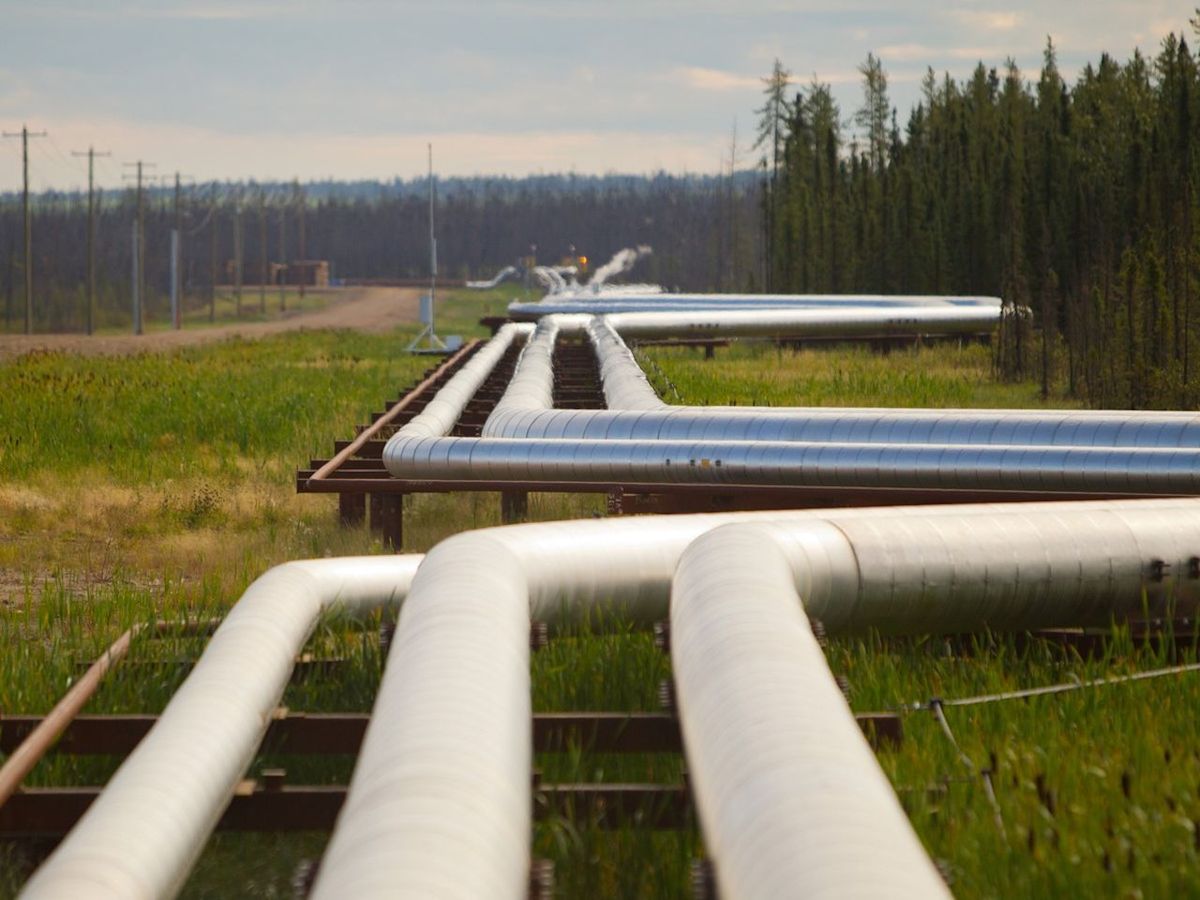
It's the ugly stepchild of the oilpatch, but it would play a vital role in any expansion in the industry — growth the federal government is pursuing to diversify trade away from the United States.
And right now, Canada relies on imports from the U.S.
This precious commodity is called condensate. The oilpatch needs the straw-coloured liquid, also known as diluent, to ship heavy crude that producers mine and steam out of the oilsands.
"Almost no one talks about diluent or the constraint it may impose on production growth," said Richard Masson, former chief executive of the Alberta Petroleum Marketing Commission, who has long worried about the supply.
Heavy crude from the oilsands is too thick to travel through a pipeline on its own, so producers thin it with a lighter hydrocarbon, extracted from natural gas. While Canada and the U.S. are trading tit-for-tat in a tariff war, Western Canada continues to rely on American imports for about a third of the condensate it needs.
Prime Minister Mark Carney last week declared a new oil pipeline to the West Coast, now called Pacific Link, a project of national interest. Filling the line, however, will take a lot more condensate to dilute sticky, tar-like crude from the oilsands, and Canada already uses more of it than it makes.
Matthew Lewis, founder of Plainview Energy Analytics, a Denver-based research firm, said bitumen is "like a sludge." "It's a really heavy crude, and it can't be transported easily via pipeline," he said.
Producers solve this by mixing in condensate, also known as diluent. Lewis described it as the lightest form of oil you could think of, and the blend is "less sludgy." Canada makes about 570,000 barrels a day of condensate, mostly from gas fields in western Alberta and northeastern B.C.
Taylor Lee, vice-president of Canadian upstream research at Rystad, said record oilsands output this year has pushed condensate imports from the U.S. closer to 300,000 barrels a day.
Imported condensate travels on two pipelines that start near Chicago. Lee said the available data on the lines is limited, but "it really does look like those lines are running very, very close to full capacity," he said.
Pacific Link could deepen condensate dependence
Carney said at an announcement in Fort McMurray on Thursday that 90 per cent of Alberta's oil now goes to the United States, and that Pacific Link will reduce that dependence by opening up Asian markets.
But the same pipeline could deepen Canada's reliance on American condensate. If the U.S. stopped sending condensate north, "there really wouldn't be an immediate alternative source that could fill that void that quickly," Lee said. Oilsands operations would likely shut in, he said, because "that crucial element of blending for transporting bitumen really wouldn't be able to resolve itself within Canada."
Lee does not expect it to come to that. U.S. refineries rely on Canadian oil, he said, and "we don't think a scenario like that would play out."
Gitane De Silva, who represented Alberta in Washington during Donald Trump's first term, said Pacific Link is a positive step toward diversifying markets, since Canada gets more money for a resource it sells from its own coast.
"Canadians think about our relationship with the United States more than the Americans think about us," said De Silva, now executive director of the Peter Lougheed School of Politics and Democracy at the University of Alberta.
De Silva doubts the U.S. would ban condensate. It would hurt its own access to the imports it needs, she said, and it needs them "desperately right now." "If we're at the point of considering using energy as a hammer or any of its inputs, then we have a lot of other things to worry about," she said.
Pacific Link would run about 1,250 kilometres from Bruderheim, Alta., to a port near Delta, B.C., and carry an additional one million barrels a day. Ottawa and Alberta would own it in equal shares, with Indigenous communities offered at least 10 percent.
Trans Mountain Corp. would lead development, and Pembina would invest as a private partner. Ottawa aims to settle the conditions for building it by Sept. 1, 2027.
If that pipeline is built and Enbridge Inc. keeps expanding, Canada could face a gap of about 383,000 barrels a day of condensate, Rystad said in its highest estimate. That volume would be hard to fill at home and could mean bringing condensate in by rail, it said.
"We're going to be in a diluent crunch, in my view, for years to come," said Masson, a long-time industry watcher.
Separatist, environment, and some First Nation groups speak out against new Alberta-B.C. pipeline
West Coast 'Pacific Link' pipeline is in Canadian national interest: Carney, Smith
Bookmark our website and support our journalism: Don't miss the news you need to know — add EdmontonJournal.com and EdmontonSun.com to your bookmarks and sign up for our newsletters here.
You can also support our journalism by becoming a digital subscriber. Subscribers gain unlimited access to The Edmonton Journal, Edmonton Sun, National Post and 13 other Canadian news sites. Support us by subscribing today: The Edmonton Journal | The Edmonton Sun.
Related Stories
 Canada
National Newspaper Week Asks Canadians Who Is Really Behind the News
49 minutes ago
 Canada
First blizzard warning of the season for major Canadian highway
49 minutes ago
 Canada
‘Unintended consequences’: Poll shows UCP independence referendum boosting Alberta NDP
49 minutes ago
 Canada
Nobel medicine prize goes to 3 scientists for research into brain activity
1 hour ago
 Canada
Spanish prime minister announces snap general election
1 hour ago
 Canada
It’s election day in Quebec: What you need to know to vote
1 hour ago
 Canada
Skills Ontario celebrates Team Canada at WorldSkills Shanghai
1 hour ago
 Canada
PM Mark Carney pledged to ‘Buy Canadian.’ Since then, $7.8 billion in contracts went to American corporations
1 hour ago