
How an amateur found Germany’s biggest hoard of Roman silver coins
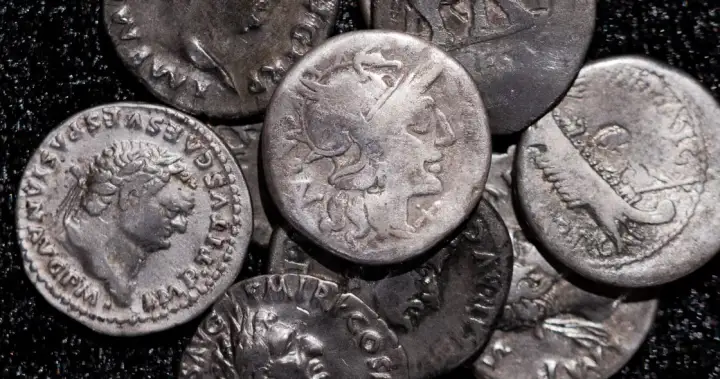
An amateur archaeologist who discovered several Roman silver coins in a field in western Germany realized he had stumbled upon something bigger when his metal detector kept beeping.
Oliver Riedl called the authorities for help and a group of experts who began digging immediately discovered a total of 934 Roman silver denarii. It is the biggest coin treasure ever found in Germany from the time of Roman Emperor Hadrian, the local office in charge of archaeological monuments said Tuesday.
“It was clear to me that there was something bigger buried here,” Riedl said, describing how his metal detector continued signaling even after he had found several coins near Wesseling, south of Cologne a year ago.
The hoard of coins, which weighs 3.1 kilograms (6.8 pounds), went on display at the LVR-LandesMuseum Bonn on Tuesday.
The collection of coins was probably buried deliberately in the second quarter of the second century A.D., according to the LVR Office for the Preservation of Archaeological Monuments in the Rhineland.
“Of course, we can only speculate about the motives, but it’s very likely that someone wanted to keep this money safe. After all, banks didn’t exist back then,” said Erich Classen, state archaeologist and the director of the office.
Classen said it wasn’t clear why the treasure was never recovered before, adding that “perhaps the owner died before that could happen, without being able to pass on the knowledge about the coins.”
Treasure troves from ancient Roman times or other distant eras are not uncommon. However, few from the second century are as extensive as the one found in Wesseling, the archaeological office said, adding that it was difficult to estimate the coins’ value at the time.
However, the pay of Roman legionaries, which is well documented in written sources, provides a point of reference.
“At that time, an ordinary soldier in the legion earned 300 denarii a year. However, about half of that was withheld for food and equipment,” said Rahel Otte, a research associate at the archaeological office.
“A legionary would therefore have had to save all of his disposable income for about six years to amass the Wesseling hoard,” Otte said. She added that it remains unclear exactly who ultimately amassed this considerable fortune.
The Cologne area was under Roman control roughly from 39 BC to AD 459. The Romans established a presence in the region under General Marcus Vipsanius Agrippa to secure their empire’s border along the Rhine River, setting up a military outpost which later became Colonia Agrippina — today’s Cologne.
Related Stories
 Finance
How can Winnipeg end homelessness for good?
4 hours ago
 Finance
Can Canada turn its airports into money
13 hours ago
 Finance
Taylor Frankie Paul teases exit from ‘Secret Lives of Mormon Wives’
16 hours ago
 Finance
Chancellor vows to stay on for Germany’s ‘democratic future’ after latest loss to far
18 hours ago
 Finance
What to Invest In Right Now, September 2026
18 hours ago
 Finance
Why Annamalai's Periyar clarification is a strategic pivot to consolidate his movement in Tamil Nadu...
1 day ago
 Finance
Government plans to introduce economy bill critics say will threaten right to strike
1 day ago
 Finance
‘It’s unrecognisable’: How being a tax haven has changed Jersey
1 day ago